

-
May, Fri, 2026

How deep is the water in the 7 inch grinding disc industry? From the workshop to the construction site, a thorough explanation.
You might think you’re just buying a grinding wheel, but in reality, you’re buying the formula, the manufacturing process, and a complete safety logic behind it. A 7 inch (180mm) grinding disc, a frequently seen “hard currency” in the hardware market and industrial procurement lists, is far more complex than you imagine. It’s not just a consumable; it’s a crucial element that determines your work efficiency, the quality of finished products, and even your personal safety.
Slow and steady wins the race: The birth of a qualified grinding wheel.
You may never have imagined where this grinding wheel in your hand comes from. It’s not an injection molded part that can be pressed out in one go. In our industry, a standard 7 inch grinding disc undergoes a long “refinement” process from raw material to finished product.
First, the molding temperature is not arbitrarily set; it is usually controlled between 170 and 180 degrees Celsius, with a stable value of 178 degrees Celsius. At this temperature, the resin binder can flow and fix fully, firmly “welding” the abrasive and reinforcing mesh together. This process cannot be rushed; a complete molding cycle takes approximately 18 hours.
Moreover, they are not fired in large, assembly-line kilns, but rather in individual small furnaces where they are left to rest and fire. This seemingly inefficient, rudimentary method actually allows for more precise control of the curing curve of each batch, ensuring stable performance. A single machine running at full capacity can produce around 6,000 pieces in 12 hours; frankly, for the sake of quality, the output is not particularly high.
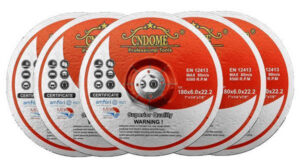
We’ve encountered all the pitfalls in production for you.
What you can’t see are the flaws that can easily appear on the production line if you’re not careful; we call them “process devils.” For example:
- Resin leakage: If the material is too wet or the pressing pressure is too high, the resin will be squeezed out, which will directly affect the strength and usability of the grinding wheel.
- Black spots on the surface: This is mostly because the workers did not clean the mold cover plate in time, and the sand particles left over from the last time were pressed into the trademark or empty ring surface of the new grinding wheel.
- Bubbling: If the material is not scraped evenly, there will be tiny depressions on the surface. After baking, the gas will expand, forming a bulge. Using this type of grinding wheel is extremely dangerous.
- Chipping and chipping: This is your problem, and it’s ours too. Besides the amount of force you use, the main reasons are either the product itself being too hard or the binder not holding the abrasive firmly enough. Interestingly, soft films, because of their larger internal gaps and better elasticity, are less prone to this problem.
Dual-network or triple-network? This is definitely not just about adding another piece of paper.
You may have noticed that there are double-wire and triple-wire double-paper grinding wheels on the market. What’s the difference? Is it just a gimmick? Absolutely not.
Simply put, the wire mesh is like the reinforcing steel in concrete; it forms the skeleton of the grinding wheel. The specifications of the wire mesh, such as the 8-mesh, 260-gram reinforcing mesh we use, directly determine the impact resistance and rotational fracture strength of the grinding wheel.
- Double-grip: Most commonly used in the Southeast Asian market. It meets the safety requirements of conventional angle grinders, offers high cost-effectiveness, and is sufficient for grinding ordinary metals.
- Triple-network double-paper: This is the mainstream in Europe and America, not only because it looks better and sells better. Structurally, the extra layer of wire mesh and the additional black paper means more bonding points between the abrasive and the substrate, resulting in higher overall safety. This is a crucial factor, especially when dealing with harsh working conditions.
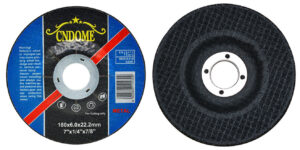
Which type of grinding wheel should you use for your job?
This is where the most problems occur. Many users report that the files “can’t be processed” or “use too many discs,” and 90% of the time it’s because they didn’t choose the right type.
Routine task: Polishing general steel and stainless steel
You’re doing basic metalworking, working with medium hardness—neither too hard nor too soft. Our standard double or triple mesh grinding wheels, used with your general-purpose angle grinder, can safely handle both the national standard of 72 m/s (7600 rpm) and the European standard of 80 m/s (8500 rpm). Remember to keep the label facing inwards and the working surface facing outwards, applying force evenly at a 45-degree angle.
Tough tasks: shipyards, military industry, superhard alloys
In shipyards or heavy industry plants, you might be using powerful pneumatic angle grinders, grinding against hard-on weld spatter and ultra-high-strength steel. In these situations, conventional grinding wheels will shatter or be instantly consumed. What you need are reinforced discs with at least 2.5 mesh sheets, or even “pneumatic discs” specifically designed for pneumatic tools, with completely different formulas and manufacturing processes. Ordinary discs pose a significant safety hazard in these environments.
Soft metals: copper, aluminum, and other soft metals
Caution! Never use regular grinding wheels to grind soft materials like copper, aluminum, or stainless steel. Cutting these soft metals will instantly clog the pores on the grinding wheel surface, causing the grinding wheel to slip and become ineffective. The more force you apply, the greater the load on the angle grinder, and there’s even a risk of it burning out or stopping. These materials require extremely sharp, specialized grinding wheels. Frankly, for products requiring extremely high and stable grinding ratios, consistency in bulk production is a challenge for many manufacturers. We approach this with caution.
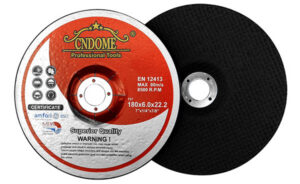
A user’s existential question: Why are all the ones I buy so fragile?
The last question, which you often encounter, is: “Why are your grinding wheels more prone to chipping and breaking when I use them than when you test them?”
The answer is straightforward: because you’re not testing, you’re making money. Your workers, driven by efficiency, will subconsciously apply more pressure and use more demanding angles to grind the workpiece. This rough, real-world use is completely different from the gentle, standardized testing in a lab. The ever-changing nature of workpiece materials only exacerbates the problem. Often, the sample you send us is a completely different material from what you’re actually grinding. So, next time you encounter a problem, don’t just say “it won’t grind,” try to describe the material and its hardness so we can help you find the truly “suitable” grinding wheel. Remember, there are no universal grinding wheels, only the most suitable combination.
FAQ
1. How can you quickly judge the quality of a 7 inch grinding disc by its appearance?
No specialized equipment is needed; you can filter out a batch of inferior products just by looking. When you get the grinding wheels, first check the trademark surface and around the hole ring for black spots or pits. These are traces of residual sand from the mold cover that wasn’t cleaned before being pressed in, indicating lax quality control. Next, check the surface for small bumps; these are internal bubbles, a hidden danger left by uneven material scraping before baking, which will cause problems immediately upon use. Then check the edges for traces of glue seepage; if the resin has gone to where it shouldn’t, there will be less adhesive inside. Finally, feel the edges; a smooth, even surface is a basic requirement. Don’t expect a manufacturer that can’t handle these details to produce anything good.
2. What is the correct installation direction for the grinding wheel? Should the label side face inwards or outwards?
This is a very basic question, but one that gets asked every day. Just remember: the label side should face inwards towards the inside of the angle grinder, and the working side outwards. In other words, the side where you can see the label should be mounted flush against the angle grinder’s flange. When grinding, maintain an approximately 45-degree angle between the grinding disc and the workpiece, applying even pressure. Don’t press too hard; pressing too hard not only doesn’t necessarily increase efficiency, but it also shortens the lifespan of both the grinding disc and the angle grinder.
3. Can 7 inch grinding discs (180mm) of different brands and screen counts be used interchangeably?
Same dimensions don’t mean you can just swap them out. The aperture is the first thing to check; 22.23mm is the internationally accepted standard aperture, but there might be exceptions. Next is the guard matching; ensure the outer diameter of the new grinding wheel is within the coverage area of your angle grinder’s guard. The risk of mixing different disc counts isn’t whether they can be installed, but rather the mismatch in strength. For example, if your machine is rated for 8500 RPM, and you replace it with a double-disc disc rated for 7600 RPM, without upgrading the disc count, the frame strength won’t be sufficient—this is a ticking time bomb. Therefore, the safety principle for mixing discs is simple: the rated speed must be equal to or higher than your angle grinder’s, and never lower.
4. What is the shelf life of a 7 inch grinding disc? Can it still be used after two years?
Grinding wheels aren’t cookies, but they do “age.” The main component that ages is the resin binder, which absorbs moisture from the air and undergoes slow chemical changes, leading to a decrease in strength. Grinding wheels from reputable factories, stored in a dry and well-ventilated environment, are generally recommended to be used within three years of manufacture. They aren’t unusable after this time, but the risks accumulate. You can do a simple test: gently tap them with a wooden mallet. A crisp sound indicates the internal structure is fine, while a dull sound may indicate cracks or moisture absorption. However, this is just a basic method; for safety, don’t use expired products.
5. What are the differences in choosing grinding wheels when polishing stainless steel and ordinary carbon steel?
The difference is significant, primarily in terms of heat. Stainless steel has poor thermal conductivity, so during polishing, all the heat is concentrated on the surface, easily causing it to blue and deform. Therefore, polishing discs for stainless steel typically require sharper abrasives with better self-sharpening properties, ensuring the polishing process involves more “cutting” than “grinding” to reduce heat generation. Another crucial requirement is that the polishing disc itself must be a “pollution-free” formula, free of iron, sulfur, and chlorine. Otherwise, it will contaminate the stainless steel surface, and subsequent rusting will begin from these contaminated points. If you only polish stainless steel occasionally, general-purpose polishing discs will suffice, but for batch work, specialized discs are essential.
6. Why does my grinding wheel start to shake and become unstable halfway through use?
It’s highly likely that the grinding wheel has experienced uneven wear. There are several possible reasons: First, prolonged use at a fixed angle may have worn the edge of the disc into a bevel, disrupting the dynamic balance. Second, the disc itself may have uneven density, with one side denser than the other, causing it to become misaligned during grinding; this is likely due to uneven material distribution during production. Third, the flange may be improperly installed, or the flange itself may be worn or deformed, causing the disc to rotate off-center. Try replacing the flange first; if that doesn’t work, replace the disc. If the shaking persists, check the angle grinder spindle.
7. If I’m unsure what material I want to grind, can I send a sample to the factory for them to help me choose?
Absolutely, and this is the most reliable way. Often, when we ask customers over the phone, “What material are you grinding?” they can’t answer clearly and will simply say, “It can’t grind” or “It’s too fast.” Every material has a different combination of hardness and toughness; no single grinding wheel can handle everything. Just send us a workpiece, or tell us the specific material grade, and our formulation engineers can tailor the abrasive type, grit size, and binder hardness to create a sample that best matches your actual working conditions. This is the core value of OEM customization—it’s not just selling you a grinding disc, it’s helping you find the most suitable grinding solution.
8. The grinding discs produced inconsistent colors after firing. Is there a quality issue?
Not necessarily. The final color of the wafers depends primarily on the fillers and resin system in the formulation, not on quality indicators. Wafers from the same formulation and fired in the same furnace will generally have a consistent color. However, if there are significant color differences within a batch, it may indicate uneven temperature control, with some areas over-fired and others under-fired. Our independent small furnaces allow for individual temperature monitoring of each chamber, resulting in wafers with uniform color tone and no unevenness. Therefore, when judging color, you shouldn’t focus on aesthetics, but rather on uniformity—uniformity indicates a stable process, while inconsistencies in color depth raise questions.
9. At what point should grinding wheels be replaced? Is there a standard?
Yes. The industry-standard safety line is: when the grinding wheel wears down to about two-thirds of its original diameter, it should be scrapped. For example, a 7 inch (180mm) grinding disc should be replaced when it wears down to about 120mm in diameter. Additionally, if you see cracks, chips, or delamination on the edges, or feel a significant increase in vibration during idle running, replace it immediately without waiting for it to wear down further. Another easily overlooked indicator is: if the grinding wheel suddenly becomes dull during operation and cannot grind away material no matter how you push it, it means the surface has become caked. Continuing to use it will only generate heat and build up, which is also a sign to replace it.
10. My grinding wheel makes a buzzing sound and vibrates a lot when it’s idle after I install it. What could be the problem?
Don’t use it immediately; troubleshoot step by step. First, remove the grinding wheel and run the angle grinder idle to check if the spindle is bent or the bearings are loose—these are machine problems. Second, try replacing the flange; worn or deformed flanges are a common cause of vibration. Third, rotate the grinding wheel you installed 90 or 180 degrees and reinstall it; sometimes it’s just a matter of misalignment. If the vibration persists after trying all of the above, try replacing the grinding wheel. If the vibration stops immediately after replacing the disc, it means the original disc had uneven internal density, indicating a problem with material distribution during production. At this point, you can talk to the supplier about quality control.
