
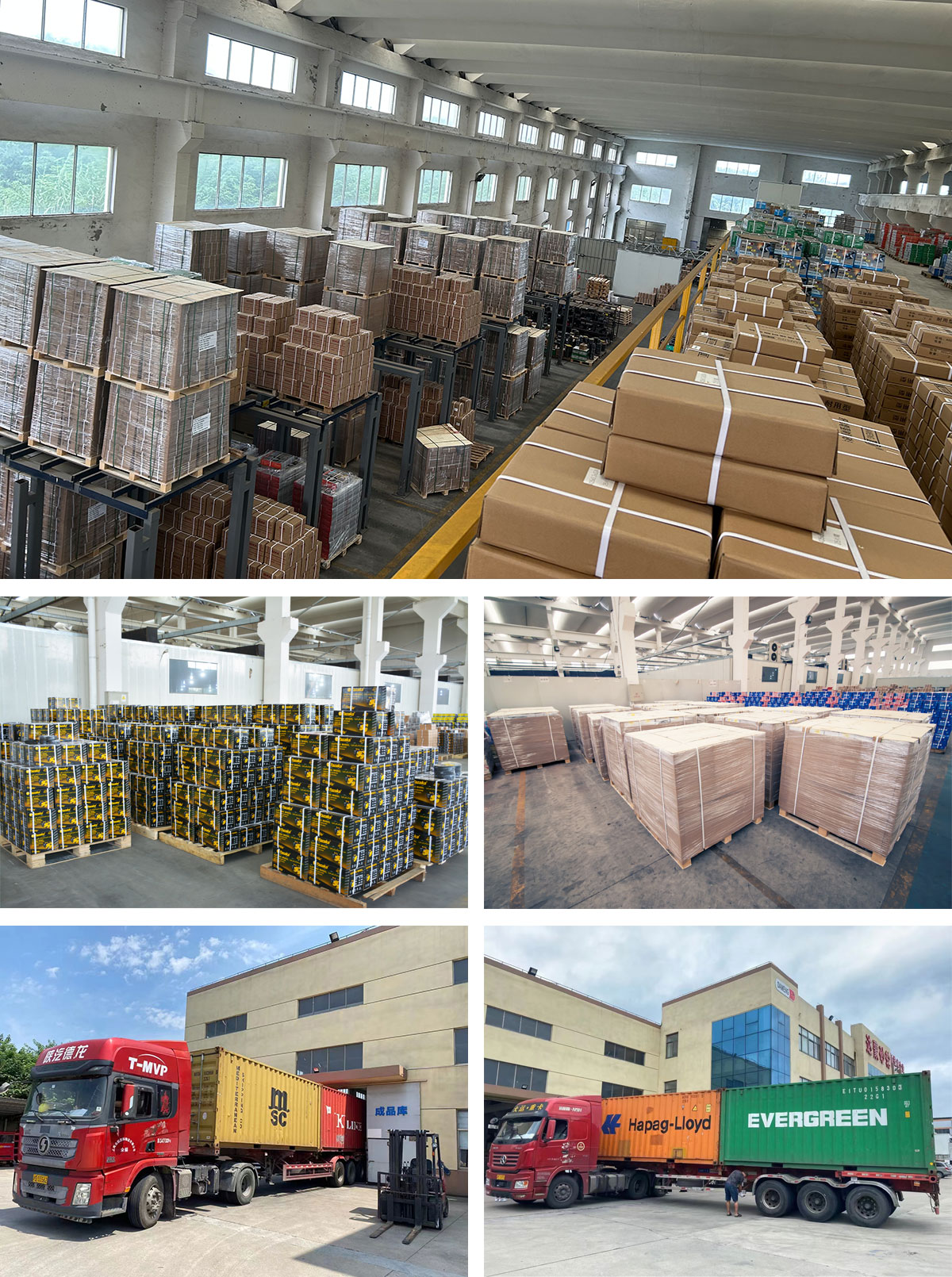
20,000㎡ Workshop
MPA / ISO14001 Certified
600,000 PCS Daily
26 Years OEM Experience
Stainless Steel Cutting Discs & INOX Cutting Wheels
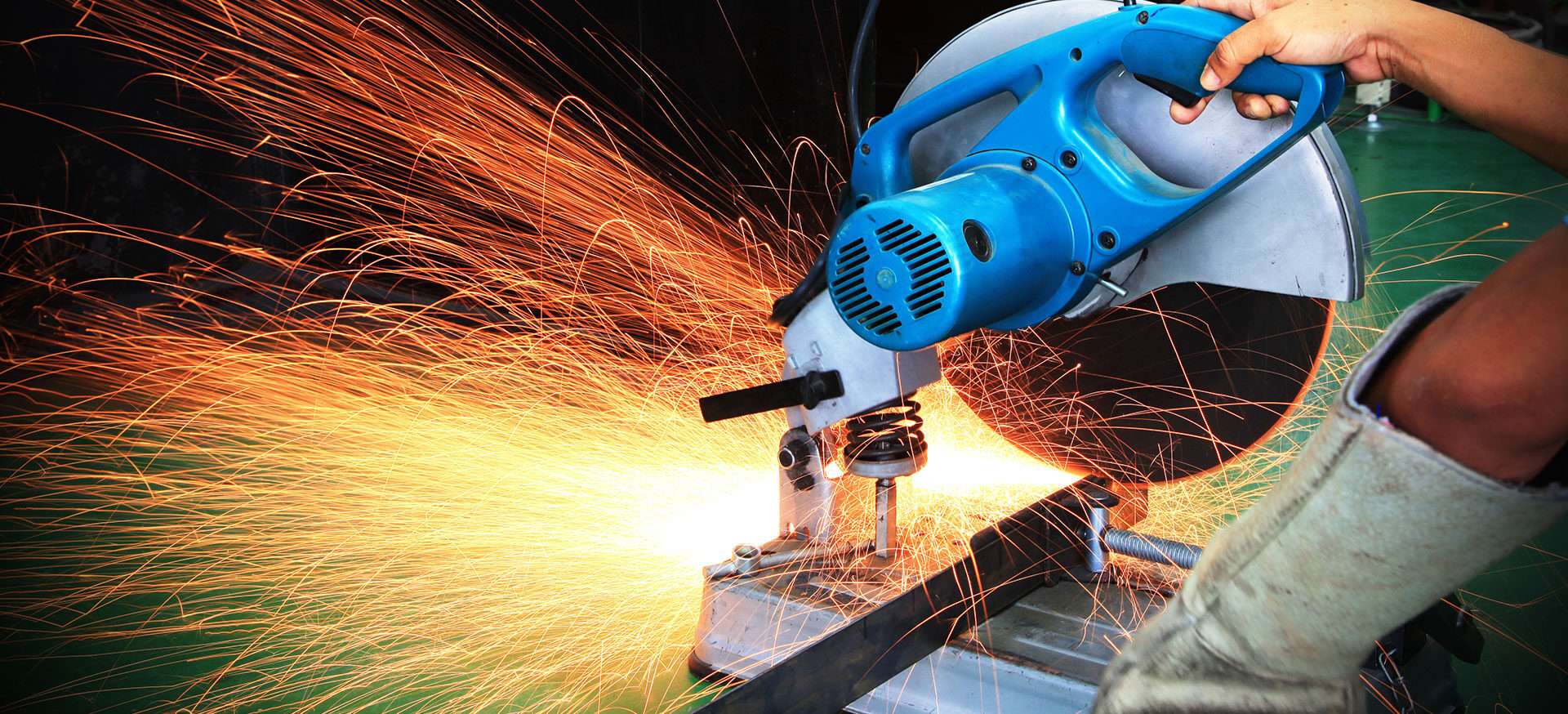
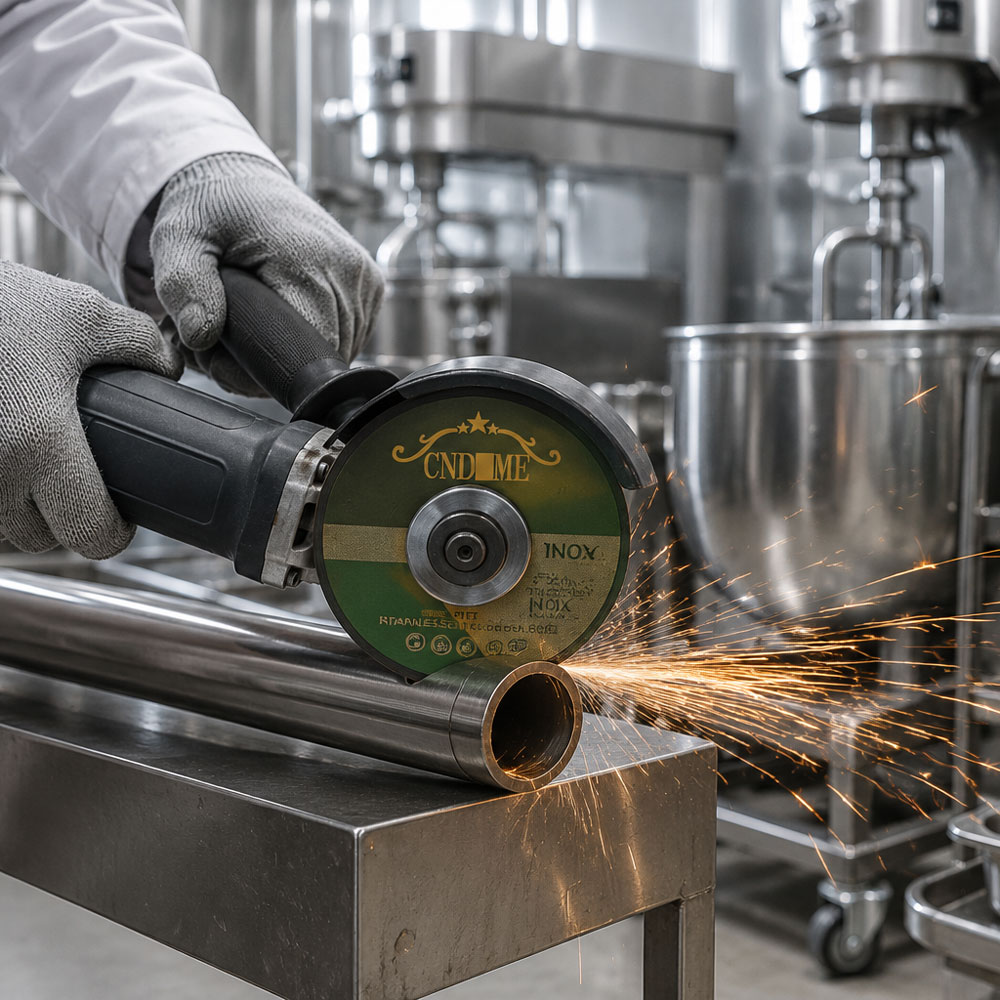
DOME is a manufacturer and OEM supplier of resin-bonded stainless steel cutting discs and INOX cutting wheels. Our special INOX formula minimizes heat generation during the cutting process; the cut surface retains its natural silvery-white luster, free of burn marks or burrs, eliminating the need for re-grinding. Our stainless steel cutting discs meet EN12413 safety standards, ensuring structural integrity and reliability even at high speeds. We offer a variety of diameters and thicknesses to meet diverse operating conditions. Furthermore, we provide OEM/ODM customization services, tailoring specifications, apertures, packaging, and branding to specific customer requirements. We maintain comprehensive in-house control over the entire production process, from formulation to finished product, ensuring rapid delivery, shortening procurement cycles, and reducing customer inventory turnover costs.
Dome Abrasives Catalogue
What Is a Stainless Steel Cutting Disc?
A stainless steel cutting disc is a thin, resin-bonded abrasive tool designed specifically for cutting austenitic stainless steels, such as grades 304 and 316. Typically mounted on an angle grinder or a chop saw, it performs cutting operations through high-speed rotation.
Why use a resin bond?
The resin bond holds abrasive grains (such as zirconia alumina) together while offering self-sharpening properties; as the bond wears down during cutting, new, sharp abrasive grains are exposed, maintaining consistent cutting power. Compared to ceramic or metal bonds, resin bonds offer superior toughness, allowing them to withstand the impact and vibration associated with high rotational speeds.
Why use fiberglass reinforcement?
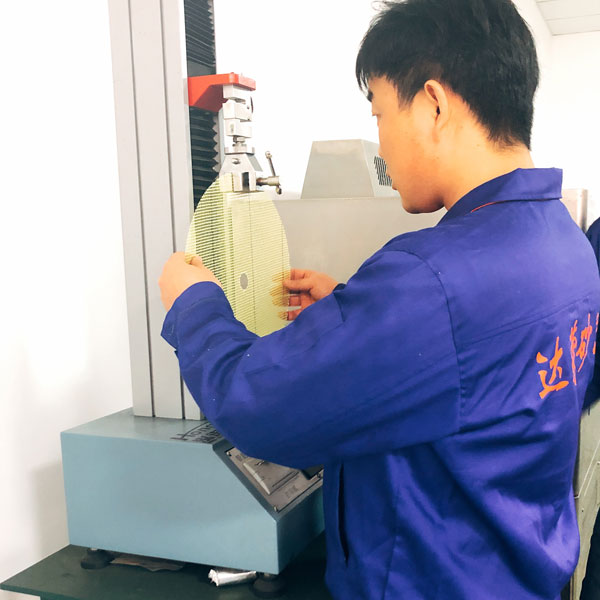
Stainless steel cutting discs feature embedded layers of fiberglass mesh designed to withstand centrifugal forces at high speeds. These stainless steel cutting discs operate at high RPMs (e.g., 13,300 RPM for a 115mm disc); the fiberglass reinforcement provides the necessary tensile strength to prevent the disc from shattering during operation. The EN12413 safety standard mandates specific requirements for this type of reinforcement.
What is an ultra-thin cutting disc?
Cutting discs with a thickness ranging from 1.0mm to 1.6mm are classified as ultra-thin. Stainless steel has poor thermal conductivity (only one-third that of carbon steel), meaning that cutting with thicker cutting discs causes heat buildup, leading to blue or black discoloration on the workpiece. Ultra-thin cutting discs offer a shorter contact arc and lower cutting resistance, resulting in faster cutting speeds that prevent heat accumulation. They produce a narrow kerf with minimal material loss and fewer burrs, often eliminating the need for subsequent grinding.
INOX Cutting Discs for Stainless Steel
The term INOX—short for the French inoxydable, meaning “not oxidizable” or “non-rusting”—is the European designation for stainless steel. An INOX cutting disc is an abrasive wheel specifically engineered to cut this corrosion-resistant alloy without compromising its surface integrity.
Unlike standard metal cutting discs, an INOX cut off wheel uses a high‑purity bond formulation that prevents iron, sulfur, and chlorine from transferring onto the workpiece during cutting. This makes the INOX abrasive disc the professional’s choice for any application where rust prevention and surface finish are critical.
Why Use a High-Purity INOX Cutting Disc?
Stainless steel demands more than just a sharp cutting edge—it requires chemical purity. Our high‑purity INOX cutting discs are engineered to protect your workpiece from contamination, heat damage, and surface defects. Here’s why professionals choose them.
Fe + S + Cl ≤ 0.1% – The Industry Purity Standard
The defining specification of a true INOX cutting disc is its ultra‑low residual content of iron, sulfur, and chlorine. Our formulation meets the industry‑recognized threshold of Fe + S + Cl ≤ 0.1% , ensuring that no rust‑initiating deposits transfer to the cut surface during grinding.
Low Contamination – No Iron Embedment
Standard abrasive wheels can leave iron particles embedded in the stainless steel surface. Over time, these particles oxidize, creating brown rust stains and initiating pitting corrosion. Our low contamination cutting disc prevents this issue entirely, preserving the material’s corrosion‑resistant oxide layer.
Low Heat – No Work‑Hardening or Bluing
Excessive friction during cutting can work‑harden stainless steel—making it difficult to machine—and cause unsightly blue discoloration. Our INOX cutting disc uses specialized grains and thin profiles (1.0–1.6mm) that generate minimal friction, keeping the workpiece cool and preserving its silver‑bright finish.
Minimal Burrs – Clean, Ready‑to‑Use Edges
Rough cuts require additional deburring, adding time and cost to your production. Our discs deliver minimal burrs, producing clean edges that are ready for welding or finishing immediately—reducing secondary operations and speeding up your workflow.
Burn‑Free Cutting – Preserving Material Integrity
Burn‑free cutting is the hallmark of a high‑quality INOX disc. By maintaining low temperatures and preventing iron contamination, our discs ensure that the metallurgical properties of your stainless steel remain unchanged. No thermal damage, no micro‑cracks, no compromised performance.
Stainless Steel Cutting Discs by Grade
Different stainless steel grades exhibit varying work-hardening rates, heat conductivity, and corrosion resistance. Cutting the wrong grade with a generic cutting disc can cause discoloration, edge hardening, or even contamination. Select the cutting disc engineered for your specific alloy.
304 Stainless Steel Cutting Disc
Austenitic 304 stainless steel is the most widely used grade—found in kitchen equipment, architectural trim, and industrial tanks. Our 304 stainless steel cutting disc uses a specialized zirconia grain that stays sharp under the moderate heat generated by this ductile alloy. The cutting disc for 304 stainless steel features a low-iron bond that prevents surface contamination, preserving the material’s corrosion-resistant oxide layer. For European markets, our 304 inox cutting disc delivers burr-free cuts on sheet and tube without work-hardening the cut edge.
316 Stainless Steel Cutting Disc
Grade 316 stainless steel contains molybdenum for superior pitting resistance—making it the choice for marine environments, pharmaceutical plants, and chemical processing. This higher alloy content increases work-hardening tendency during cutting. Our 316 stainless steel cutting disc utilizes heat-activated ceramic grains that continuously micro-fracture, preventing glazing and minimizing the heat-affected zone. A cutting disc for 316 stainless steel requires a sulfur-free resin bond to prevent intergranular corrosion. Our 316 inox cutting disc is specially formulated for thick-walled pipe and plate, where heat management is critical.
430 Stainless Steel Cutting Disc
Grade 430 stainless steel is a ferritic alloy with lower nickel content—commonly used in automotive exhaust systems and appliance panels. Our 430 stainless steel cutting disc is formulated for this less ductile material, using aluminum oxide grains with a tougher bond to handle its higher surface hardness. The cutting disc for 430 stainless steel resists edge chipping, delivering clean, straight cuts on decorative trim and structural applications where magnetic properties are required.
Specialty Stainless Grades – 316L, 321, and Duplex Alloys
Beyond the standard grades, we offer discs tailored for specialty stainless alloys. Our 316L stainless steel cutting disc uses extra-fine zirconia to handle the low-carbon variant’s reduced heat tolerance. For titanium-stabilized 321 stainless steel, our discs feature a balanced ceramic formulation to prevent intergranular cracking during high-speed cutting. For duplex stainless steel cutting disc applications (2205, 2507), our heavy-duty ceramic grain resists the extreme work-hardening of these high-strength alloys, maintaining aggressive cut rates where standard discs would stall.
Stainless Steel Cutting Disc Sizes
Selecting the correct disc diameter for stainless steel cutting ensures proper machine compatibility, optimal cutting depth, and heat management. Our range spans from compact 100mm to large-diameter 405mm—covering everything from light-gauge sheet to heavy structural sections.
105mm Stainless Steel Cutting Disc
Our 105mm stainless steel cutting disc (4-inch) is ideal for pneumatic die grinders and compact electric tools. A 4 inch stainless steel cutting disc excels at trimming thin stainless sheet, cutting small-diameter tubes, and accessing confined spaces where larger tools won’t fit.
| Product | Thickness | Suitable Materials | Max. RPM | Features |
|---|---|---|---|---|
| Ultra Thin INOX | 1.0mm / 1.2mm | Sheet metal, thin‑wall tubes | 15,200 | Ultra‑thin · High speed · Precision cutting |
| Standard INOX | 1.6mm | General stainless steel | 15,200 | Balanced speed and durability |
Best for: Small angle grinders, tight spaces, DIY, automotive repair, fine cutting.
115mm Stainless Steel Cutting Disc
The 115mm stainless steel cutting disc (4.5-inch) is the global standard for stainless fabrication. A 4.5 inch stainless steel cutting disc offers the ideal balance of cut depth and control for angle grinder work. Our 115mm inox cutting disc is available in thicknesses from 1.0mm to 1.6mm, allowing you to match the gauge to your material. For thin-wall tube and sheet, the 115mm 1mm cutting disc minimizes heat input and prevents discoloration. When cutting thicker sections, the 1.6mm variant provides additional stability. The 115mm cutting disc for stainless steel delivers clean, burr-free cuts that preserve the alloy’s corrosion resistance.
| Product | Thickness | Suitable Materials | Max. RPM | Features |
|---|---|---|---|---|
| Ultra Thin INOX | 1.0mm / 1.2mm | Sheet metal, thin‑wall tubes | 13,300 | Most popular size worldwide · Fastest cutting |
| Standard INOX | 1.6mm | Medium plates, tubes, sections | 13,300 | Most versatile · Daily cutting workhorse |
Best for: Construction sites, pipe installation, stainless fabrication, everyday cutting.
125mm Stainless Steel Cutting Disc
Moving up to 1,000W+ angle grinders, the 125mm stainless steel cutting disc (5-inch) offers 2–3mm additional cutting depth—critical for 2-inch stainless pipe and medium structural profiles. A 5 inch stainless steel cutting disc maintains the same heat-controlled cutting action as its smaller cousin. Our 125mm inox cutting disc features zirconia or ceramic grains that micro-fracture under heat, preventing work-hardening. For precision applications, the 125mm 1mm cutting disc delivers ultra-smooth cuts on thin panels and cladding. The 125mm cutting disc for stainless steel is available in 1.0mm, 1.2mm, and 1.6mm thicknesses to suit your exact material gauge.
| Product | Thickness | Suitable Materials | Max. RPM | Features |
|---|---|---|---|---|
| Ultra Thin INOX | 1.0mm / 1.2mm | Sheet metal, thin‑wall tubes | 12,200 | Mainstream in North America & Asia · Deeper cuts |
| Standard INOX | 1.6mm | Medium plates, tubes, sections | 12,200 | Speed and service life balanced |
Best for: North American market, general profile cutting, high‑volume jobs.
180mm Stainless Steel Cutting Disc
For high-powered angle grinders above 1,400W, the 180mm stainless steel cutting disc (7-inch) handles thick-walled pipe and heavy plate. A 7 inch stainless steel cutting disc incorporates reinforced fiberglass to absorb vibration from large-diameter cuts on stainless sections.
| Product | Thickness | Suitable Materials | Max. RPM | Features |
|---|---|---|---|---|
| Heavy Duty INOX | 2.0mm / 3.0mm | Medium‑thick plates (5–15mm) | 8,500 | Designed for high‑power angle grinders · Heavy hand‑held cutting |
Best for: 7″ angle grinders, thick plate cutting, pipework, steel structure installation.
230mm Stainless Steel Cutting Disc
The 230mm stainless steel cutting disc (9-inch) is paired with 2,000W+ grinders for cutting large stainless beams and pressure vessel components. A 9 inch stainless steel cutting disc features extra reinforcement and cooling channels to manage the heat generated by deep cuts on high-alloy steel.
| Product | Thickness | Suitable Materials | Max. RPM | Features |
|---|---|---|---|---|
| Heavy Duty INOX | 2.0mm / 2.5mm / 3.0mm | Thick plates (≥15mm), solid bars | 6,600 | Largest hand‑held size · High durability |
Best for: 9″ angle grinders, construction sites, thick plate processing, heavy repair work.
355mm Stainless Steel Cutting Disc
Exclusively for chop saws and automatic cut-off machines, the 355mm stainless steel cutting disc (14-inch) delivers high-torque parting-off on bundled stainless tubes and large sections. The 14 inch stainless steel cutting disc runs at lower RPM but uses a specialized bond to resist the work-hardening tendencies of austenitic grades.
| Product | Thickness | Suitable Materials | Max. RPM | Features |
|---|---|---|---|---|
| Large Diameter INOX | 2.5mm / 3.0mm / 3.5mm / 4.0mm | Large sections, big‑bore pipes, rails | 4,400 | One‑pass cutting · Stationary saw only |
Best for: Stationary chop saws, high‑volume batch cutting, structural steel fabrication, pipe prefabrication.
405mm Stainless Steel Cutting Disc
For heavy industrial saws, our 405mm stainless steel cutting disc handles the largest stainless billets, beams, and pipe runs. A large diameter stainless steel cutting disc at this size is engineered with maximum fiberglass reinforcement and heat-dissipating formulations. Our 405mm stainless steel cutting disc ensures straight, square cuts on the most demanding heavy-fabrication applications.
| Product | Thickness | Suitable Materials | Max. RPM | Features |
|---|---|---|---|---|
| Large Diameter INOX | 3.0mm /3.2mm / 3.5mm / 4.0mm | Heavy structural beams, large-diameter pipe, solid billets, duplex alloys | 3,800 | Ceramic grain · Extra-heavy reinforcement · Vented for heat dissipation · Stationary saw only |
Best for: Industrial stationary saws, high-volume beam cutting, large-bore pipe fabrication, and heavy stainless stock removal where precision and safety are critical.
Stainless Steel Cutting Disc Thickness
Stainless steel is particularly sensitive to heat—excessive friction causes work-hardening, discoloration, and edge contamination. Selecting the correct disc thickness balances cut speed, heat control, and durability for your specific material gauge.
1.0mm Stainless Steel Cutting Disc
Our 1mm stainless steel cutting disc delivers the narrowest kerf, minimizing friction and heat generation on thin sheet and tubing. The 1.0mm stainless steel cutting disc is ideal for automotive trim, kitchen equipment, and decorative panels. A 1mm inox cutting disc reduces the heat-affected zone, preventing the bluing and warping common with thicker discs. For precision work on thin-gauge stainless, our ultra thin stainless steel cutting disc ensures burr-free edges and preserves the material’s corrosion-resistant surface.
1.2mm Stainless Steel Cutting Disc
The 1.2mm stainless steel cutting disc bridges ultra-thin agility with improved deflection resistance. A 1.2mm inox cutting disc maintains cutting speed on thin pipe and sheet while absorbing minor off-angle feeding—ideal for general stainless maintenance and light fabrication where control matters.
1.6mm Stainless Steel Cutting Disc
The 1.6mm stainless steel cutting disc is the industry default for structural stainless fabrication—balancing cut speed, heat control, and wheel life across most angle grinder applications. Our 1.6mm inox cutting disc handles medium-gauge pipe, angle, and sheet with consistent performance, making it the go-to for daily stainless fabrication and repair work.
2.0mm Stainless Steel Cutting Disc
When longer wheel life outweighs ultra-fast cutting, the 2.0mm stainless steel cutting disc delivers. A heavy duty stainless steel cutting disc at this thickness offers increased abrasive mass for extended runs on structural sections and plate. The 2.0mm gauge resists wear through mill scale and surface impurities, reducing changeover downtime on multi-shift stainless fabrication jobs.
2.5mm Stainless Steel Cutting Disc
The 2.5mm stainless steel cutting disc steps into heavy-duty territory, providing the backbone for cutting thick-walled stainless pipe, beams, and solid bars. Our heavy duty stainless steel cutting disc at this thickness absorbs high torque and intermittent shock without deforming—essential for 1,500W+ grinders and chop saws on thick austenitic sections.
3.0mm Stainless Steel Cutting Disc
For heavy fabrication, pressure vessel work, and large-diameter stainless stock, the 3mm stainless steel cutting disc offers unmatched resilience. A thick stainless steel cutting disc at 3.0mm withstands aggressive feed rates, side-loading, and high-vibration environments. The 3mm stainless steel cutting disc maintains structural integrity where thinner wheels would glaze or shatter—ensuring safety and productivity on the heaviest stainless applications.
Quick Stainless Steel Thickness Selection Guide
| Thickness | Best For | Max Material Thickness | Key Benefit |
|---|---|---|---|
| 1.0mm | Thin sheet, decorative panels | Up to 3mm | Minimal heat, no bluing |
| 1.2mm | Light tubing, maintenance | Up to 4mm | Deflection resistance |
| 1.6mm | Structural sections, general fab | Up to 6mm | Versatile, standard choice |
| 2.0mm | Plate, continuous use | Up to 10mm | Extended wheel life |
| 2.5mm | Heavy pipe, thick sections | Up to 15mm | Torque absorption |
| 3.0mm | Large stock, extreme conditions | 15mm+ | Maximum durability |
Stainless Steel Cutting Discs by Machine
Stainless steel requires careful heat management and contamination control. The machine you use determines the cutting disc’s required reinforcement, cooling characteristics, and operating speed. Select the disc engineered for your specific power tool.
Angle Grinder Cutting Disc
Our stainless steel cutting disc for angle grinder is engineered for the extreme RPMs (11,000+) of hand-held tools, using zirconia or ceramic grains that micro-fracture under heat to prevent glazing. A cutting disc for angle grinder stainless steel features a sulfur- and iron-free bond to prevent edge contamination. For daily shop work, the angle grinder stainless steel cutting wheel delivers clean, cool cuts on sheet, pipe, and sections. The inox cutting disc for angle grinder is available in 115mm and 125mm diameters with 1.0–1.6mm thicknesses—optimized for burr-free, heat-controlled cutting on all austenitic grades.
Chop Saw Cutting Disc
Fixed-base chop saws generate sudden downward strokes and high starting torque. Our stainless steel chop saw disc incorporates extra fiberglass reinforcement to absorb impact without deformation. The stainless steel chop saw cutting wheel runs at lower surface speeds but uses a specialized bond to resist work-hardening on thick stainless sections. For production shops, the chop saw cutting disc for stainless steel delivers straight, weld-ready kerfs on tube bundles and structural profiles—without the edge hardening common with generic abrasives.
Stationary Cut-Off Wheel
For automatic or semi-automatic industrial saws, our stainless steel stationary cutting disc prioritizes dimensional stability and heat dissipation over long shifts. A stainless steel cut off wheel uses coarser grit blends and coolant-compatible bonds to maintain free-cutting action through hundreds of cycles. When you need a large diameter stainless steel cutting wheel for billets, heavy wall pipe, or thick plate, our stationary-grade wheels ensure consistent parting-off quality with minimal edge contamination.
Quick Machine Selection Guide
| Machine Type | Key Demand | Recommended Disc Feature |
|---|---|---|
| Angle Grinder | High RPM, heat control, handheld agility | Zirconia/ceramic grain, 1.0–1.6mm, sulfur-free bond |
| Chop Saw | Impact absorption, high torque | Extra reinforcement, thicker bond (2.0–2.5mm) |
| Stationary Saw | Long runs, consistency, cooling | Coarse grit, coolant-compatible, large diameter |
Stainless Steel Cutting Disc Applications
Stainless steel is used across diverse industries, each with unique cutting requirements—from sanitary food equipment to corrosion-resistant marine components. Selecting the right disc for your specific application ensures clean cuts, material integrity, and productivity.
Stainless Steel Pipe Cutting
Cutting round pipe and tube demands a disc that resists deflection and stays true to the cut line. Our stainless steel pipe cutting disc features a thin, rigid profile for clean entry into curved surfaces. The stainless steel tube cutting disc minimizes burrs on both inner and outer walls, ensuring weld-ready edges. For production runs, the stainless steel pipe cut off wheel delivers fast, straight cuts without work-hardening the material.
Stainless Steel Sheet Cutting
Thin sheet warps easily under excessive heat and pressure. Our stainless steel sheet cutting disc uses an ultra-thin 1.0mm profile to reduce friction and preserve panel flatness. The stainless steel sheet metal cutting wheel delivers fast, accurate cuts on cladding, panels, and decorative trim—without discoloration or edge hardening.
Stainless Steel Angle Cutting
Angle and channel sections require a disc that handles both flat and edge cutting without binding. Our stainless steel angle cutting disc delivers clean, burr-free cuts on equal and unequal angles. The stainless steel angle iron cutting wheel offers the durability needed for repetitive fabrication work on structural stainless.
Stainless Steel Bar Cutting
Solid bar and rod demand a disc that maintains stability under continuous feed. Our stainless steel bar cutting disc features extra reinforcement to absorb vibration during deep passes. The stainless steel solid bar cutting wheel handles large diameters with aggressive, heat-controlled cutting—minimizing the heat-affected zone on high-alloy grades.
Food Equipment
Hygiene is critical in food processing and dairy equipment. Our stainless steel cutting disc for food equipment uses sulfur- and iron-free bonds to prevent surface contamination. The stainless steel cutting wheel for food machinery preserves the material’s corrosion-resistant oxide layer, ensuring cuts meet sanitary standards.
Shipbuilding
Marine-grade stainless requires robust discs for thick sections and harsh environments. Our stainless steel cutting disc for shipbuilding handles heavy plate, pipe, and structural components with maximum reinforcement and heat dissipation—ensuring cut integrity in high-humidity, salt-exposed conditions.
Automotive
From exhaust systems to decorative trim, automotive stainless demands precise, cool cutting. Our stainless steel cutting disc for automotive is available in thin profiles (1.0mm) for clean cuts on formed panels and tubes—without heat-induced distortion or edge discoloration.
Metal Fabrication
For general fabrication shops handling mixed stainless work, our stainless steel cutting disc for metal fabrication offers versatile performance across sheet, pipe, angle, and bar. Available in multiple thicknesses and diameters, it’s the dependable choice for daily workshop productivity.
Quick Application Selection Guide
| Application | Key Demand | Recommended Thickness |
|---|---|---|
| Pipe / Tube | Deflection resistance, weld-ready edges | 1.2–1.6mm |
| Sheet Metal | Heat control, no warping | 1.0mm |
| Angle / Channel | Precision, burr-free | 1.6mm |
| Solid Bar | Stability, vibration control | 2.0–2.5mm |
| Food Equipment | Contamination-free | 1.0–1.2mm |
| Shipbuilding | Heavy section, corrosion-resistant | 2.5–3.0mm |
| Automotive | Thin gauge, no distortion | 1.0mm |
| Metal Fabrication | Versatile, general purpose | 1.6mm |
Low-Iron Stainless Steel Cutting Discs
Standard abrasive wheels can embed iron particles into stainless steel surfaces during cutting. These embedded particles rust over time, compromising the material’s corrosion resistance and appearance. Our low iron stainless steel cutting disc is engineered with a high‑purity INOX formulation that prevents this contamination.
Technical Standard – Fe + S + Cl ≤ 0.1%
Our low contamination cutting disc meets the industry‑recognized threshold of Fe + S + Cl ≤ 0.1%. This ultra‑low residual content ensures the disc leaves no rust‑initiating deposits on the cut surface. While some suppliers market “iron free” cutting discs, our formulation reflects the precise, non‑absolute standard used by leading manufacturers—delivering low‑iron performance without overclaiming.
Why Low‑Iron Matters – Preserving Stainless Integrity
Cutting with a non contaminating cutting disc prevents three critical issues:
- No rust initiation – Iron particles embedded in the cut edge oxidize over time, creating brown staining that is costly to remove.
- No pitting corrosion – Chlorine and sulphur residues can trigger localized corrosion in aggressive environments.
- No discoloration – Low‑iron bonds minimize heat‑related bluing, preserving the silver‑bright finish of your workpiece.
A stainless steel cutting disc no contamination formulation is essential for food equipment, pharmaceutical plants, marine components, and architectural stainless where surface integrity is critical.
How to Choose a Stainless Steel Cutting Disc
Step 1: What material are you cutting?
| Material | Abrasive Type | Notes |
|---|---|---|
| 304 Stainless Steel | Zirconia Alumina | Most common grade – kitchenware, piping, decoration |
| 316 Stainless Steel | Zirconia Alumina | Molybdenum‑added, higher corrosion resistance – marine/medical |
| 430 Stainless Steel | Zirconia Alumina | Ferritic grade – lower work‑hardening tendency |
→ All use INOX‑specific discs (zirconia alumina, Fe+S+Cl ≤0.1%)
Step 2: How thick is your material?
| Material Thickness | Recommended Disc Thickness | Product Series |
|---|---|---|
| Sheet / thin‑wall tube (≤3mm) | 1.0mm | Ultra Thin Stainless Steel |
| Medium plate / tube (3–8mm) | 1.2mm | Standard Stainless Steel |
| Thick plate / heavy‑wall tube (8–15mm) | 1.6mm | Heavy Duty Stainless Steel |
| Solid bar / large sections (≥15mm) | 3.0mm | Heavy Duty / Large Diameter |
Step 3: What tool are you using?
| Your Tool | Recommended Diameter | Recommended Thickness | Series |
|---|---|---|---|
| 100–125mm angle grinder | 100–125mm | 1.0–1.2mm | Ultra Thin / Standard |
| 180–230mm angle grinder | 180–230mm | 1.6–3.0mm | Heavy Duty |
| Stationary cut‑off saw | 300–355mm | 3.0–4.0mm | Large Diameter |
Step 4: Your recommended disc specification
| Your Combination | Recommended Spec |
|---|---|
| 304 sheet (≤3mm) + 115mm grinder | 115×1.0×22.23mm |
| 304 medium plate (3–8mm) + 115mm grinder | 115×1.2×22.23mm |
| 316 stainless + 125mm grinder | 125×1.2×22.23mm |
| Thick plate (8–15mm) + 230mm high‑power grinder | 230×1.6×22.23mm |
| Solid bar (≥15mm) + 230mm grinder | 230×3.0×22.23mm |
| Large structural sections + stationary saw | 355×3.0×25.4mm |
| Large‑bore heavy‑wall pipe + stationary saw | 355×4.0×25.4mm |
304 vs 316 Stainless Steel Cutting Disc
Choosing the right cutting disc for your stainless steel grade is more than a performance decision—it’s a material integrity decision. While both 304 and 316 are austenitic stainless steels, their different alloy compositions demand different cutting approaches. Here’s how to select the stainless steel cutting disc that matches your specific grade.
Understanding the Difference – 304 vs 316 Stainless Steel
| Property | 304 Stainless | 316 Stainless |
|---|---|---|
| Key Alloy | 18% Chromium, 8% Nickel | 16% Chromium, 10% Nickel, 2% Molybdenum |
| Corrosion Resistance | Good (food, architectural) | Excellent (marine, chemical) |
| Work‑Hardening Rate | Moderate | Higher (molybdenum increases hardening) |
| Heat Sensitivity | Moderate | High (overheating reduces corrosion resistance) |
| Typical Applications | Kitchen equipment, exhaust trim, tanks | Shipbuilding, pharmaceutical, offshore |
The molybdenum in 316 stainless steel provides superior pitting resistance but also makes the material more prone to work‑hardening during cutting. This means your cutting disc for 316 stainless steel must manage heat more aggressively than a cutting disc for 304 stainless steel.
Cutting Disc for 304 Stainless Steel
Grade 304 is the most common stainless steel—found in food equipment, architectural components, and automotive trim. It is relatively ductile and moderately work‑hardening, making it suitable for a broad range of discs.
Recommended Disc Specifications:
| Parameter | Recommendation |
|---|---|
| Abrasive Grain | Zirconia alumina (general) or ceramic (heavy feed) |
| Thickness | 1.0mm for sheet/pipe, 1.6mm for structural sections |
| Bond Purity | Low‑iron / INOX (Fe + S + Cl ≤ 0.1%) |
| Best Size | 115mm or 125mm for angle grinder work |
The best cutting disc for 304 stainless steel balances cut speed and wheel life while preventing heat discoloration. Standard INOX discs with zirconia grain perform exceptionally well on this grade.
Cutting Disc for 316 Stainless Steel
Grade 316 contains molybdenum, which increases work‑hardening during cutting. If the disc generates excessive heat, the cut edge becomes hardened, making it difficult to continue cutting and accelerating disc wear.
Recommended Disc Specifications:
| Parameter | Recommendation |
|---|---|
| Abrasive Grain | Ceramic (preferred) or high‑grade zirconia |
| Thickness | 1.0mm for reduced friction (minimizes heat input) |
| Bond Purity | Low‑iron / INOX (prevents contamination) |
| Best Size | 115mm or 125mm with 1.0mm thickness |
The best cutting disc for 316 stainless steel prioritizes heat control. Ceramic grains micro‑fracture under heat, continuously self‑sharpening and preventing the glazing that leads to friction buildup. For thin sections like pipe and sheet, a 1.0mm ultra‑thin disc reduces heat generation significantly.
Stainless Steel Cutting Disc Selection – General Guidelines
For reliable stainless steel cutting disc selection, follow these principles:
- 1. Always use a low‑iron (INOX) bond – Regardless of grade, contamination is unacceptable on stainless.
- 2. Choose ceramic for 316 – The self‑sharpening property is essential for managing work‑hardening.
- 3. Choose zirconia for 304 – Cost‑effective and performs well on this ductile grade.
- 4. Go thin (1.0mm) when heat is a concern – Thinner discs generate less friction and preserve material properties.
- 5. Test first – If you cut both grades regularly, stock separate discs optimized for each.
INOX Disc vs Standard Metal Cutting Disc
| Criteria | Stainless Steel Cutting Disc | Standard Metal Cutting Disc |
|---|---|---|
| Cutting Speed | Fast (ultra‑thin design, low resistance) | Slower (thicker, higher friction) |
| Heat Generation | Low (short contact time, heat dissipates quickly) | High (thick disc, poor thermal conductivity of stainless) |
| Burrs | Minimal – often no deburring needed | More burrs – requires deburring |
| Contamination Risk | None (Fe+S+Cl ≤0.1%) | High (contains iron, sulphur, chlorine – transfers to workpiece at high temperatures) |
| Service Life | Longer (zirconia alumina is highly wear‑resistant) | Moderate (brown fused alumina wears faster on stainless) |
| Recommended Materials | Stainless steel (304/316/430), carbon steel | Carbon steel, structural steel (not suitable for stainless) |
| Safety | High (EN12413 + 100% RPM tested) | General (basic safety standards) |
When to Use Standard Metal Disc?
For cutting carbon steel and general structural steel – carbon steel has good thermal conductivity and causes mild abrasive wear; brown fused alumina discs offer the best cost‑performance. For rough cutting on non‑critical surfaces – where cut quality and contamination are not a concern.
Rule of thumb: Standard discs are for carbon steel only. Using them on stainless is not just “less effective” – it contaminates the material.
When Must You Use a Stainless Steel Cutting Disc?
When cutting any stainless steel – standard discs contain iron, sulphur, and chlorine. At cutting temperatures, these contaminants transfer to the stainless surface, causing iron embedment (leading to rust), sulphur/chlorine attack on the passive layer, and blue/black discolouration.
For food equipment, medical devices, and pharmaceutical machinery – contaminants become breeding grounds for bacteria; only Fe+S+Cl ≤0.1% pure formulations are acceptable.
For marine engineering and shipbuilding – in constant salt‑spray environments, iron contamination is the starting point for corrosion.
When surface quality matters – Stainless steel cutting discs deliver silver‑bright, burn‑free, burr‑free cuts, eliminating secondary finishing.
Stainless Steel Cutting Disc Specifications
| Parameter | Specification | Notes |
|---|---|---|
| Diameter | 100mm / 105mm / 115mm / 125mm / 180mm / 230mm / 300mm / 355mm | Must match the tool’s guard size |
| Thickness | 1.0mm / 1.2mm / 1.6mm / 2.0mm / 2.5mm / 3.0mm / 4.0mm | Thinner = faster, thicker = more durable |
| Bore Size (Arbor) | 16mm / 22.23mm (7/8″) / 25.4mm / 32mm | Must match the tool’s spindle |
| Maximum RPM | 105mm: 15,200 / 115mm: 13,300 / 125mm: 12,200 / 180mm: 8,500 / 230mm: 6,600 / 355mm: 4,400 | Never exceed the rated RPM |
| Maximum Speed (Circumferential) | 80 m/s | Standard for resin-bonded discs |
| Abrasive Grain | Zirconia Alumina (for stainless steel) | Self-sharpening, resists glazing on stainless |
| Bond Type | Resin Bonded (Resinoid) | Provides controlled grain retention and self-sharpening |
| Reinforcement | Multi-layer Fiberglass Mesh | High tensile strength, burst resistance |
| Material (Workpiece) | 304 / 316 / 430 Stainless Steel, Carbon Steel | Match the disc to the metal being cut |
| Shape | T41 (Flat) / T42 (Depressed Center) | T41 for straight cutting; T42 for angle grinders |
| Packing | Shrink-wrapped / Boxed / Custom | Protects discs from moisture and damage during transit |
| MOQ | OEM orders: contact for details | Flexible for wholesale and distribution partners |
| OEM | Custom sizes, thickness, bore, colour, packaging | Full OEM/ODM support available |
| Certification | EN12413 / MPA / ISO9001 | Mandatory safety standard for bonded abrasives |
Technical Notes:
Disc thickness directly affects cutting speed, heat generation, durability, and safety. The relationship between thickness and application is governed by three physical principles:
- Thin discs (0.8–1.0mm) → short contact arc, fast penetration, low heat → ideal for sheet metal (≤3mm) – clean, discolouration‑free cuts with minimal burrs
- Medium‑thickness discs (1.2–1.6mm) → balanced speed and durability → ideal for general cutting (3–15mm) – covers over 80% of daily fabrication tasks
- Thick discs (2.0–3.0mm) → high rigidity, impact resistance, long life → ideal for thick plates (≥15mm), solid bars, and large structural sections
Core logic: the thicker the workpiece, the thicker the disc. Thin discs on thick materials risk breakage; thick discs on thin materials generate excessive heat and wide kerfs. For hand‑held angle grinders, thickness should not exceed 2.5mm; stationary cut‑off machines can use 2.5–3.0mm discs, prioritising durability and service life.
OEM Stainless Steel Cutting Disc Manufacturer
As a specialized stainless steel cutting disc manufacturer, we offer end‑to‑end OEM and private label services for distributors, tool brands, and industrial buyers worldwide. From high‑purity INOX formulations to custom branding, we deliver cutting discs engineered for contamination‑free performance on all stainless grades.
Stainless Steel Cutting Disc Supplier – Technical Expertise You Can Rely On
Choosing the right stainless steel cutting wheel supplier ensures product consistency, safety compliance, and supply reliability. Our manufacturing facility is ISO‑certified and produces discs that meet the industry‑recognized Fe + S + Cl ≤ 0.1% purity standard. We serve clients across food equipment, pharmaceutical, marine, automotive, and general fabrication sectors.


INOX Cutting Disc Manufacturer – High‑Purity Formulation Expertise
As an INOX cutting disc manufacturer, we specialize in low‑contamination bonds that prevent iron embedment and preserve stainless steel corrosion resistance. Our INOX cutting disc supplier services include:
- Low‑iron bond technology – Fe + S + Cl ≤ 0.1%
- Zirconia and ceramic grain options – Heat‑controlled for 304 and 316 grades
- Multiple thicknesses – 1.0mm (ultra‑thin) to 3.0mm (heavy‑duty)
- Full size range – 100mm to 405mm diameters
OEM Stainless Steel Cutting Disc – Factory‑Direct Supply for Brands
For tool manufacturers and industrial brands, our OEM stainless steel cutting disc services provide reliable, high‑quality abrasive solutions at competitive wholesale pricing. We produce runs to your exact specifications—grain type, bond hardness, diameter, thickness, and packaging—with rigorous quality control at every stage.

Wholesale & Bulk Stainless Steel Cutting Discs – Scalable Supply for Distributors
Stock your inventory with confidence through our wholesale stainless steel cutting discs program. We offer bulk stainless steel cutting discs in various quantities—from pallet orders to full container loads—with flexible logistics to meet your demand cycles. As a trusted stainless steel cutting wheel supplier, we maintain raw material inventory and production capacity for rapid fulfillment.
Private Label Stainless Steel Cutting Discs – Your Brand, Our Expertise
Launch your own line of stainless steel abrasives with our private label stainless steel cutting discs. We handle everything from manufacturing to packaging, so you can focus on sales and distribution. Options include:
| Service | Options Available |
|---|---|
| Custom Logo | Laser etching, pad printing, label design |
| Custom Packaging | Box design, blister packs, carton branding |
| Custom Formulations | Grain type, bond strength, purity level |
| Custom Sizes | Diameters from 100mm to 405mm, thickness from 1mm to 3mm |
Stainless Steel Cutting Disc Manufacturing & Quality Control
Producing high‑purity INOX cutting discs requires more than standard abrasive manufacturing—it demands strict contamination control at every stage. From raw material selection to final testing, our process ensures every disc meets the Fe + S + Cl ≤ 0.1% specification required for stainless steel applications.
Manufacturing Process
1. Raw Material Inspection
Abrasives, resins, and fiberglass mesh are tested in every batch upon arrival at the factory. Abrasives with incorrect particle size are returned immediately, resins with substandard viscosity are not used, and fiberglass meshes with insufficient tensile strength are not released. Raw material inspection data is recorded, making each batch traceable. If the source is wrong, everything else is wasted.
2. Mixing
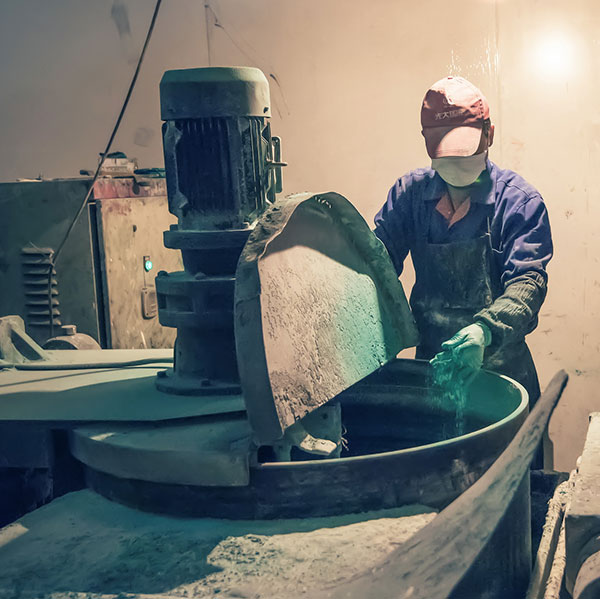
The qualified raw materials are accurately weighed according to the formula and put into a closed mixing system. Zirconia-alumina abrasive, resin binder, and INOX additives are thoroughly mixed. If the proportion deviation exceeds the set range, the entire batch is discarded. The uniformity of the mixture directly determines the consistency of the cutting force of the cutting disc—this is non-negotiable.
3. Pressing
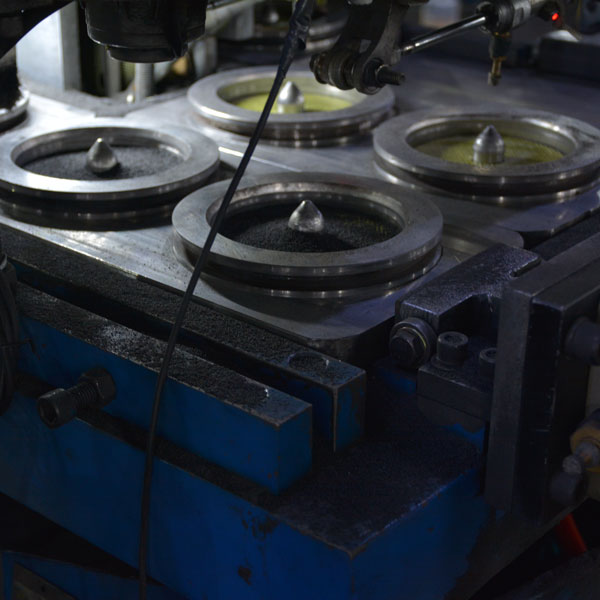
The mixture is fed into a press and formed under high pressure. During pressing, fiberglass mesh is embedded in the abrasive layers, forming a reinforcing skeleton. There are tolerances for both pressure and thickness; anything exceeding these tolerances is scrapped. The resulting blank has the shape of a slit, but it is still very fragile at this stage.
4. Curing
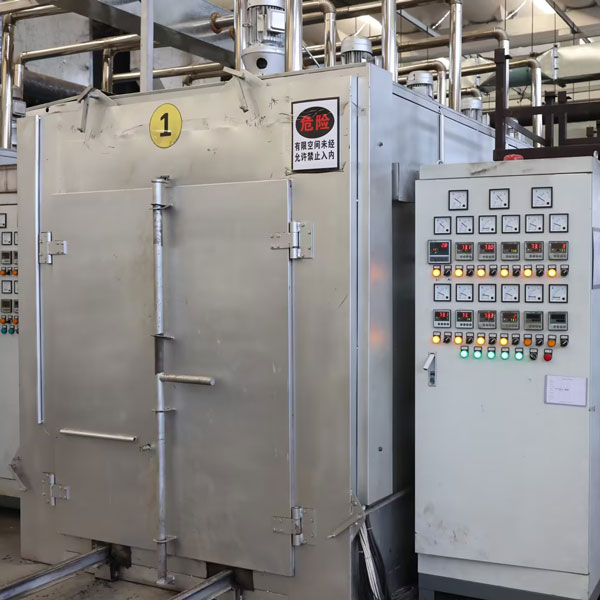
The preform enters the curing oven and is heated for tens of hours according to the set temperature profile. The resin undergoes a cross-linking reaction at high temperature, changing from a liquid state to a solid state through thermal curing, firmly fixing the abrasive particles. Too high or too low a temperature will cause problems, so DOME uses a programmed temperature control system to lock the curing conditions for each batch, keeping the fluctuations between batches within a very small range.
5. Balancing
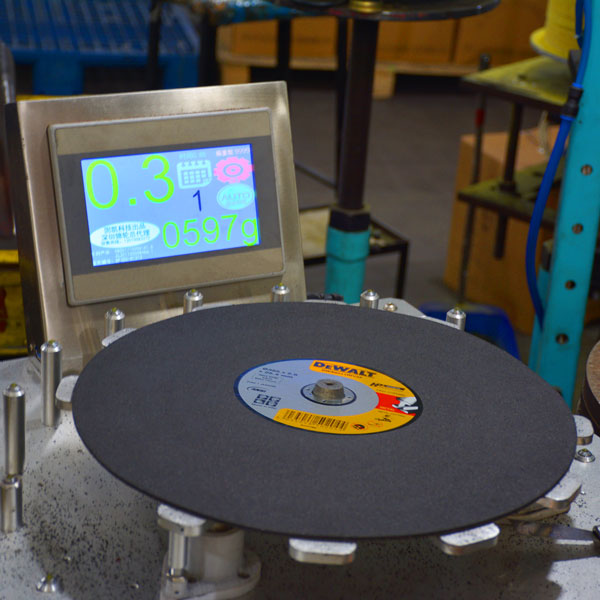
Each cutting disc is tested by a dynamic balancing machine. Cutting discs with excessive eccentricity cannot pass the test—when such discs are mounted on an angle grinder, the entire machine vibrates, and the cut lines are crooked. DOME’s balancing standards are stricter than industry-standard requirements, and large-diameter discs undergo two more tests.
6. Burst Test
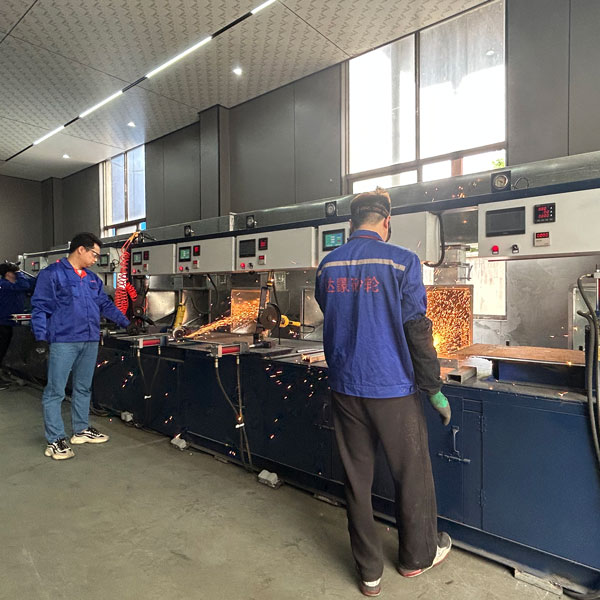
Random samples are taken from each batch, and the machine is accelerated from zero to fracture speed, recording the fracture speed. EN12413 standard stipulates that the fracture speed must not be less than 1.5 times the rated maximum speed. DOME’s internal standard is even higher than this. If the data fails to meet the requirements, the entire batch will not be shipped—without exception.
7. Packaging
After all tests are passed, each piece is individually packaged to prevent moisture damage during transportation and storage. The label must include all specifications, aperture, maximum speed, and EN12413 markings. The outer carton must have complete batch information. DOME performs random inspections on each carton – incorrect labeling or damaged packaging results in the entire carton being reworked.
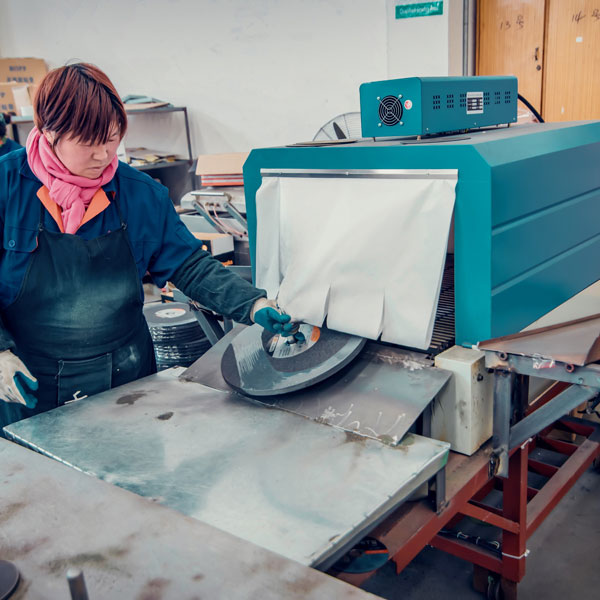
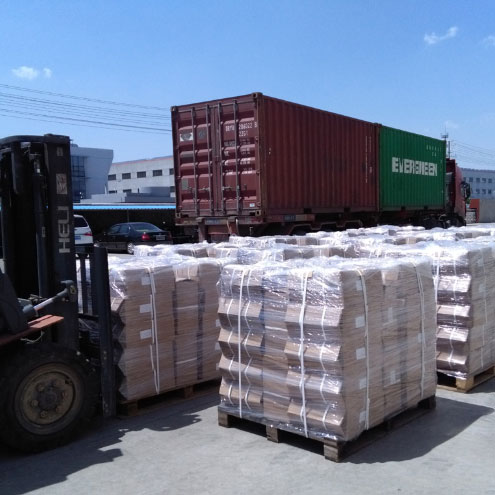
8. Shipment
Finished products are categorized and stored according to orders, ready for shipment. Each batch of goods is accompanied by a Certificate of Analysis (COA), covering data such as dimensional accuracy, dynamic balance, and burst testing for that batch. From raw material intake to finished product shipment, every piece can be traced back to its specific batch and testing records. The buyer receives not only cutting discs, but also traceability of the entire supply chain.
Quality Control
Before every disc leaves the factory, it must pass six inspection checkpoints. Each checkpoint has clear, measurable standards.
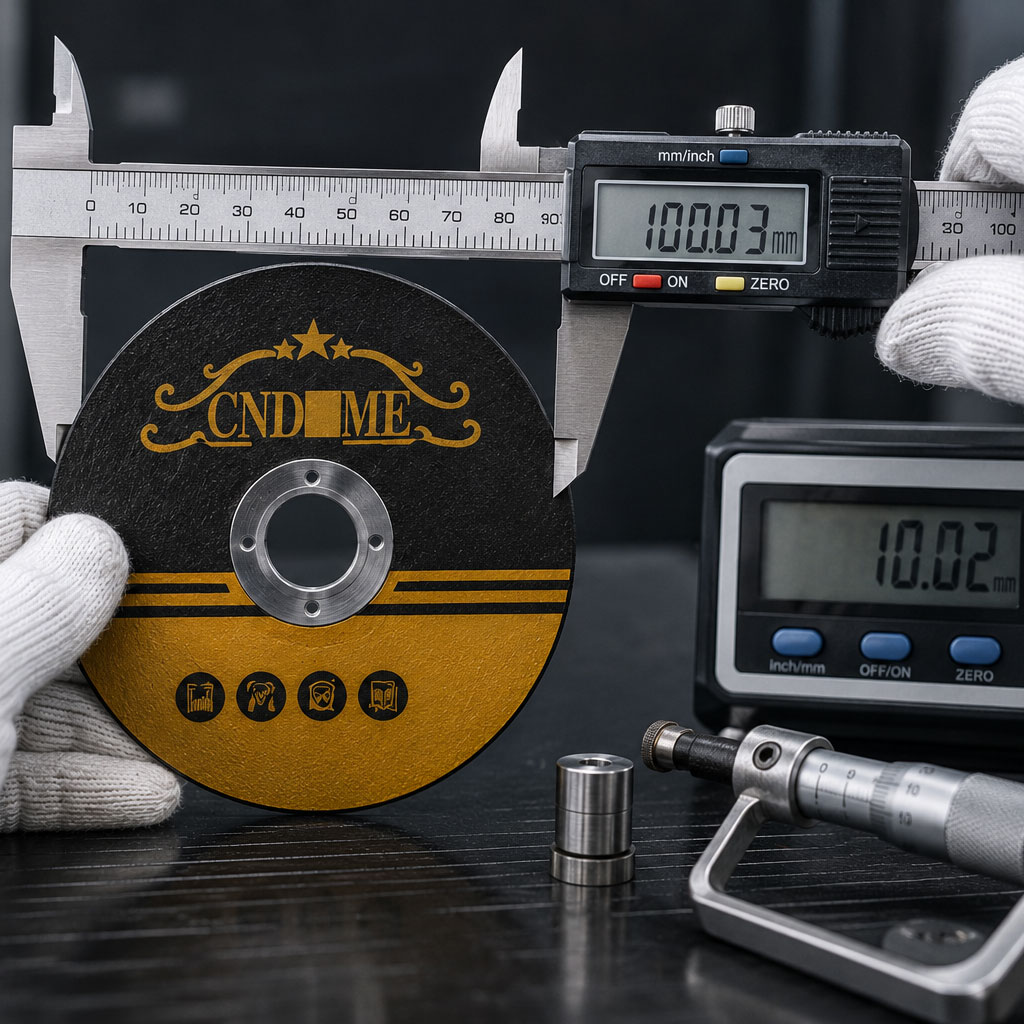
1. Dimensional Accuracy Inspection
The outer diameter, thickness, and aperture of each cutting disc must be measured. If the outer diameter is too large, it won’t fit into the machine; if it’s too small, it will wobble after installation. A thickness deviation exceeding 0.1mm will result in inconsistent kerf widths. An unqualified aperture will prevent the disc from being installed at all. DOME uses high-precision measuring instruments to inspect each disc individually, and any discs exceeding the dimensional tolerances are rejected.

2. Appearance inspection
Visually inspect, touch, and listen to the sound when tapped. Surface cracks, bubbles, missing corners, and uneven coloring result in immediate rejection. The tapping test is an industry-standard method—a good cutting disc produces a crisp sound when tapped, while one with internal cracks produces a dull sound. While appearance defects may seem minor, any micro-defect can become a fracture point during high-speed rotation.
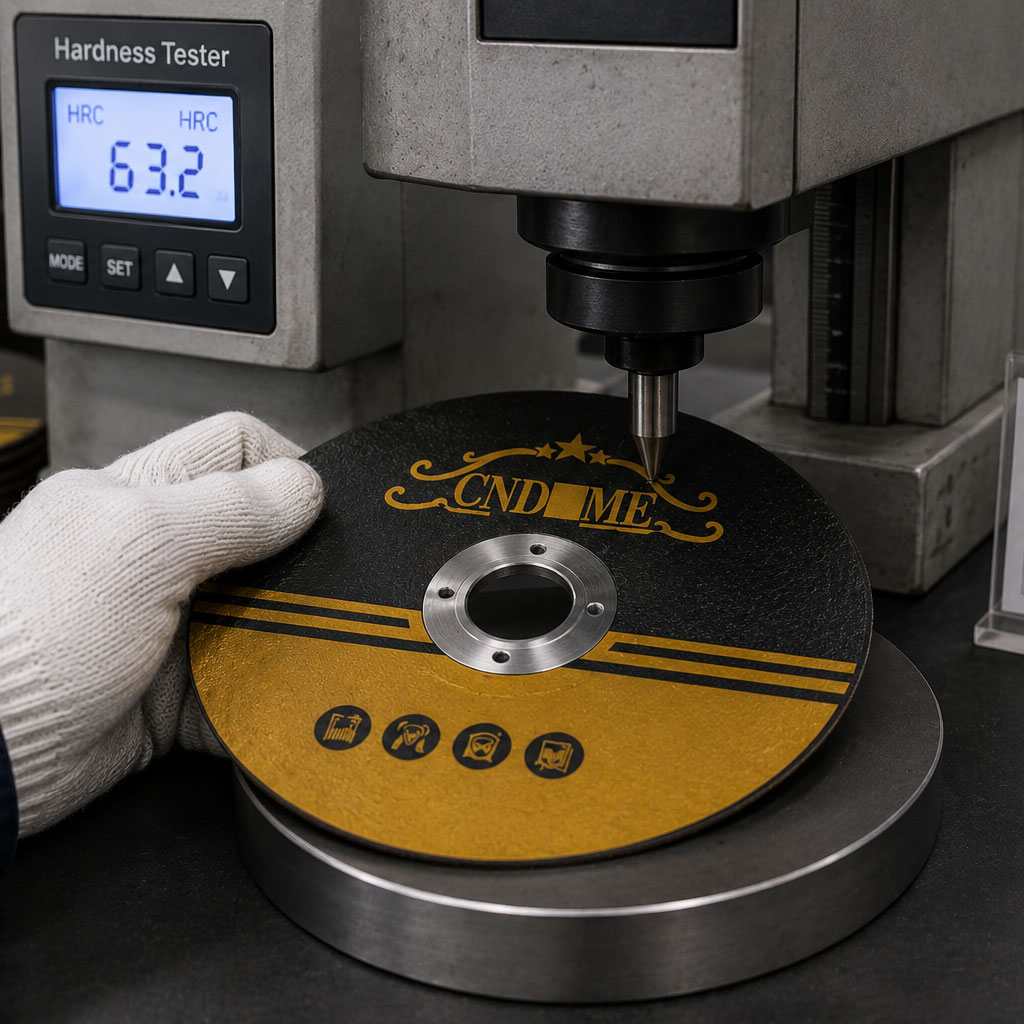
3. Hardness testing
Hardness measurement doesn’t measure the material’s hardness, but rather the binding force of the resin binder on the abrasive grains. A hardness tester is used to mark points on the cutting disc’s surface; the reading must be within the standard range. Too high a hardness means the abrasive grains become dull and won’t fall off, resulting in slower cutting and increased heat. Too low a hardness means the abrasive grains fall off before being fully worn away, leading to a shorter lifespan. If the hardness fails to meet the standard, the entire batch is returned.
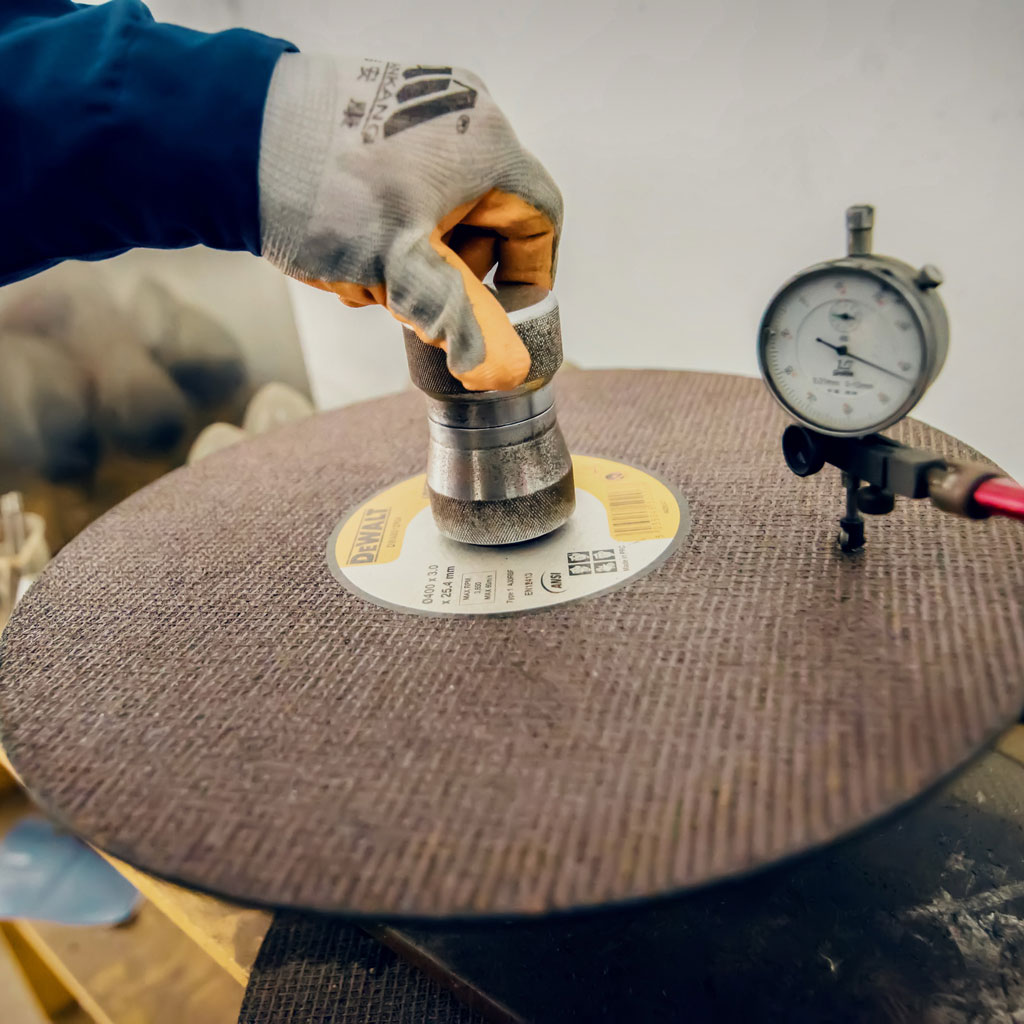
4. Dynamic balancing test
If the cutting disc is misaligned during high-speed rotation, it will generate centrifugal force, causing vibration. DOME tests each cutting disc with a dynamic balancing machine; any disc that is misaligned is immediately scrapped. This is especially true for the 355mm large-diameter discs, where the balancing requirements are much stricter than for smaller discs. If a disc that is not properly balanced is mounted on an angle grinder, the entire machine will vibrate, resulting in crooked cuts.
5. Rupture test
This is the most critical test in the safety process. Random samples are taken from each batch and tested on a testing machine, gradually accelerated from a standstill to 1.5 times the calibrated maximum speed, continuously verifying structural integrity. The EN12413 standard requires a fracture speed ≥ 1.5 times the rated maximum speed. DOME’s internal standards are even stricter than EN12413. Any abnormality during testing results in the entire batch being rejected.
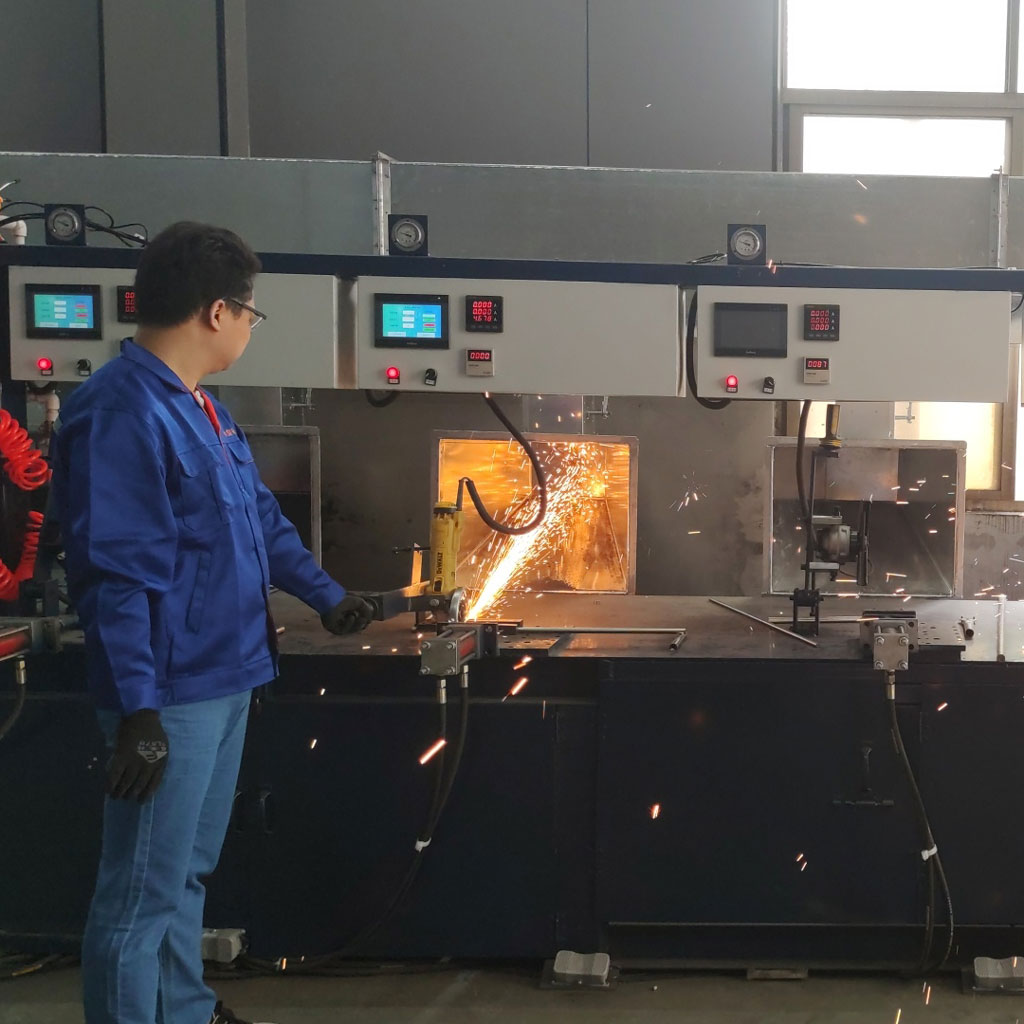
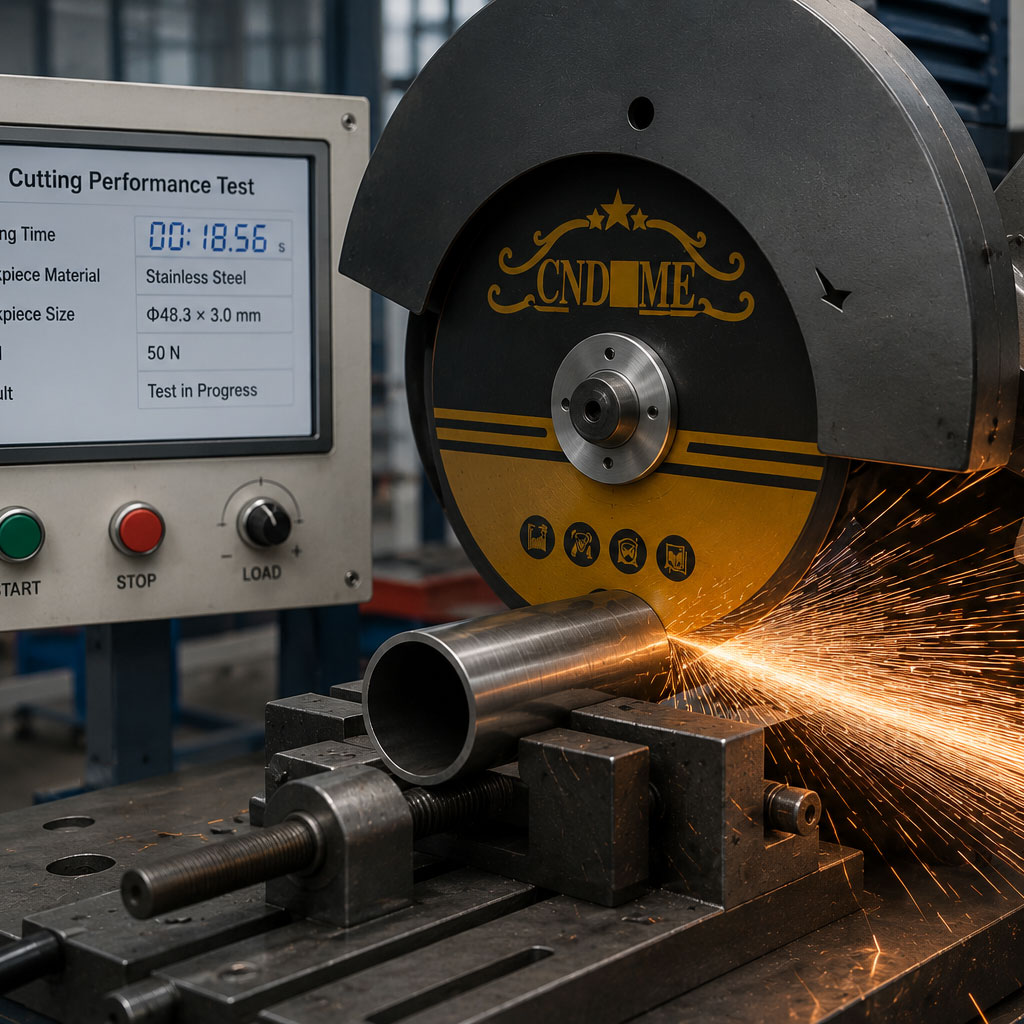
6. Cutting performance test
Sample cutting discs are mounted on an angle grinder to cut standard test pieces (such as 12mm stainless steel bars), and the cutting speed and number of cuts are recorded. Cutting speed reflects the sharpness of the abrasive, while the number of cuts reflects its lifespan. DOME conducts tests on various materials—stainless steel, carbon steel, etc.—to ensure consistent performance of each batch of products under different operating conditions. If the data fails to meet standards, the entire batch is reworked.
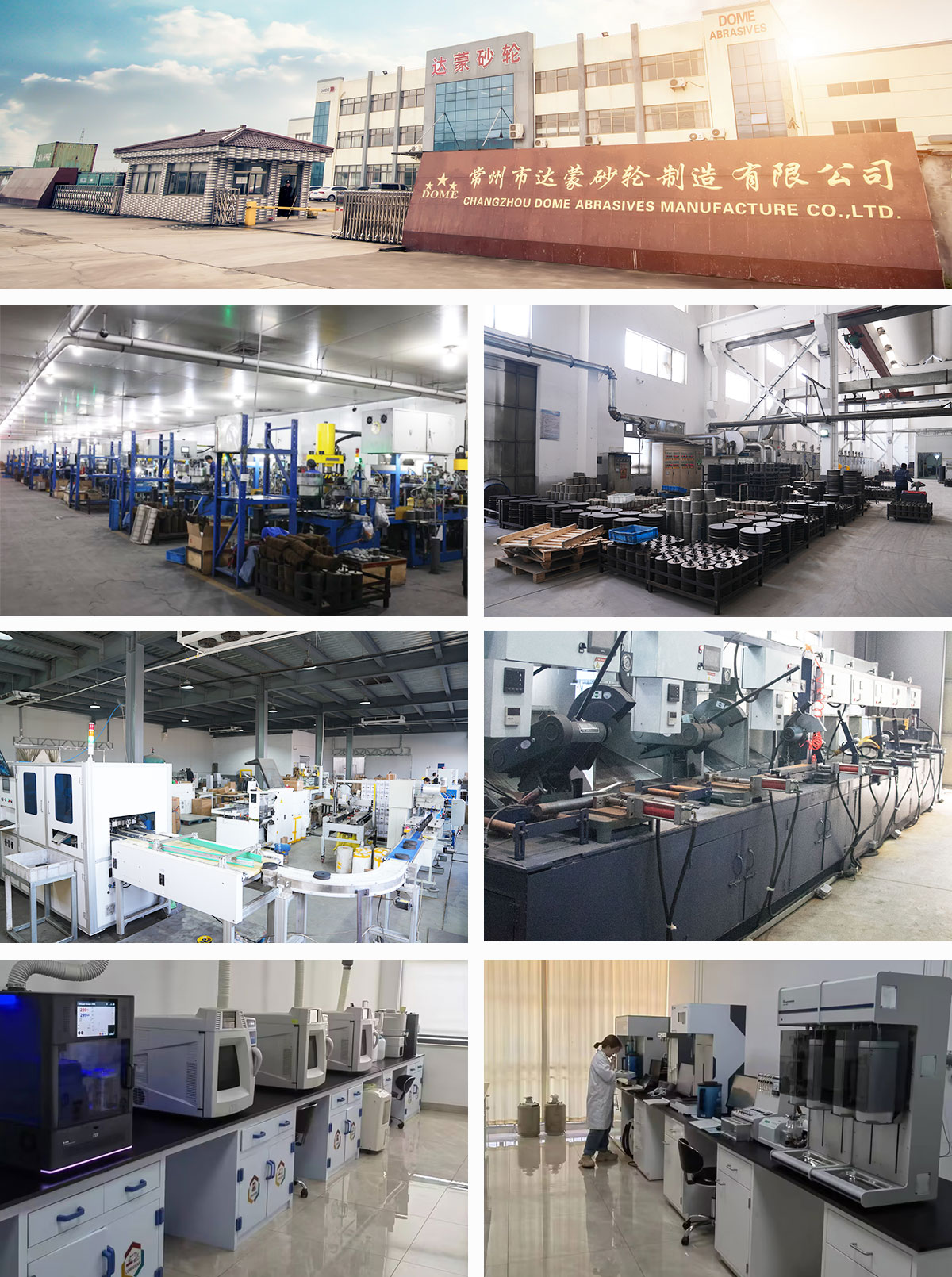
Factory Strength
Changzhou Dome Grinding Wheel Manufacturing Co., Ltd. (DOME), established in 2001, is a manufacturing enterprise specializing in the research and development and production of resin-bonded cutting discs and grinding discs.
| Indicator | Data |
|---|---|
| Factory Area | 20,000 m² (13,000 m² climate‑controlled) |
| Production Equipment | Nearly 100 sets |
| Automated Lines | 60 |
| Daily Output | 600,000 discs |
| R&D Team | 10+ professionals |
| Export Share | 80% |
| Export Countries | 60+ |
| OEM Clients | 3,000+ |
| Certifications | ISO9001 / MPA / CE / BSCI / EN12413 / ISO14001 |
Factory and Laboratory
Warehousing and Container Loading
Certificates
Each certification is strong proof of DOME’s manufacturing qualifications and product safety.
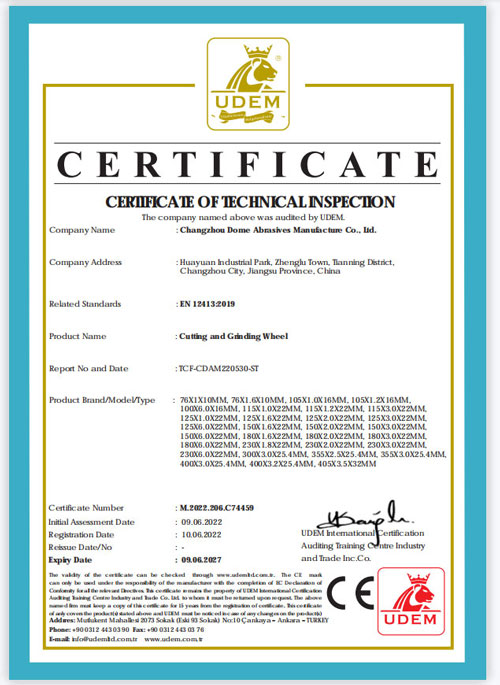
EN12413
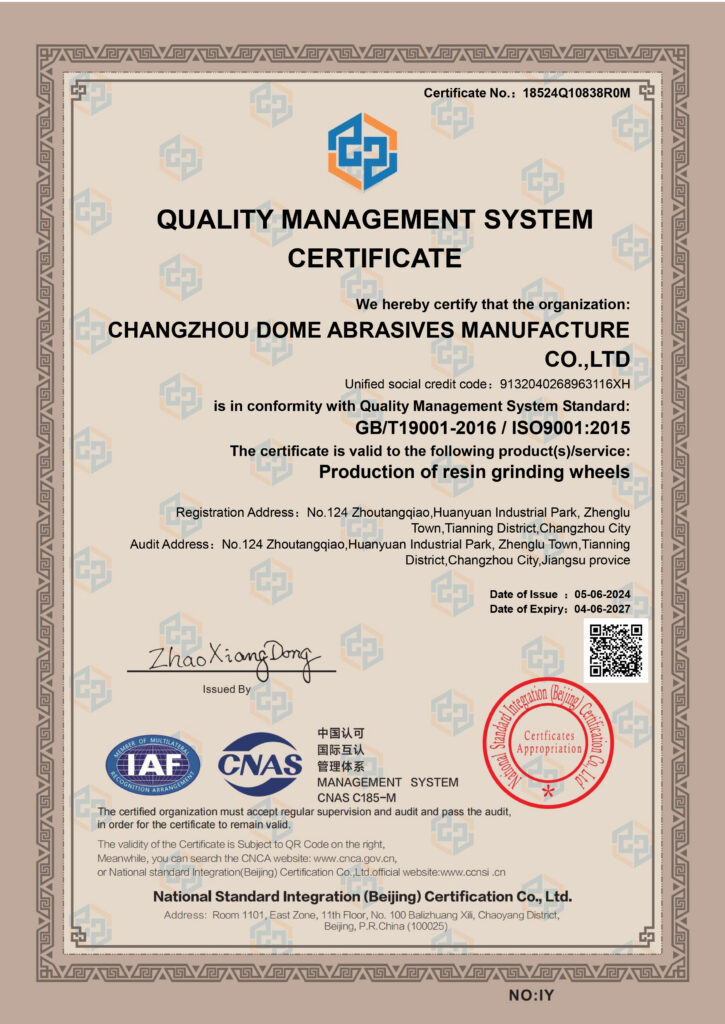
ISO9001
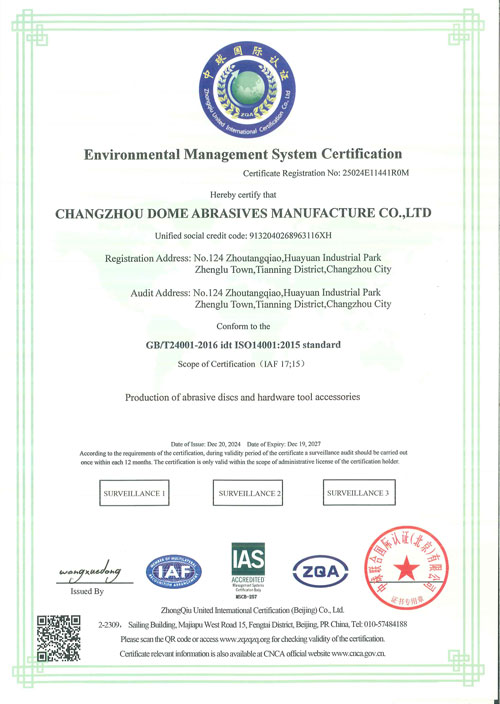
ISO14001
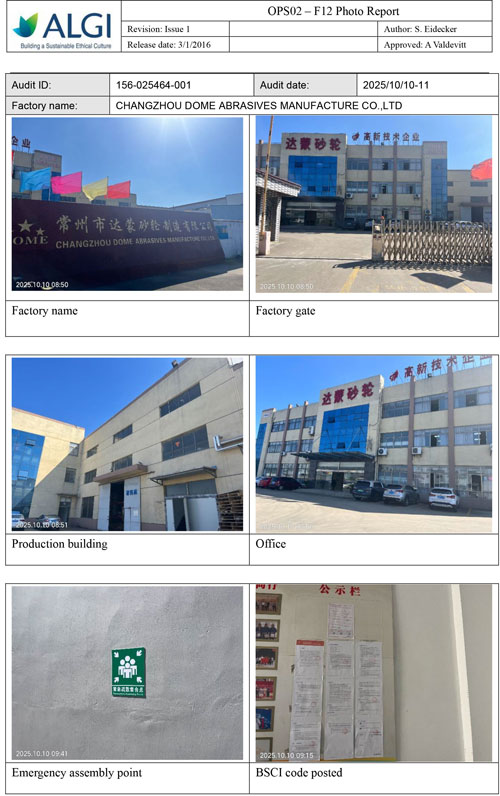
BSCI
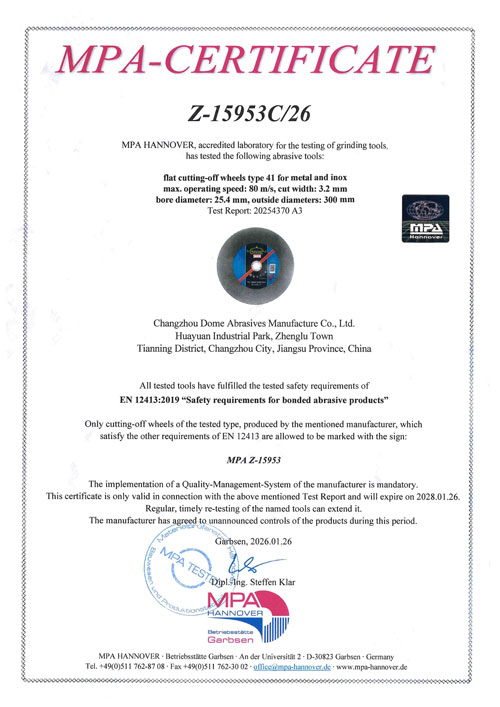
MPA
| Certification | Type | Core Value |
|---|---|---|
| EN12413 | Product Safety Standard | Guaranteed disc structural integrity and burst safety |
| ISO9001 | Quality Management System | Batch consistency, stable quality, full traceability |
| ISO14001 | Environmental Management System | Production processes comply with regulations, reducing supply chain environmental risks |
| BSCI | Social Responsibility Audit | Factory conditions meet international standards, satisfying global brand procurement requirements |
| MPA | German Safety Certification | Complies with the world’s most stringent market safety requirements |
Stainless Steel Cutting Disc FAQ
1. What is the best cutting disc for stainless steel?
The best cutting disc for stainless steel combines three essential features:
· Ultra-thin 1.0mm profile – minimises heat generation, prevents work-hardening and discolouration
· INOX low-iron bond – Fe + S + Cl ≤ 0.1%, prevents rust-inducing contamination
· Zirconia or ceramic abrasive – self-sharpening, maintains aggressive cut rates on 304 and 316 grades
Available in 115mm and 125mm diameters with 22.23mm bore for standard angle grinders. For precision cutting of stainless sheet, pipe, and tube, a 1mm INOX cutting disc delivers the fastest, cleanest results.
2. Can you use a metal cutting disc on stainless steel?
You can physically cut stainless steel with a standard metal cutting disc—but you shouldn’t. Standard metal cutting discs contain iron and other contaminants that embed into the stainless surface during cutting. Over time, these embedded particles rust, causing brown stains and pitting corrosion. For stainless steel, always use a stainless steel cutting disc with INOX low-iron formulation to preserve corrosion resistance.
3. What is an INOX cutting disc?
An INOX cutting disc is an abrasive wheel specifically formulated for stainless steel and other corrosion-sensitive materials. The term INOX (from French inoxydable) indicates the disc meets the industry purity standard of Fe + S + Cl ≤ 0.1% —ensuring no iron, sulfur, or chlorine contaminants transfer to the workpiece. INOX discs prevent rust initiation, preserve the material’s corrosion-resistant oxide layer, and are required for food equipment, pharmaceutical, marine, and architectural stainless applications.
4. What size cutting disc is best for stainless steel?
The best size depends on your angle grinder and material thickness:
· 115mm / 4.5″ – General stainless fabrication, sheet, thin pipe (most common)
· 125mm / 5″ – Medium structural, 2″ pipe, wider sheet (extended reach)
· 180mm / 7″ – Heavy fabrication, thick-walled stainless (1.6mm thickness)
For most workshop applications, a 115mm stainless steel cutting disc is the standard choice. Match your grinder’s guard size and RPM rating.
5. What thickness stainless steel cutting disc should I use?
Stainless steel cutting disc thickness depends on material gauge and desired cut quality:
· 1.0mm – Thin sheet, pipe, precision cutting (fastest, coolest, minimum heat)
· 1.2mm – Light fabrication, mixed materials (speed + durability)
· 1.6mm – Structural sections, thicker plate (extended life, higher durability)
For most stainless applications, a 1mm cutting disc is recommended to minimise heat and prevent work-hardening.
6. Can a 1mm cutting disc cut stainless steel?
Yes, a 1mm cutting disc is specifically recommended for stainless steel. The ultra-thin profile generates less friction and heat than thicker wheels—preventing the work-hardening, bluing, and discolouration common when cutting 304 and 316 grades. For stainless, always choose a 1mm cutting disc for stainless steel with INOX low-iron bond.
7. Can I cut 304 stainless steel with an angle grinder?
Yes, 304 stainless steel can be cut with an angle grinder using a stainless steel cutting disc (INOX bond, 1.0mm thickness). Standard 115mm or 125mm angle grinders with 22.23mm bore discs are suitable. Always verify your grinder’s maximum RPM does not exceed the disc’s rating. For 304 stainless, a cutting disc for 304 stainless steel with zirconia or aluminum oxide abrasive delivers clean, burr-free cuts.
8. Can I cut 316 stainless steel with an angle grinder?
Yes, 316 stainless steel can be cut with an angle grinder using a stainless steel cutting disc with INOX low-iron bond. 316 contains molybdenum, which increases work-hardening during cutting—use a 1mm cutting disc to minimise heat generation and prevent edge hardening. A cutting disc for 316 stainless steel with ceramic or zirconia grain is recommended for optimal results.
9. Why does stainless steel turn blue when cutting?
Stainless steel turns blue when excessive heat builds up at the cut edge. This blue discolouration—known as “bluing” or heat tint—occurs when temperatures exceed approximately 200°C. The blue oxide layer is a sign of thermal damage that can reduce corrosion resistance. To prevent bluing:
· Use a 1mm ultra-thin cutting disc (less friction = less heat)
· Use intermittent cutting (short passes, allow cooling)
· Use a higher RPM grinder to reduce contact time
10. How do I prevent stainless steel from rusting after cutting?
Stainless steel rusts after cutting when iron particles from the cutting disc embed into the cut edge and oxidise over time. To prevent this:
· Always use an INOX cutting disc (Fe + S + Cl ≤ 0.1%)
· Use a low‑iron, resin‑bonded disc specifically formulated for stainless steel
· After cutting, passivate the cut edge using a stainless steel passivation solution
· Clean the cut edge with a stainless steel wire brush (never use carbon steel brushes)
A stainless steel cutting disc no contamination formulation is essential for preserving corrosion resistance in food, marine, and architectural applications.
11. Do you test every disc or just batch sample?
We test every single disc for dimensional accuracy, thickness tolerance, bore size, and dynamic balance. For burst testing and cutting performance, we use batch sampling – but every disc is individually RPM tested at 150% of rated speed. This ensures that if there’s a structural defect, it’s caught before the disc reaches the customer.
12. How long do stainless steel cutting discs last?
Service life depends on material thickness, cutting frequency, and operator technique. On 3mm stainless sheet, a 1.0mm disc typically lasts 50–100 cuts. On thicker materials, life is shorter – but zirconia alumina abrasives extend life compared to standard aluminium oxide. The best indicator is visual wear – replace the disc when it approaches the flange. Overused discs are unsafe and cut poorly.
13. How are cutting discs packed for shipping?
Each disc is individually shrink‑wrapped to protect against moisture during transit and storage. Discs are then packed in sturdy export cartons with proper cushioning. Cartons are palletised and stretch‑wrapped for container shipping. For OEM orders, we can match your specific packaging requirements. All packaging is designed to ensure discs arrive in perfect condition – no cracks, no moisture damage.
14. What is the minimum order quantity for a wholesale order?
Minimum order quantity depends on the product type and whether it’s a standard or custom order. For standard products, MOQ is flexible – we work with both small and large distributors. For OEM custom orders with private label packaging, MOQ is higher but negotiable based on your order volume. Contact us with your requirements and we’ll provide a specific quote.
15. Do you offer samples before placing a bulk order?
Yes – we provide free samples for testing before you commit to a bulk order. Samples are sent with full specifications and test data. We recommend testing the disc on your actual material and equipment to confirm cutting speed, life, and cut quality match your requirements. Once you’re satisfied, we proceed with production.
Related Cutting & Grinding Products
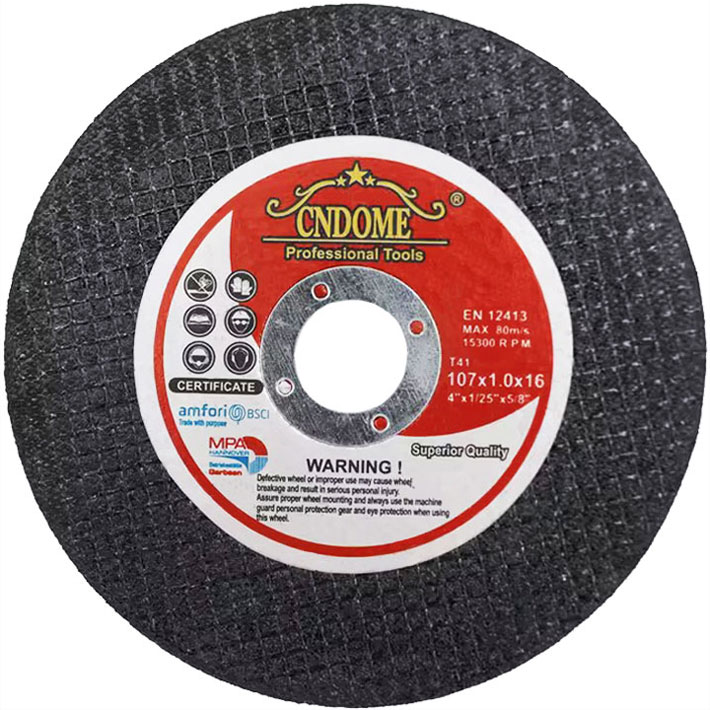
Metal Cutting Disc
General-purpose metal cutting disc for everyday cutting of carbon steel, structural steel, and ordinary steel.
Suitable Materials: Carbon steel / Structural steel / Iron
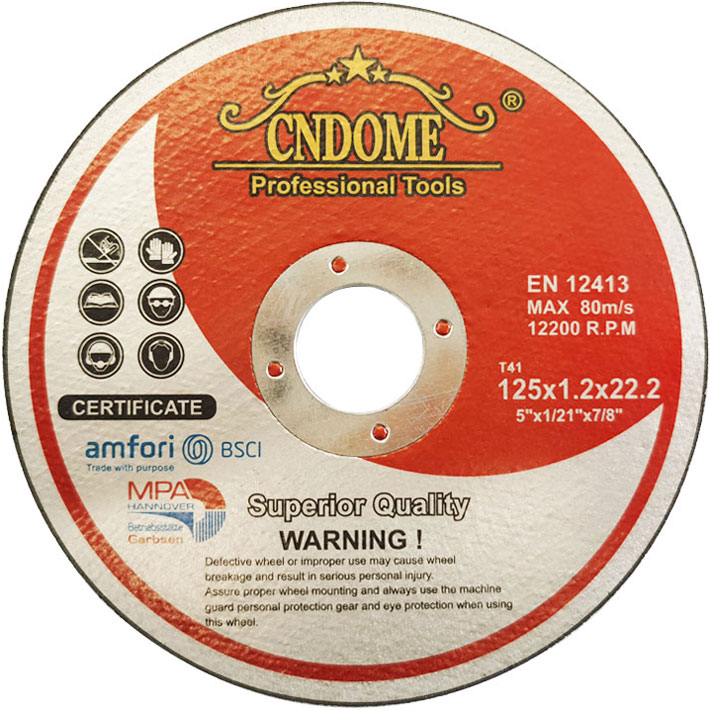
Stainless Steel Cutting Disc
Engineered for stainless steel cutting with Fe+S+Cl≤0.1% pure formula, delivering silver-bright, burn-free cuts.
Suitable Materials: 304 / 316 / 430 stainless steel
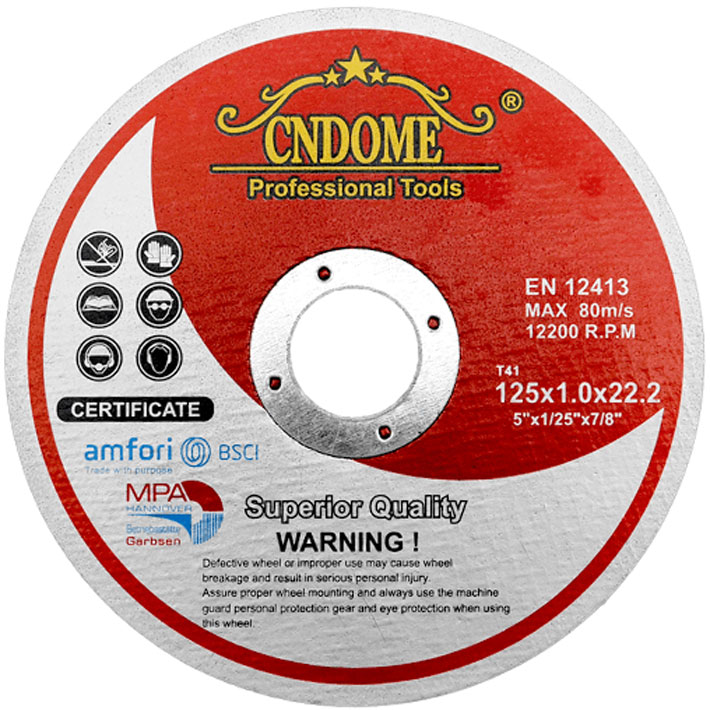
Ultra Thin Cutting Disc
Ultra-thin 1.0–1.6mm design for fast, low-heat, low-burr precision cutting of sheets and thin-wall tubes.
Suitable Materials: Stainless steel sheet / Carbon steel sheet / Thin-wall tube
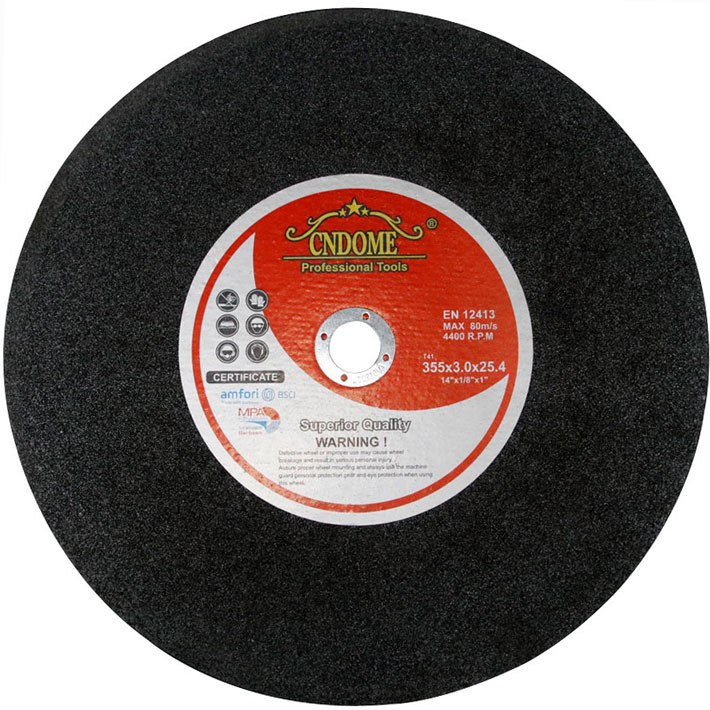
Large Diameter Cutting Disc
355mm large-diameter disc for stationary saws, cutting through large structural steel sections and heavy-wall pipes in one pass.
Suitable Materials: H-beams / I-beams / Large-diameter pipes / Rails
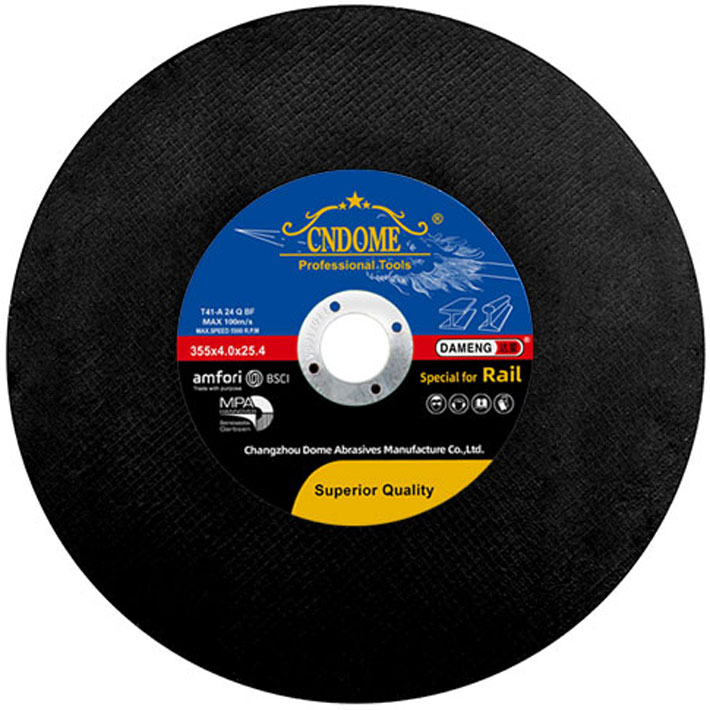
Rail Cutting Disc
Rail-specific disc with zirconia alumina and multi-layer fiberglass reinforcement, designed for heavy-duty high-hardness rail cutting.
Suitable Materials: U71Mn / U75V rails / Crane rails / High-manganese frogs
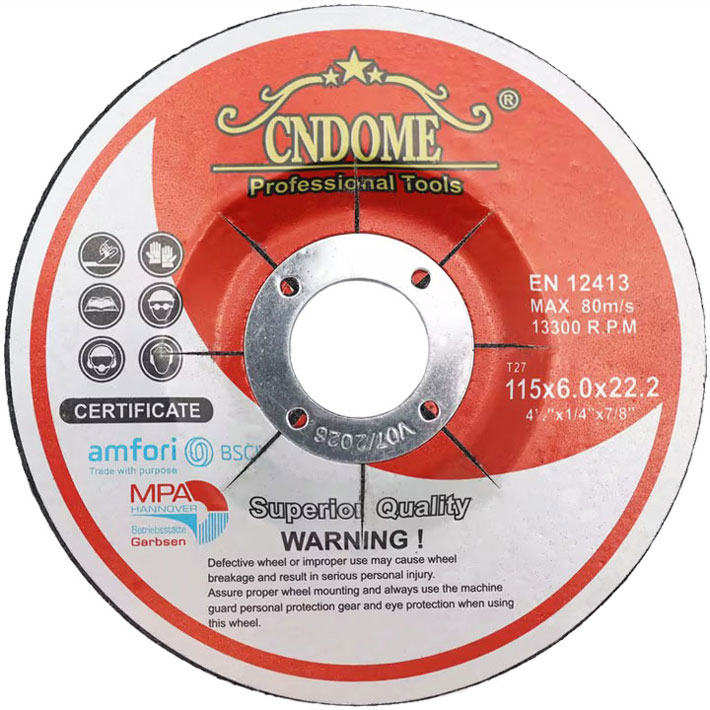
Grinding Wheel
Resin-bonded grinding wheel for surface grinding, weld dressing, and burr removal on all types of angle grinders.
Suitable Materials: Carbon steel / Stainless steel / Cast iron
Related Articles
- Your Complete Guide to Finding the Best Cutting Discs for Stainless Steel
- Stainless Steel Grinding and Polishing: A Practical Guide to Better Finishes
- Grinding Discs for Stainless Steel: The Right Choice for Precision and Performance
- Grinding Discs for Stainless Steel: How to Choose and Use Them Correctly
Ready to Source High-Quality Stainless Steel Cutting Discs?
Looking for a reliable stainless steel cutting disc supplier? We offer free samples for quality testing. Comprehensive OEM and private label customization services help you build your own brand. A quick quote within 24 hours ensures your project isn’t delayed. Worldwide shipping directly to your location. Contact us today to start your order.
Tel/WhatsApp
+86 18796960868
DomeGrinding@hotmail.com
Address