
26 Years Abrasive Manufacturing
600,000 PCS Daily Capacity
MPA / CE / ISO9001 Certified
Cutting Wheels & Cutting Discs Manufacturer | OEM Abrasive Cutting Wheels & Cutting Discs Supplier
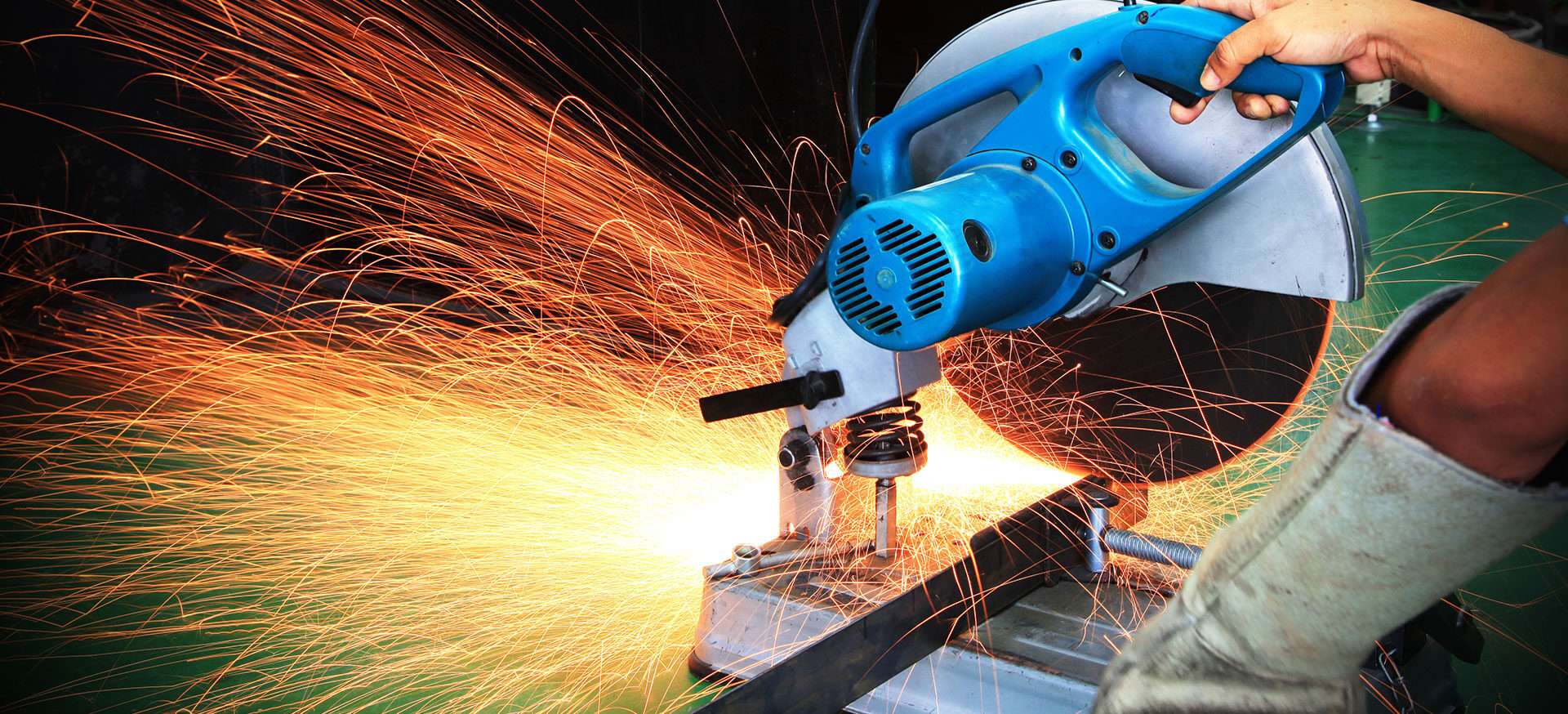
DOME manufactures resin bonded cutting wheels and abrasive cutting discs for metal fabrication, construction, automotive, railway and industrial applications. OEM customization, private label service and bulk supply available. Cutting discs are available in sizes from 38mm to 405mm.
Dome Abrasives Catalogue
What Are Cutting Wheels, Cutting Discs & Cut-Off Wheels?
Cutting wheels are also commonly called cutting discs, cut-off wheels, abrasive cutting wheels or cut-off discs. These terms generally refer to thin resin-bonded abrasive wheels designed for cutting metal and other materials with angle grinders, chop saws and stationary cutting machines. Unlike a saw blade that cuts with teeth, a cutting wheel removes material through abrasion: thousands of sharp abrasive grains on the wheel’s surface grind away tiny chips of metal with each rotation.
How Cutting Wheels Are Made
A resin bonded cutting disc is a composite structure. It starts with abrasive grain—typically aluminum oxide for general steel, zirconia alumina for stainless steel and tough alloys, or ceramic alumina for extreme applications. These grains are bonded together by a resin binder (usually phenolic resin), which holds the abrasive particles firmly in place while allowing worn grains to break away and expose fresh, sharp cutting edges beneath. To withstand the immense centrifugal forces of high-speed rotation, the disc is reinforced with layers of fiberglass mesh, preventing it from shattering during operation.
Types of Cutting Wheels
Cutting wheels can be categorized by material, size, and machine type. Understanding these classifications can help you quickly find the right product for your specific needs.
Metal Cutting Wheel
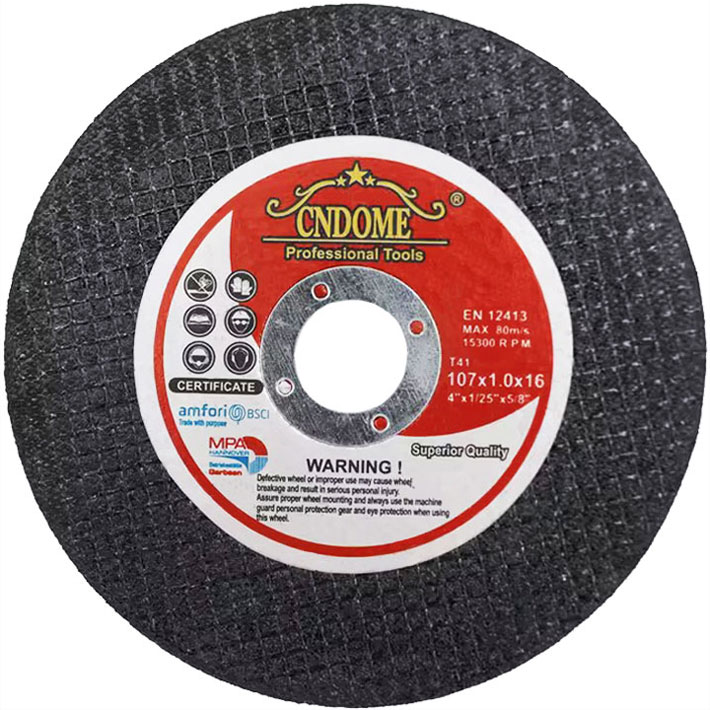
Designed for carbon steel, cast iron, and general structural steel. Typically uses brown fused alumina abrasive for cost‑effective, fast cutting. Thickness ranges from 1.0mm to 3.0mm – thin discs for sheet and tube, thick discs for solid bars and heavy‑duty jobs.
Stainless Steel Cutting Disc
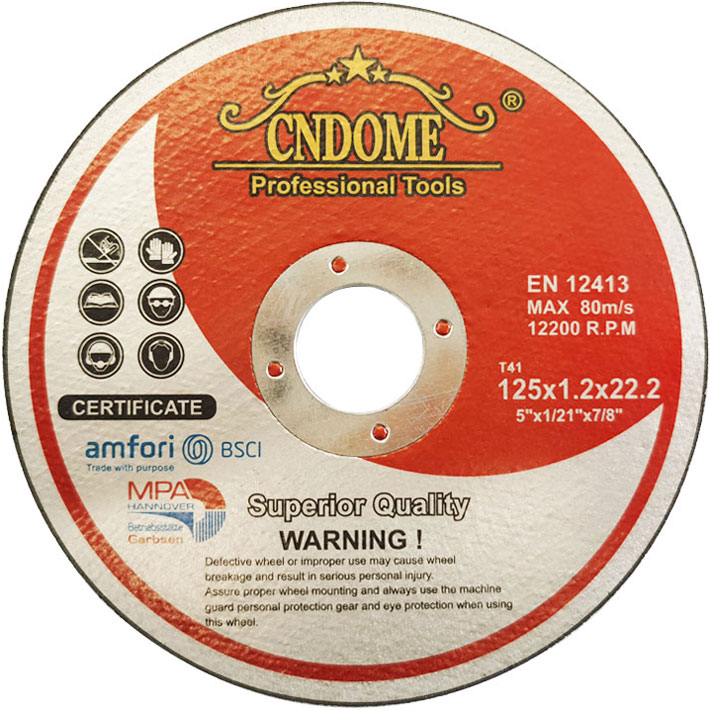
Engineered specifically for austenitic stainless steels like 304 and 316. Uses zirconia alumina abrasive with a low‑iron pure formulation (Fe+S+Cl ≤0.1%) to prevent iron embedment and subsequent rust. Delivers silver‑bright, burn‑free cuts without workpiece contamination.
Aluminum Cutting Wheel
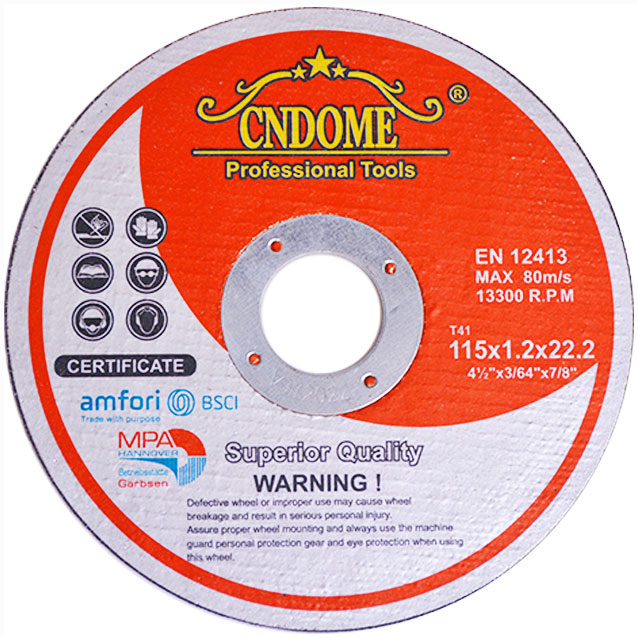
Designed for soft non‑ferrous metals like aluminum and copper. The main challenge is clogging – soft metals tend to load the abrasive. These discs use special additives and a more open structure to reduce loading and maintain cutting efficiency.
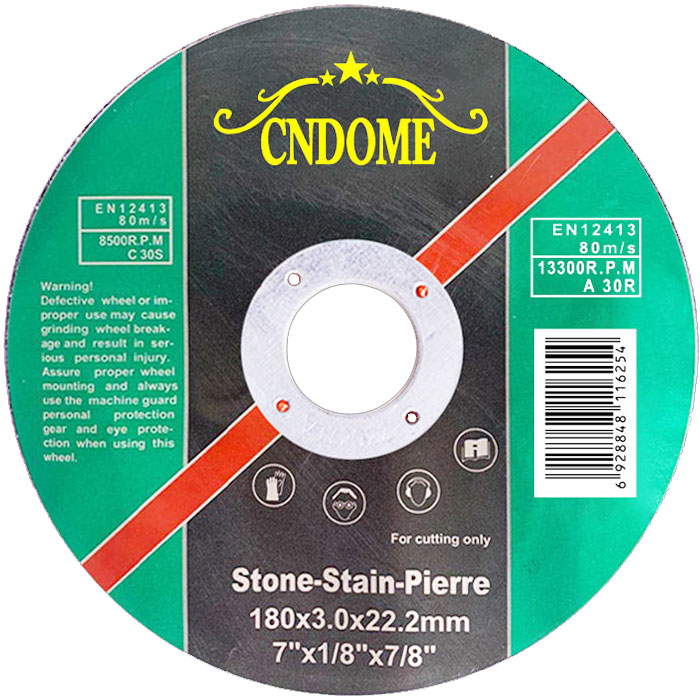
Stone Cutting Disc
Used for cutting concrete, brick, stone, and other hard brittle materials. Typically uses silicon carbide abrasive, which is hard and sharp. Note: stone cutting discs are not suitable for metal cutting, and vice versa.
Cutting Wheels by Size
Choosing the correct cutting wheel diameter isn’t just about fitting your angle grinder; it directly dictates your maximum cutting depth, optimal operating RPM, and the cross-sectional thickness of metal you can efficiently sever. Using an oversized cutting disc on an underpowered tool leads to stalling and kickback, while an undersized cutting disc wastes time and accelerates wear. Use this diameter guide to align your abrasive tooling with your specific angle grinder, die grinder, or stationary cut-off saw.
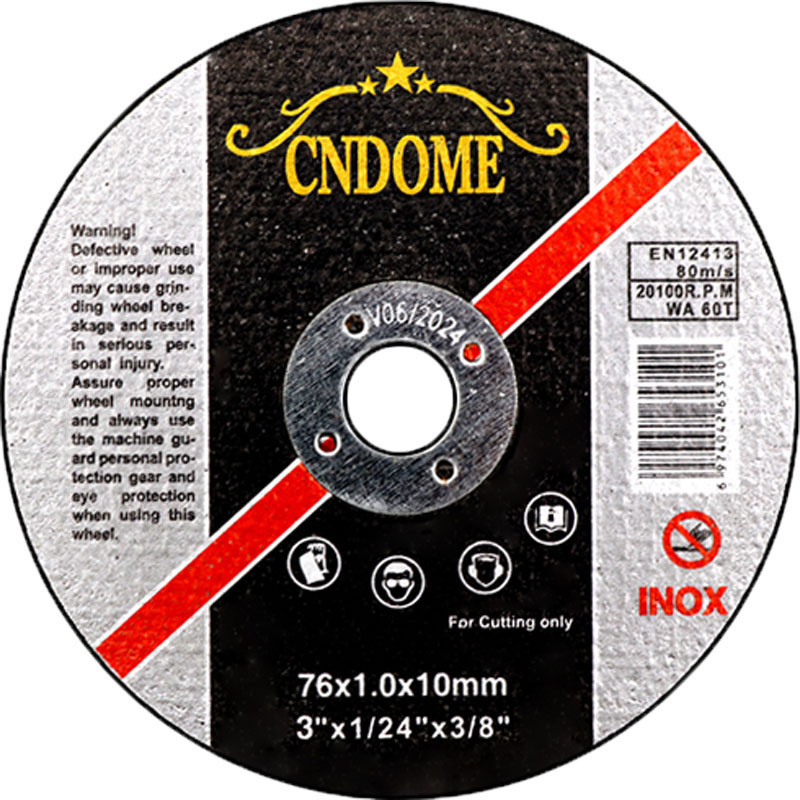
3 Inch / 76mm Cutting Wheels
Designed for high-speed pneumatic die grinders and compact electric tools, the 3 inch cutting wheel excels in automotive panel trimming, spot-weld removal, and cutting small-diameter fasteners in cramped engine bays. This mini size delivers unmatched control for delicate work. For quick severing of thin-walled tubes or conduit, a 3 inch cut off wheel provides clean, burr-free exits with minimal spark scatter. When working with metric collet systems, the 76mm cutting disc is the go-to choice for fine finishing, while the 76mm cutting wheel in thicknesses around 1.0mm is ideal for slicing through sheet metal without warping the surrounding material.
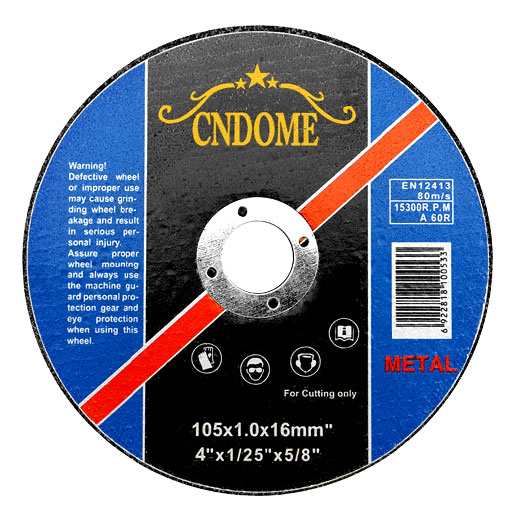
4 Inch / 100mm Cutting Wheels
Sitting between compact portability and functional cut depth, the 4 inch cutting wheel is frequently paired with 500W–700W angle grinders for maintenance and repair tasks. It is particularly effective for cutting small rebar ties, threaded rods, and metal strapping. The 4 inch cut off wheel offers a lower vibration profile, reducing operator fatigue during overhead work. On the metric side, the 100mm cutting disc provides an excellent balance of arbor size (commonly 16mm) and peripheral speed, while the 100mm cutting wheel is robust enough to handle light gauge steel framing used in drywall construction.
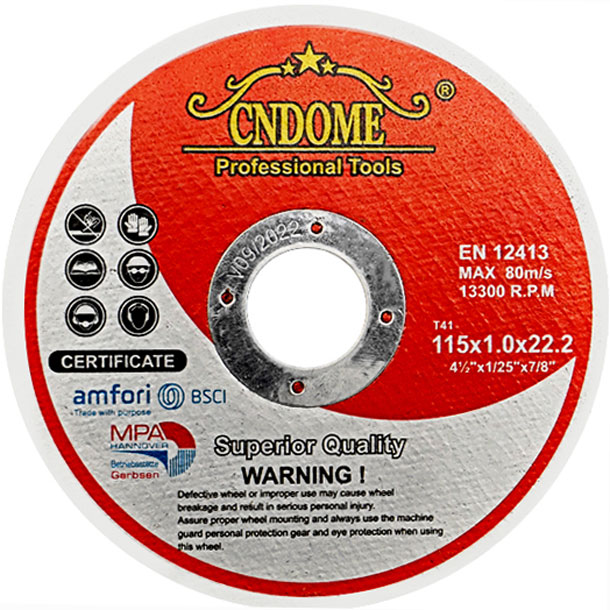
4.5 Inch / 115mm Cutting Discs
Arguably the most popular size worldwide, the 4.5 inch cutting disc is the perfect match for 700W–900W angle grinders, making it the daily workhorse for structural steel erectors and general fabrication shops. This diameter hits the sweet spot between consumable cost and cutting efficiency for materials up to 3mm thick. Our premium 4.5 inch cutting wheel features a depressed center design that allows flush cutting against flat surfaces. For international machinery, the 115mm cutting disc offers the widest variety of abrasive blends—from zirconia for stainless to alumina for carbon steel—and the 115mm cutting wheel consistently delivers the fastest cut-off times for solid bar stock up to 12mm in diameter.
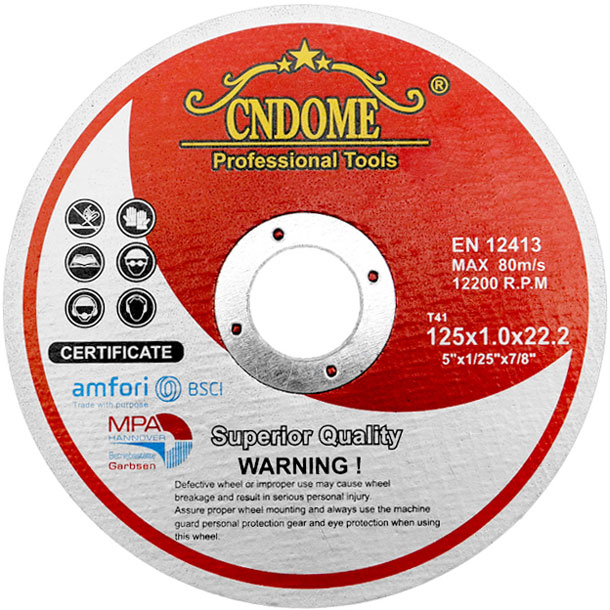
5 Inch / 125mm Cutting Discs
When you step up to high-powered angle grinders exceeding 1000W, the 5 inch cutting disc provides that extra 2mm–3mm in cutting depth compared to its 4.5-inch cousin, which is a critical advantage when coping small angle iron or channel sections. The 5 inch cutting wheel utilizes a larger arbor bore (22mm) in many models, ensuring torque is efficiently transferred without spindle slippage. For metric operators, the 125mm cutting disc is the preferred choice for cutting 2-inch nominal pipe, offering a deeper bite that reduces the need to rotate the workpiece. Meanwhile, the 125mm cutting wheel is engineered to handle the increased surface feet per minute (SFPM) generated by larger armature motors, maintaining cool cutting even during prolonged use.
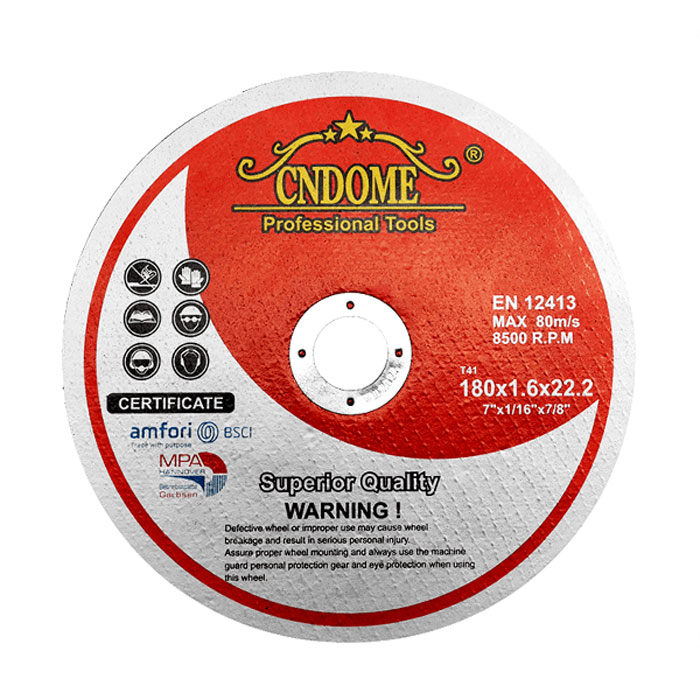
7 Inch / 180mm Cutting Wheels
Transitioning into heavy-duty industrial applications, the 7 inch cutting wheel demands a grinder with at least 1400W of power and an M14 spindle thread to handle the increased load. This diameter is the minimum recommendation for cutting solid rebar over 20mm or thick-walled structural tubing. The 7 inch cutting disc features a reinforced, heat-treated inner ring to stabilize the wheel against high-frequency vibration. For workshop environments using European machinery, the 180mm cutting disc is the entry-level size for semi-automatic chop saws, allowing operators to cleanly sever medium sections of steel profile with minimal burr formation—making it indispensable for preparatory welding tasks.
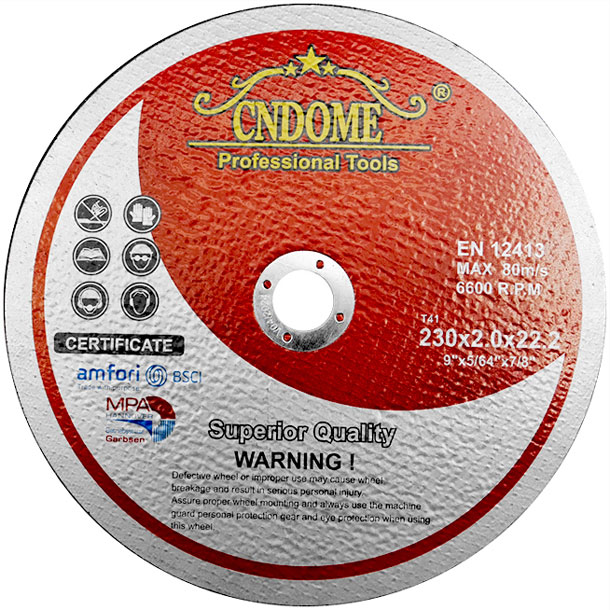
9 Inch / 230mm Cutting Wheels
When industrial maintenance, shipbuilding, or large-scale civil construction calls for brute force, the 9 inch cutting wheel is the undisputed champion. Paired exclusively with 2000W–2500W (2.5kW+) angle grinders, this size easily chews through railroad tracks, high-manganese steel castings, and large-diameter solid shafts. The 9 inch cut off wheel is designed with maximum glass-fiber reinforcement to withstand the violent kickback potential of deep cuts. For metric global standards, the 230mm cutting disc delivers exceptional linear velocity, capable of severing a 25mm solid rebar in under 5 seconds, while the 230mm cutting wheel incorporates specialized cooling holes to prevent bond softening when cutting abrasive materials like ductile iron.
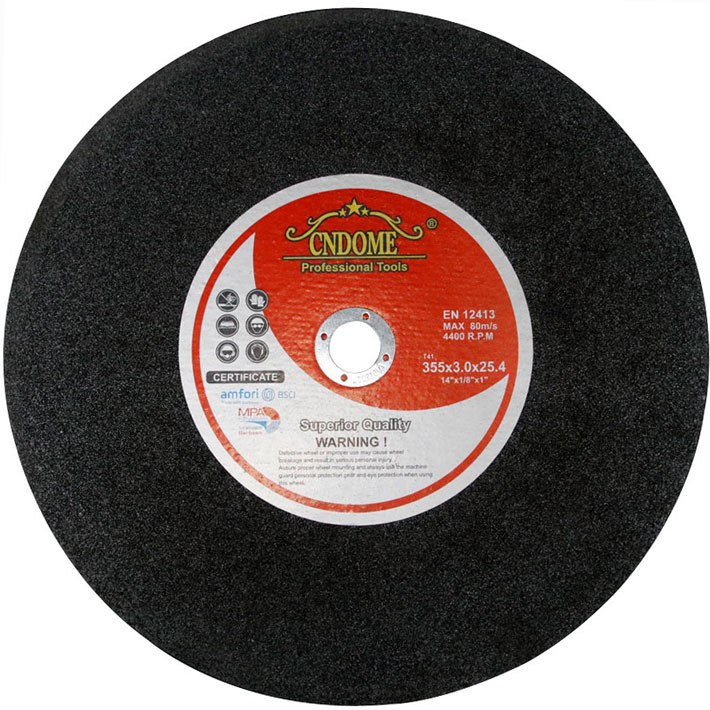
14 Inch / 355mm Cutting Wheels
Moving away from hand-held grinders, the 14 inch cutting wheel is exclusively engineered for stationary or semi-stationary abrasive chop saws and miter saws used in metal service centers. This diameter is optimized for high-volume production cutting of bundled tubes, angle irons, and structural beams. The 14 inch cut off wheel operates at a lower RPM (typically under 4000 RPM) but utilizes immense torque to achieve deep, straight penetration. For metric-spec industrial cut-off machines, the 355mm cutting disc usually features a standard 25.4mm (1-inch) arbor, ensuring universal fitment. The 355mm cutting wheel stands out with its large side vents that actively dissipate friction heat, ensuring that the bond remains stable during 30+ minute continuous cutting cycles, guaranteeing perfectly square edges every time.
Final Pro Tip for Size Selection:
Always check your tool’s maximum wheel diameter and no-load speed (RPM) printed on the nameplate. Never mount a 9-inch (230mm) cutting wheel on a 7-inch (180mm) grinder, even if the arbor fits—the peripheral speed will be dangerously high. When in doubt, size up your machine power first, then select the diameter that maximizes your required cutting depth without overloading the motor.
Cutting Wheels by Thickness
The thickness of your cutting disc determines cut quality, feed speed, and wheel durability. Match the gauge to your material and grinder power—thinner cutting disc for precision and speed, thicker cutting disc for heavy loads and side stress.
Ultra Thin Cutting Discs
Our ultra thin cutting discs are the go-to for trimming sheet metal, exhaust pipes, and thin-walled profiles. The 1mm cutting disc deliver a narrow kerf, reducing material loss and post-cut cleanup. For a bit more edge strength without sacrificing speed, the 1.2mm cutting disc offers excellent resistance to deflection—ideal for stainless and coated steels. Choose an ultra thin cutting wheel whenever heat discoloration or burrs are a concern.
Standard Cutting Discs
For everyday fabrication and construction tasks, a standard cutting disc provides consistent cut-off rates on rebar, angle iron, and general structural steel. The 1.6mm cutting disc is the industry default for balanced durability and speed, while the 2mm cutting disc extends wheel life when dealing with abrasive or moderately hard alloys. These discs handle minor off-angle feeding and keep your workflow smooth across multiple shifts.
Heavy Duty Cutting Wheels
When cutting large solid bars, castings, or high-tensile materials, a heavy duty cutting wheel absorbs shock and lateral pressure without breaking. The 3mm cutting disc offers the extra body needed for deep slotting and foundry work, while our thick cutting wheel (3.0mm+) ensures maximum longevity under heavy feed rates. For reliable performance on rail tracks and heavy steel sections, a heavy duty cutting disc maintains a sharp cut even under extreme torque.
Cutting Discs by Machine
Every cut-off machine operates differently—high RPM, high torque, or continuous production loads. Pairing the wrong cutting disc invites stalling, premature wear, or safety risks. Use this guide to match abrasive cutting wheel construction to your specific equipment.
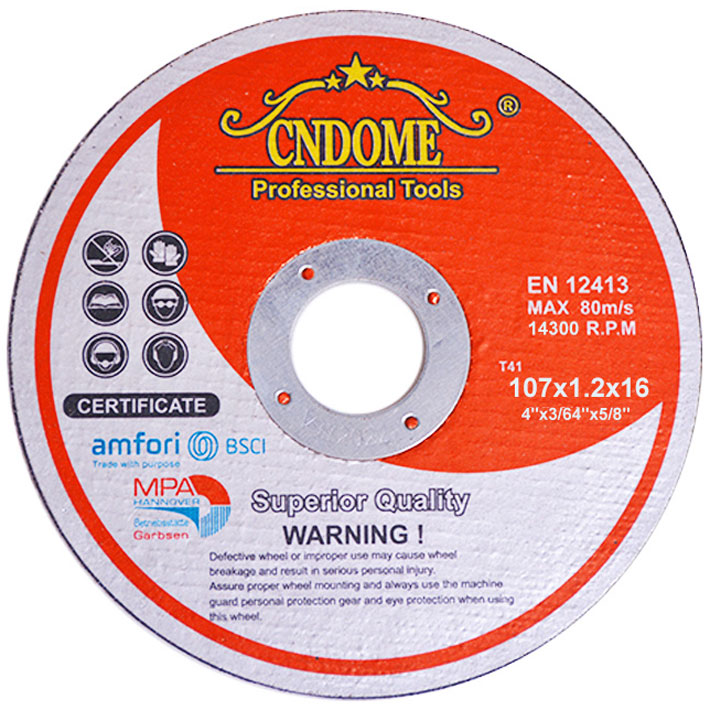
Angle Grinder Cutting Wheels
Our angle grinder cutting wheels handle extreme RPMs (11,000+) with reinforced centers to resist twisting forces during freehand operation. For thin sheet or general maintenance, our cutting disc for angle grinder (cut off wheel for angle grinder) deliver cool, clean cuts in a thin profile—minimizing operator fatigue and burr formation.
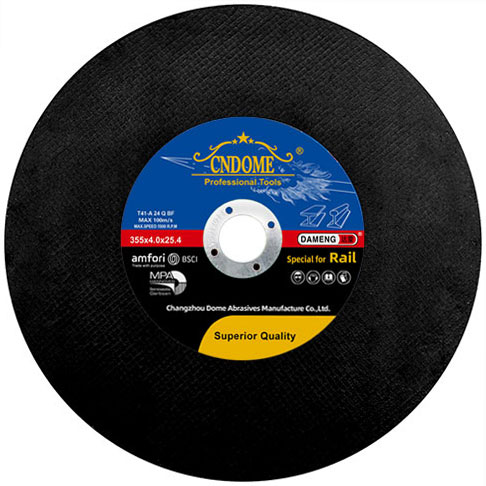
Chop Saw Cutting Wheel
Fixed pivot-arm saws generate sudden downward strokes and high starting torque. Our chop saw cutting wheels feature extra fiberglass reinforcement to absorb impact, while the chop saw cutting disc ( chop saw cut off wheel) maintain straight kerfs under heavy feed. These run at lower speeds but use a thicker bond to retain structural integrity throughout each cut.
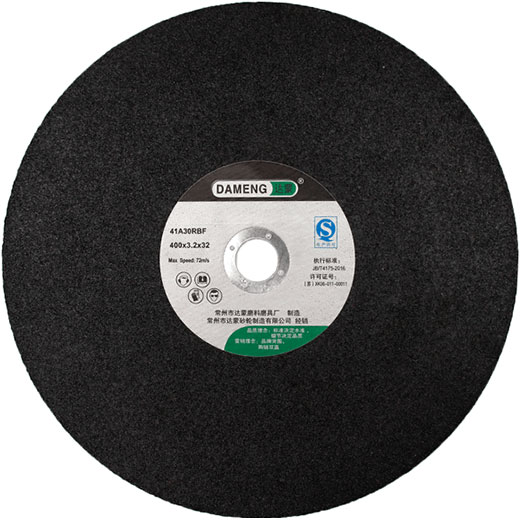
Stationary Machine Wheel
For automated or semi-automated industrial systems, our stationary cutting wheels prioritize dimensional stability over long shifts. Coarser grit blends ensure free-cutting action, while our industrial cutting wheel bonds are compatible with coolant systems to prevent edge hardening on large billets and structural beams.
Cutting Wheels by Abrasive Grain
The abrasive mineral determines how a disc interacts with heat, pressure, and workpiece chemistry. Selecting the wrong grain leads to glazing, premature dulling, or thermal damage to your base material. Below, we break down four key abrasive families based on their fracture behavior and ideal substrate match.
Aluminum Oxide Cutting Wheels
Our aluminum oxide cutting wheel strikes an optimal balance between hardness and toughness, making it the default choice for general carbon steel and low-alloy fabrication. When subjected to cutting pressure, this mineral fractures at a controlled rate to expose fresh, sharp edges. The aluminum oxide cutting disc performs reliably across standard structural shapes, while the aluminum oxide abrasive wheel delivers excellent cost-per-cut value in high-volume maintenance tasks.
Zirconia Cutting Wheels
Unlike standard oxide, our zirconia cutting wheel exhibits a unique micro-fracturing mechanism that triggers specifically under elevated temperatures generated by heavy feeds. This self-sharpening action prevents glazing on tough alloys. The zirconia cutting disc excels at cutting stainless steel and thin-walled tubing, where heat buildup causes work-hardening. For demanding field work, the zirconia abrasive cutting wheel maintains aggressive cut rates even when intermittent side-loading occurs.
Silicon Carbide Cutting Wheels
Much harder but more brittle than oxide, our silicon carbide cutting wheel offers an aggressive “biting” action that easily severs soft, gummy materials without loading. The silicon carbide cutting disc is the go-to solution for aluminum, brass, and cast iron—where conventional oxides tend to dull rapidly. For masonry and asphalt applications, the silicon carbide abrasive wheel retains its edge against embedded aggregates, delivering fast, debris-resistant cutting on job sites.
Ceramic Cutting Wheels
Engineered with a sol-gel microcrystalline structure, our ceramic cutting wheel fractures at a microscopic level, continuously generating thousands of fine cutting points without shedding large abrasive chunks. This results in significantly cooler cuts. The ceramic cutting disc is purpose-built for hardened tool steels, high-nickel alloys, and heat-sensitive aerospace materials. When surface integrity matters most, the ceramic abrasive cutting wheel minimizes the heat-affected zone (HAZ) and prevents post-cut cracking.
Quick Abrasive Selection Summary
| Grain Type | Fracture Behavior | Best-Suited Materials |
|---|---|---|
| Aluminum Oxide | Controlled, blocky fracture | Carbon steel, structural beams |
| Zirconia | Heat-activated micro-fracture | Stainless steel, pipes, heavy stock |
| Silicon Carbide | Sharp, brittle fracture | Aluminum, brass, cast iron, concrete |
| Ceramic | Microscopic, continuous self-sharpening | Hardened steel, superalloys, titanium |
Cutting Wheels by Application
In the fields of metalworking and construction, selecting the wrong cutting disc not only leads to inefficiency but can also pose safety risks. Variations in base materials, equipment power, and operating environments necessitate matching the right consumables to each specific task. Drawing on decades of industry experience, we offer professional cutting disc solutions tailored to six key areas.

Metal Fabrication & Structural Steel Cutting
Heavy fabrication and structural steel work involve frequent cutting of high‑strength carbon steel, angle iron, and medium‑thickness plates. In these environments, impact resistance and material removal rate are the top priorities.
Our Recommendation:
We supply metal fabrication cutting wheels engineered for heavy‑duty loads, with reinforced fiberglass mesh that significantly improves resistance to side‑loading. Whether you are doing high‑volume cut‑off work or precise trimming, our metal fabrication cutting discs maintain consistently low wear rates even during prolonged shifts. For tougher alloy steels, we recommend cutting discs for steel that contain special active fillers – they reduce heat generation and prevent workpiece discoloration. When working with stainless steel sheets, our steel cutting wheels deliver smooth, burr‑free edges, minimising secondary deburring operations.

Construction & Rebar Cutting
Construction sites are notoriously harsh – cutting concrete, asphalt, or rebar with hard surface contaminants demands discs with extreme abrasion resistance and toughness.
Our Recommendation:
Our construction cutting wheels feature a double‑reinforced design to withstand the bending stress and accidental impacts common on site. For rebar fabrication and tying, we have developed cutting discs for construction with a unique bond formulation that effectively “bites” through the mill scale on rebar, maintaining sharpness throughout the job. For rebar diameters above 25 mm, our cutting wheels for rebar incorporate optimised chip‑clearance grooves that drastically reduce pinching and stalling. These discs also perform excellently on hollow concrete blocks and lightweight masonry, making them a versatile all‑rounder for any job trailer.

Automotive Repair & Maintenance
The automotive repair environment involves cutting irregularly shaped parts – rusted chassis bolts, exhaust system pipes, or body panels. This scenario demands thinness and agility to minimise material waste and protect adjacent sensitive components.
Our Recommendation:
Designed specifically for body shop technicians, our automotive cutting wheels are available as thin as 1.0 mm, offering a “gentle but sharp” cutting action. Whether you are cutting hardened steel body frames or cast‑iron engine components, our automotive cutting discs deliver exceptionally fast cutting speeds. For quick repairs under the lift, our cutting discs for auto repair resist edge curling and maintain stable handling even in confined spaces, helping technicians reduce job time noticeably.

Pipe & Tube Cutting
Pipe cutting is most critical for avoiding deformation or heat‑affected zones, which directly impact subsequent weld quality. Whether it is thin‑wall stainless steel tubing or heavy‑wall oil‑transmission pipes, cut squareness and surface finish are non‑negotiable.
Our Recommendation:
We offer pipe cutting wheels with fine‑grit formulations that prevent phase changes due to overheating on thin‑wall tubes. For pressure‑bearing piping in the petrochemical industry, our pipe cutting discs demonstrate excellent straight‑line tracking. Specifically for stainless steel pipes, we recommend sulphur‑ and iron‑free cutting discs for steel pipe to eliminate any risk of corrosion initiation at the cut edge, providing a perfect bevel preparation for high‑standard welding.

Railway Maintenance & Rail Cutting
Rail cutting is one of the most demanding applications – it requires extremely fast cut‑off times (often counted in seconds) and uncompromising structural integrity under high‑speed friction.
Our Recommendation:
Designed for stress‑relief cuts on continuous welded rail and emergency repair of broken rails, our rail cutting wheels meet the strict safety requirements of EN 12413. Our rail cutting discs incorporate oversized, high‑strength fiberglass mesh to absorb the severe vibration generated during rail cutting. Even when cutting high‑manganese steel frogs, our railway cutting discs retain their self‑sharpening properties and resist “loading” from metal swarf – a trusted choice for permanent‑way maintenance crews in emergency track repairs.

Foundry & Casting Gate Removal
Foundry environments are filled with dust and extreme heat, and the workpieces are often irregularly shaped cast steel, ductile iron, and large risers. This calls for discs that combine aggressive cutting ability with exceptional durability to reduce downtime from frequent changes.
Our Recommendation:
Our foundry cutting wheels are purpose‑built for the high hardness of as‑cast structures, offering superior wear resistance. Our foundry cutting discs easily handle surface sand inclusions and flash on castings. For removing sprue and risers from large, complex castings, our casting cutting wheels provide outstanding radial stiffness, ensuring stable cuts even at heavy feed rates – dramatically improving the efficiency of the fettling and cleaning line.
How to Select the Best Specification for Your Needs?
Beyond the application, we recommend considering these three parameters for optimal performance:
- Machine Match – Verify your angle grinder or stationary cut‑off machine power (kW) and maximum RPM.
- Material Hardness – Choose silicon carbide for cast iron, aluminium oxide for steel, and specialised mixed abrasives for stainless steel.
- Thickness Strategy – Go thin (1.0–1.6 mm) for speed and productivity, or thick (2.5 mm+) for longer life and higher impact resistance.
Contact Us for Sample Testing
If you are unsure which product best fits your production requirements, please submit your operating parameters. Our engineering team will provide free, tailored consumable recommendations to help you find the perfect match.
T41 vs T42 Cutting Wheels
The difference between T41 and T42 lies in the cutting wheel’s cross-sectional shape. This determines how it mounts to your machine, the maximum cutting depth you can achieve, and, most critically, the angle at which you can safely feed the cutting disc into the workpiece. Selecting the wrong type for your tool setup compromises both performance and operator safety.
T41 / Type 1 Cutting Wheels
The T41 cutting disc features a completely flat profile with no raised center—classified internationally as a Type 1 cutting wheel. This flat design allows a flat cutting wheel to utilize its full radius for the deepest possible straight-line cut, making it the standard choice for stationary chop saws and fixed-mount cut-off machines. A T41 cutting wheel requires full-face flange support on both sides, which suits high-torque industrial spindles. However, when used freehand, this geometry forces a steep 90° approach, leaving no guard clearance for angled feeding.
T42 / Type 27 Cutting Wheels
The T42 cutting disc incorporates a depressed, dish-shaped center that offsets the rim forward—known globally as a Type 27 cutting disc. This recessed hub allows a depressed center cutting wheel to operate at shallow angles (15°–30°) without the grinder’s guard or spindle contacting the workpiece. A T42 cutting wheel also provides a natural “crush zone” that absorbs side-loading, significantly reducing kickback risk if the disc binds. This geometry is the universal standard for angle grinder applications, offering superior visibility and operator safety.
Which One Should You Choose?
- Choose T41 / Type 1 (Flat Cutting Wheel): For fixed chop saws, automatic cutting lines, or any setup where the disc mounts between two rigid flanges. Prioritize this when you need absolute maximum depth penetration on solid bars and thick structural sections.
- Choose T42 / Type 27 (Depressed Center Cutting Wheel): For all hand-held angle grinder work—from 4.5″ to 9″ diameters. Select this whenever you need to cut flush against surfaces, work in tight spaces, or maintain a safe, controlled approach angle with optimal guard clearance.
Cutting Wheels Specifications
| Parameter | Description | Common Values |
|---|---|---|
| Diameter | Outer diameter – must match your tool’s guard size | 76mm, 100mm, 115mm, 125mm, 180mm, 230mm, 355mm, 405mm |
| Thickness | Determines cutting speed vs durability – thinner = faster, thicker = longer lasting | 1.0mm, 1.2mm, 1.6mm, 2.0mm, 2.5mm, 3.0mm, 4.0mm |
| Bore Size (Arbor) | Center hole diameter – must match your tool’s spindle | 16mm, 22.23mm (7/8″), 25.4mm, 32mm |
| Maximum RPM | Maximum safe operating speed – never exceed | 105mm: 15,200 / 125mm: 13,300 / 125mm: 12,200 / 180mm: 8,500 / 230mm: 6,600 / 355mm: 4,400 |
| Maximum Speed | Peripheral speed – standard for resin‑bonded discs | 80m/s |
| Abrasive Grain | Determines what material the disc can cut effectively | Aluminum Oxide (steel), Zirconia Alumina (stainless), Silicon Carbide (stone) |
| Bond Type | Holds abrasive grains together – controls self‑sharpening | Resin Bonded (Phenolic) |
| Reinforcement | Prevents shattering at high RPM | Multi‑layer Fiberglass Mesh |
| Grit Size | Coarse = faster cut, rougher finish; Fine = slower cut, smoother finish | Coarse (16–24#), Medium (30–46#), Fine (60–80#) |
| Shape | Profile type for different applications | T41 (Flat), T42 (Depressed Center) |
| Certification | Safety standard compliance | EN12413, MPA |
Thickness Selection Guide:
- 1.0–1.2mm (Ultra Thin) – Fastest cutting, lowest heat, minimal burrs. Ideal for sheet metal (≤3mm) and thin‑wall tubes.
- 1.6mm (Standard) – Best balance of speed and durability. Covers 80% of daily cutting tasks – plates (3–8mm), pipes, and profiles.
- 2.5–3.0mm (Heavy Duty) – Greater rigidity and impact resistance. For thick plates (≥8mm), solid bars, and heavy structural sections.
- 3.0–4.0mm (Large Diameter) – Maximum durability. For stationary chop saws – large beams, heavy‑wall pipes, and rails.
Grit Size Selection Guide:
- Coarse (16–24#) – Fast material removal, rough finish. Best for heavy cutting and thick sections.
- Medium (30–46#) – The most versatile range. Good cutting speed with acceptable finish – covers most general fabrication work.
- Fine (60–80#) – Slower cutting, smoother finish. Best for precision work and thin materials where surface quality matters.
EN12413 Safety Standard:
EN12413 is the mandatory European safety standard for bonded abrasive products. It requires that the actual burst speed of a cutting disc must be at least 1.5× the rated maximum RPM. All DOME discs are EN12413 certified, with MPA (German Materials Testing Institute) certification available for European markets. Every disc is 100% RPM tested individually before leaving the factory.
How to Choose a Cutting Wheel
Choosing the right cutting wheel can save time, reduce waste, and keep you safe. With so many options on the market, you only need to check three things: the material you cut, the thickness you need, and the machine you use. Let’s break it down.
1. Match the Cutting Wheel to Your Material
Different materials require different abrasive grains and bonds. Using the wrong cutting disc leads to poor performance, overheating, or even breakage.
- Carbon steel – Use a standard aluminum oxide cutting wheel. It cuts cleanly and resists wear on tough steel.
- Stainless steel – Choose a stainless steel cutting disc made with zirconia or ceramic grain. It cuts faster and generates less heat, preventing blue discoloration.
- Aluminum – Pick a cutting wheel for aluminum with a non‑loading additive. Soft aluminum tends to clog standard wheels, so this special type stays sharp and open.
- Stone – Use a silicon carbide cutting wheel designed for masonry. These handle abrasive, brittle materials without chipping.
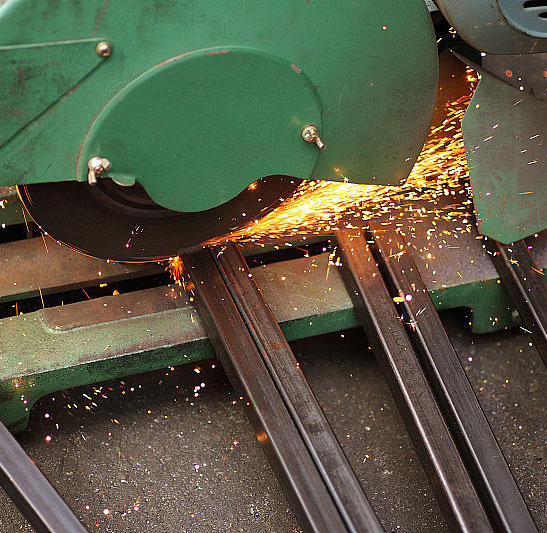
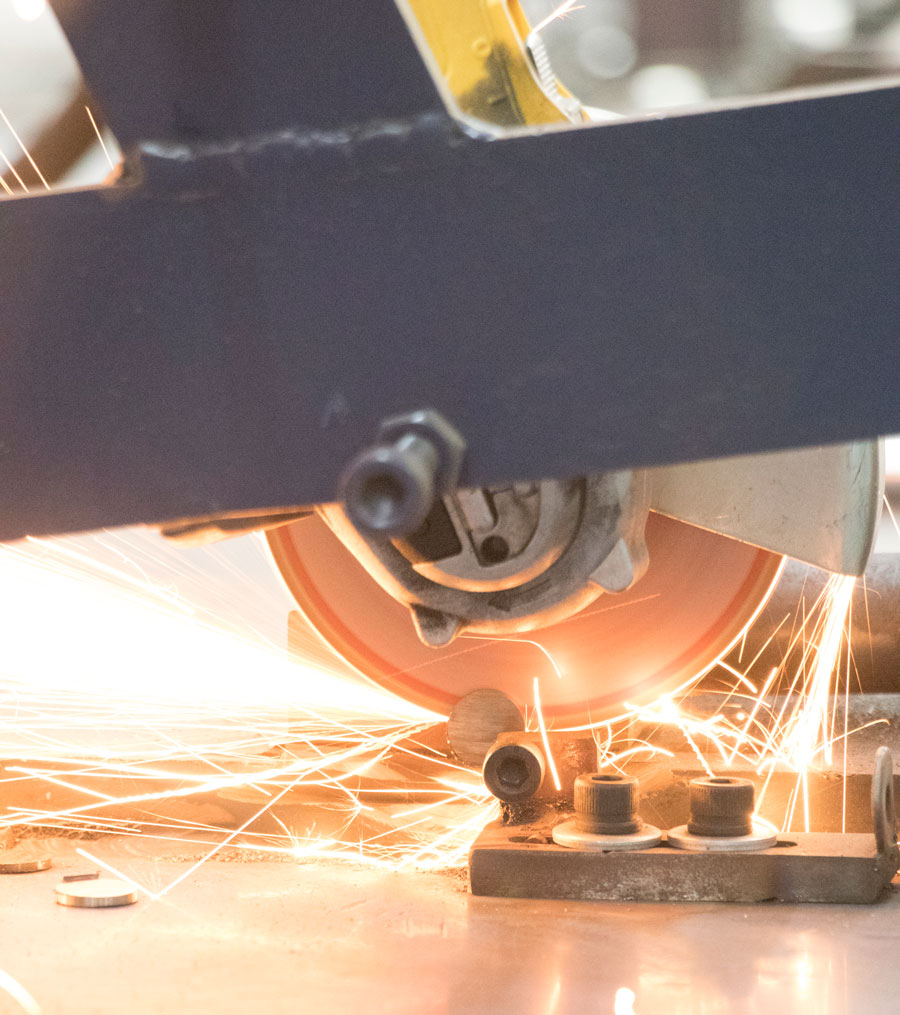
2. Choose the Right Thickness – Thin vs. Standard
Thickness affects cut speed, accuracy, and strength.
- Thin cutting disc (1.0 – 1.6 mm) – Ideal for fast, precise cuts with minimal material loss. They produce less dust, reduce sparking, and put less strain on your grinder. Perfect for sheet metal, pipes, and thin profiles.
- Standard cutting disc (2.0 – 3.0 mm) – Heavier and more durable. Use them for thicker sections, structural steel, or when you need extra side stability. They last longer but remove more material per cut.
Simple rule: Use a thin cutting disc for speed and finish; use a standard cutting disc for strength and heavy‑duty work.
3. Consider Your Application – Angle Grinder or Stationary Machine?
Your cutting tool determines the disc’s arbor size, maximum RPM, and overall design.
- Angle grinder – This is the most common machine. Most cutting wheels for angle grinders come in popular sizes like 115mm, 125mm, or 230mm (9 inch). Always check the RPM rating on the disc matches your grinder’s speed. For handheld use, thin cutting discs are especially popular because they reduce vibration and fatigue.
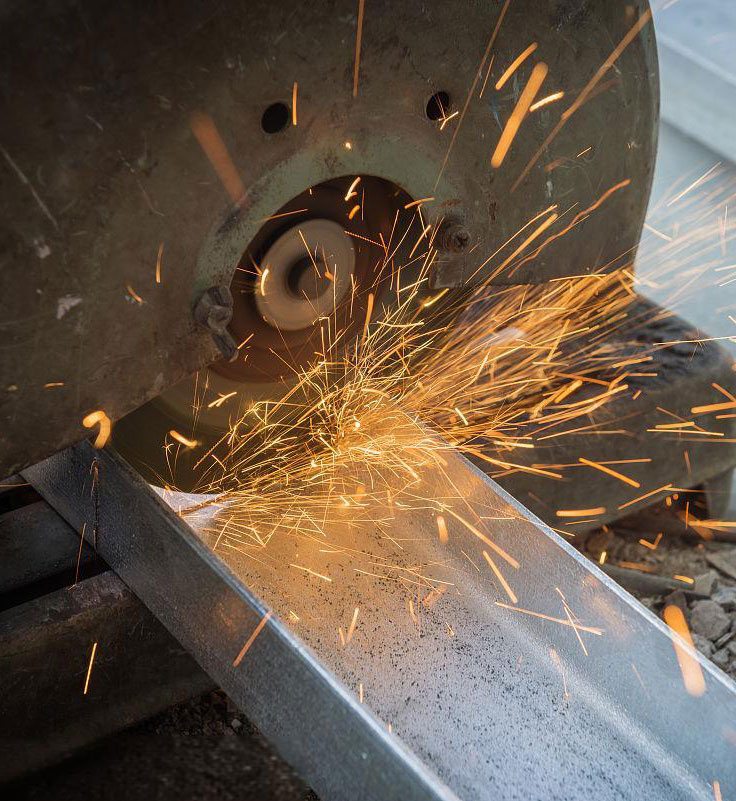
- Stationary machine (e.g., chop saw, cut‑off saw) – These use larger cutting wheels (often 14 inches or more) with reinforced cores. They provide stable, straight cuts for repetitive production work. For these machines, standard cutting discs are more common due to the higher torque and continuous operation.
Cutting Wheel Comparison Guide
Choosing the right cutting disc depends on material, thickness, tool, and job requirements. The comparison table below helps you decide quickly.
| Type | Application | Key Advantage |
|---|---|---|
| 1mm Disc (Ultra‑Thin) | Sheet metal (≤3mm), thin‑wall tubes, precision cutting | Fast cutting, low heat, narrow kerf, minimal burrs – often no finishing needed |
| 3mm Disc (Thick) | Thick plates (≥15mm), solid bars, large structural sections | High durability, impact resistance, long life – ideal for stationary saw batch work |
| INOX Disc (Stainless) | 304/316 stainless steel sheets, pipes, profiles | Fe+S+Cl ≤0.1% pure formulation – no contamination, no rust, silver‑bright cuts |
| Metal Disc (General‑Purpose) | Carbon steel, structural steel, cast iron, and other ferrous metals | Cost‑effective, wide application range, fast cutting – brown fused alumina abrasive offers economy and durability |
Thin sheet → thin disc (fast), thick material → thick disc (durable), stainless → dedicated INOX disc (prevents contamination), carbon steel → general‑purpose disc (cost‑effective). Each of the four types has its own role – no single “universal” disc can replace the performance of a dedicated one. Choose the right disc, and you get efficiency, quality, and safety all at once.
OEM / Private Label Cutting Wheel Manufacturer
Are you looking for a reliable cutting wheel supplier? Dome Abrasive Manufacture provides one-stop OEM/ODM customization services from technical consultation, formula development, sample proofing to mass production. Dome Abrasive Manufacture is equipped with a technical team of 10+ technical R&D and quality control to ensure the performance, quality and standard compliance of the cutting wheels delivered to you.
Formula Customization
Adjust the abrasive type and bond strength to the material you’re cutting, giving you cutting discs with superior cutting speed, precision and durability. For example, the 4.5-inch cutting wheel achieves over 50% more cuts than comparable products.


Brand Customization
Cutting wheels support customization from performance to packaging. Allows you to flexibly adjust cutting wheel prices based on your target market. Dome Abrasive Manufacture has also customized angle grinder cutting wheels for many tool brands to accurately match the angle grinder.
Flexible Inventory
Dome Abrasive Manufacture supports small batch trial production and stepped orders. Help you reduce inventory pressure and speed up capital turnover.


Strict Quality Control
Dome Abrasive Manufacture’s strict quality inspection system ensures consistent performance of each batch of cutting wheels. Every batch of raw materials is subject to quality checks, and every semi-finished disc and finished disc is inspected. Dome Abrasive Manufacture is responsible for the quality of the cutting wheels delivered to you.
Cutting Wheels OEM Process
1. Requirement Gathering – Client shares target market, cutting materials, performance expectations, and annual volume. Factory assesses feasibility and recommends an initial solution.
2. Formula Development – Based on the cutting application (stainless steel / carbon steel / aluminum / stone) and performance requirements (cutting speed, service life, heat control), we adjust the abrasive type, bond hardness, and additive ratios. Formula freedom is the dividing line between a basic supplier and a true OEM partner.
3. Sample Testing – Client receives samples and performs actual cutting tests on their own equipment – verifying cutting speed, service life, cut quality, and safety. Production proceeds only after client approval.
4. Mass Production – Once the formula and specifications are confirmed, we move to full‑scale production. Every batch undergoes dimensional inspection, dynamic balance testing, and sample burst testing (EN12413 requires burst speed ≥ 1.5× rated RPM).
5. Packaging – Custom labels and cartons are designed according to client branding requirements. Each disc is individually wrapped to prevent moisture damage. Carton information includes specifications, quantity, batch number, and EN12413 certification marking.
6. Shipment – Orders are consolidated and shipped with a COA (Certificate of Analysis) including key test data – dimensional accuracy, balance, and burst test results. Standard lead time: approximately 35 days. Rush orders available upon request.
Factory Capability
DOME was established in 2001, specialising in the R&D and production of resin‑bonded cutting discs. Our core capabilities are summarised below.
Production Lines
- 60 fully automated production lines (automatic feeding, mesh placement, and packaging)
- Temperature‑ and humidity‑controlled workshops (15–25°C, 40–50% humidity)
- 30–40 hour rapid forming – from raw material to finished goods in under two days
Daily Capacity
- Daily output: 600,000 discs
- Annual capacity: 95 million discs
- Standard lead time: 35 days; as fast as 20 days with packaging materials ready
- Stable capacity throughout peak and off‑peak seasons – no supply disruptions
R&D Team
- 10+ technical R&D professionals
- Annual R&D investment: 8% of revenue
- 18 cumulative patents (including anti‑decay resin formulations, precision temperature control systems, and other core technologies)
- 26 years of formulation database and process parameter accumulation
Testing Equipment
- Dimensional accuracy inspection (each disc measured for outer diameter, thickness, and bore size)
- Hardness testing (bond retention verification)
- Dynamic balance testing (each disc individually checked)
- Burst testing (EN12413 standard: burst speed ≥ 1.5× rated maximum RPM)
- Cutting performance testing (actual machine trials)
- 100% RPM testing (each disc individually verified before leaving the factory)
Cutting Wheels Manufacturing Process
DOME’s resin‑bonded cutting discs are manufactured through a rigorous, standardised process. Every step, from raw materials to finished goods, is precisely controlled to ensure consistent performance and safety.
1. Raw Material Preparation – Everything starts at the source. We strictly select and prepare key raw materials according to the product formulation – abrasive grains, phenolic resin powder/liquid, fillers, and fiberglass mesh for reinforcement. All incoming materials pass through incoming inspection to ensure quality from the very beginning.
2. Mixing – Precisely weighed raw materials – abrasives, resin, fillers – are loaded into a mixer and thoroughly blended. This step is critical – it ensures every disc has consistent performance from the start.
3. Pressing – The mixed material is layered into a mould together with fiberglass mesh – which acts as the reinforcing skeleton. It is then pressed under 200–300 bar of pressure to form a “green disc” with precise thickness and diameter. For stainless steel cutting discs, a dedicated INOX formulation is used in this step.
4. Curing – The green disc has its shape, but is not yet strong enough. The discs are then placed into curing ovens and baked in a stepped temperature cycle at approximately 180–200°C. During this process, the resin undergoes cross‑linking, firmly bonding the abrasive grains together – giving the disc its final hardness and strength.
5. Quality Control – After curing, the discs undergo a series of stringent quality checks:
- Dimensional & Visual Inspection – checking for cracks, bubbles, or surface defects.
- Hardness & Balance Testing – verifying hardness and dynamic balance meet specifications.
- Strength & Performance Testing – including EN12413‑standard burst testing (burst speed ≥ 1.5× rated maximum RPM), and cutting performance tests under simulated working conditions.
6. Packaging – All discs that pass inspection are individually sealed to prevent moisture damage. They are then labelled with key information – including specifications and maximum RPM – and packed into cartons with complete traceability data, ready for shipment to customers worldwide.
Cutting Wheels Quality Certification
Dome Abrasive Manufacture’s cutting wheels have obtained certifications such as CE, MPA and BSCI, which is the best proof of the quality of the cutting discs. By working with Dome, you get not only cutting discs, but also market access guarantees for green trade.






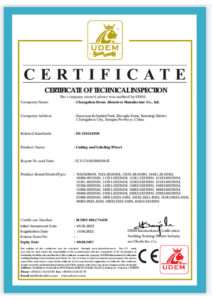
CE – Mandatory safety certification for products entering the EU market, confirming compliance with EU health, safety, and environmental requirements, and permitting legal sale within the European Economic Area.
MPA – Abrasive tool safety certification issued by the German National Materials Testing Institute, signifying that the product has passed independent testing in one of the world’s most stringent markets, meeting European market safety access requirements.
BSCI – European supply chain social responsibility audit, confirming that the factory meets international standards in labour rights, working conditions, and environmental protection, satisfying the procurement requirements of major retailers and brands.
EN12413 – Mandatory European safety standard for bonded abrasive products, requiring burst speed ≥ 1.5× rated maximum RPM, ensuring structural integrity and safe operation of cutting discs at high speeds.
ISO9001 – International quality management system standard, certifying that the company has full‑chain standardised quality control capabilities from raw material procurement to finished product dispatch, ensuring batch consistency and product traceability.
Cutting Wheels FAQ
1: What is the difference between a resin cutting disc and a diamond blade?
Resin cutting discs are used for cutting metal – abrasive grains perform micro‑cutting to separate the material. Diamond blades are used for cutting hard brittle materials like stone and concrete – the abrasive type and bond system are completely different. They are not interchangeable.
2: What is the difference between T41 and T42 cutting discs?
T41 (Type 1) is a flat disc with no recess – designed for 90° straight cutting. T42 (Type 27) has a depressed centre – the recess provides clearance for corner cutting and flush cutting, offering better cutting angles and visibility.
3: How do I know if I’ve chosen the right disc thickness?
Thin sheet (≤3mm) → 1.0mm ultra‑thin disc. Medium plate (3–15mm) → 1.6mm standard disc. Thick plate / solid bar (≥15mm) → 2.5–3.0mm heavy‑duty disc. The thicker the workpiece, the thicker the disc you need.
4: Can I use the same cutting disc for stainless steel and carbon steel?
Not recommended. A disc used on carbon steel picks up carbon steel particles. When used on stainless afterwards, these particles contaminate the surface – iron embedment leads to future rust. Stainless cutting discs should be dedicated to stainless only.
5: Why does my cutting disc wobble during use?
Possible causes: disc bore size doesn’t match the grinder spindle, the disc itself is out of balance, the grinder spindle is worn, or the flange nuts are not tightened properly. Test the disc on a balancing machine first to rule out disc issues, then check the tool.
6: Can I use a 115mm disc on a 125mm angle grinder?
No. 115mm discs go on 115mm grinders; 125mm discs go on 125mm grinders. Diameter mismatch creates improper guard clearance – a serious safety hazard.
7: Does a larger disc diameter mean deeper cuts?
Yes. Cut depth is roughly one‑third of the disc diameter: 115mm → ~35mm, 230mm → ~75mm, 355mm → ~120mm. But the diameter must match your tool – bigger is not always better.
8: Can I use a 355mm disc on a 230mm angle grinder?
Absolutely not. 355mm discs are designed exclusively for stationary chop saws. Mounting one on a hand‑held grinder is extremely dangerous – the disc won’t fit the guard properly, and if it shatters at high speed, the consequences are severe. Large‑diameter discs are never for hand‑held use.
9: Is there a relationship between disc thickness and bore size?
No – thickness and bore size are independent. Thickness determines cutting speed and durability; bore size determines whether the disc fits your tool. Check both: thickness for your material, bore for your tool spindle.
10: What is the minimum order quantity for OEM customisation?
MOQ varies based on the customisation scope. Standard sizes with packaging customisation have lower MOQs. Custom formulas, non‑standard sizes, or special colours have higher MOQs. Please provide your target specifications and annual volume – we’ll give you an accurate quote based on process complexity and tooling costs.
11. What is the lead time for custom cutting discs?
Standard lead time is approximately 30 days. With packaging materials ready, delivery can be as fast as 20 days. Formula development and certification support (e.g., MPA) may add 7–15 days of development time.
12. What customisation options are available for OEM cutting discs?
Specification customisation (diameter, thickness, bore size), abrasive formula customisation (abrasive type, bond hardness, grit size), colour customisation, label and carton branding, individual shrink‑wrap packaging, and more – full‑chain customisation from formula to packaging.
13. Can I get samples for testing?
Yes. DOME provides free samples for client testing and validation. Test cutting speed, service life, and cut quality on your own equipment – production proceeds only after your approval.
14. What does the maximum RPM on a cutting disc mean?
It is the maximum safe operating speed for the disc. Your angle grinder’s actual RPM must be lower than the disc’s rated maximum RPM. Exceeding the limit creates excessive centrifugal force – the disc can shatter and cause serious injury.
15. Why do cutting discs break?
Common causes: overspeed (most frequent), using expired or moisture‑damaged discs, improper mounting (loose flanges or bore mismatch), using a cutting disc for grinding or side loading, or pre‑existing cracks and defects in the disc.
Related Cutting & Grinding Products
Metal Cutting Disc
General-purpose metal cutting disc for everyday cutting of carbon steel, structural steel, and ordinary steel.
Suitable Materials: Carbon steel / Structural steel / Iron
Stainless Steel Cutting Disc
Engineered for stainless steel cutting with Fe+S+Cl≤0.1% pure formula, delivering silver-bright, burn-free cuts.
Suitable Materials: 304 / 316 / 430 stainless steel
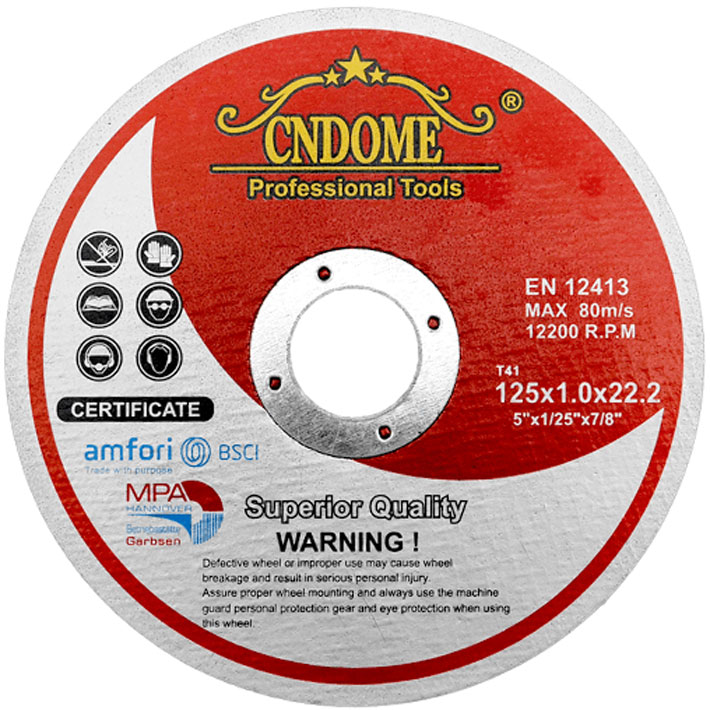
Ultra Thin Cutting Disc
Ultra-thin 1.0–1.6mm design for fast, low-heat, low-burr precision cutting of sheets and thin-wall tubes.
Suitable Materials: Stainless steel sheet / Carbon steel sheet / Thin-wall tube
Large Diameter Cutting Disc
355mm large-diameter disc for stationary saws, cutting through large structural steel sections and heavy-wall pipes in one pass.
Suitable Materials: H-beams / I-beams / Large-diameter pipes / Rails
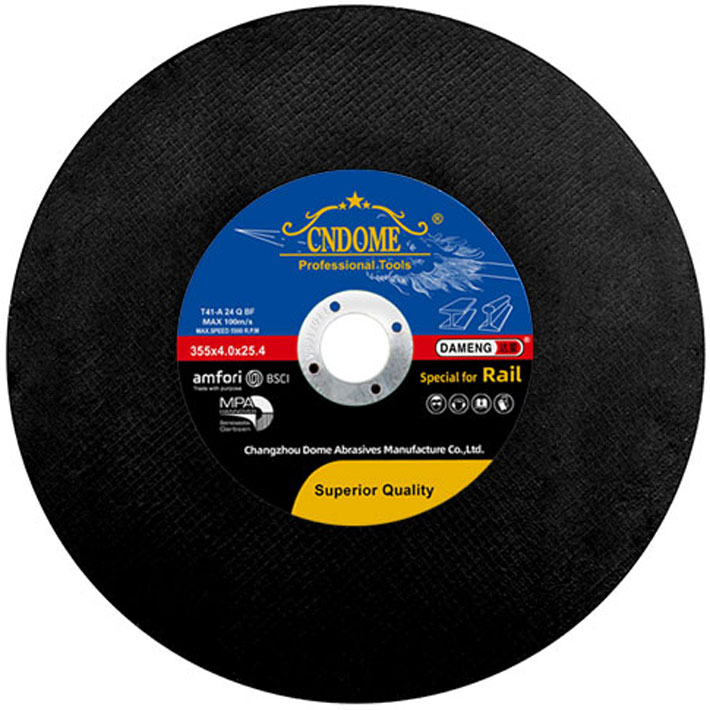
Rail Cutting Disc
Rail-specific disc with zirconia alumina and multi-layer fiberglass reinforcement, designed for heavy-duty high-hardness rail cutting.
Suitable Materials: U71Mn / U75V rails / Crane rails / High-manganese frogs
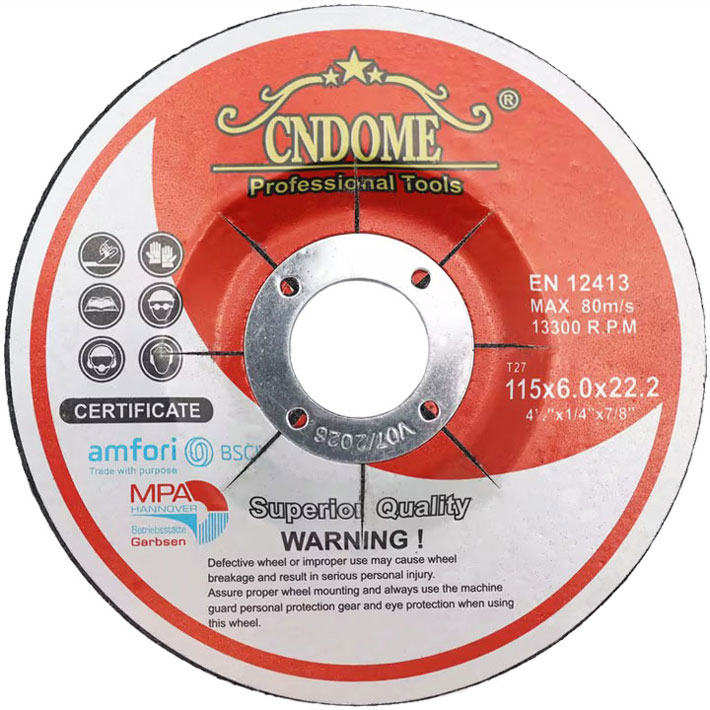
Grinding Wheel
Resin-bonded grinding wheel for surface grinding, weld dressing, and burr removal on all types of angle grinders.
Suitable Materials: Carbon steel / Stainless steel / Cast iron
Related Articles
Online Message
Dome Abrasive Manufacture provides 10 free samples for qualified projects for you to measure performance, experience quality, and verify specifications. If you’re ready to turn your vision into a reality, contact Dome Abrasive Manufacture today to discuss a project and pick up samples.
Get Quick
Response
Share your needs with us, We’ll contact you in very short time.
Zhenglu Garden Industrial Park, Tianning District, Changzhou City, Jiangsu Province
Please get in touch with any questions. Even if you don’t see what you want on our website we may be able to help.
Focus on Export Market
As a manufacturer mainly exporting OEM customized cutting wheels. Dome Abrasive Manufacture‘s cutting discs have been sold all over the world and have established long-term cooperative relationships with many tool brands. Dome Abrasive Manufacture’s cutting discs comply with the latest environmental regulations in the places where they are used. According to the market’s material preferences and process habits, Dome Abrasive Manufacture customizes the most suitable cutting disc solution for you.
Latin America

Mainstream Models:
115×1.0x22.2mm
115×3.0x22.2mm
115×6.0x22.2mm
180×1.6×22.2mm
230×2.0x22.2mm
355×3.0x25.4mm
Europe

Mainstream Models:
115×1.0x22.2mm
125×1.0x22.2mm
125×6.0x22.2mm
150×1.6×22.2mm
180×1.2×22.2mm
230×2.0x22.2mm
Africa

Mainstream Models:
115×1.0x22.2mm
180×6.0x22.2mm
230×2.0x22.2mm
Asia

Mainstream Models:
100×6.0x16mm
107×1.0x16mm
355×2.5×25.4mm
355×3.0x25.4mm
Cutting Wheel Video
You are invited to watch the video to learn about the production process of your OEM cutting wheels. This video not only shows Dome Abrasive Manufacture’s modern production workshop, but also proves Dome’s professional capabilities and quality control standards.