
-
May, Fri, 2026

Your cutting disc supplier shouldn’t just be someone who “takes orders”
You’ve definitely experienced this. You send out one inquiry and get twenty quotes in return. Prices are all over the place, the specifications all seem similar, and every company tells you, “Our quality is guaranteed.” When the goods arrive, the cuts are bluish, the burrs are frighteningly large, or the disc breaks apart as soon as it’s put into the machine. You only need to fall into these kinds of traps once, but they’re all too common in the market. So today, we’re not going to talk nonsense; we’ll go straight to the factory side and break down the things you really need to pay attention to when purchasing cutting discs, one by one.
What you’re buying is never “a cutting disc” but a cutting solution
Cutting discs are simple in theory: mix abrasive with resin binder, press out, add a mesh in the middle, and bake to harden, and you have a disc. But that’s also where its problem lies—they’re too similar, making you think that all manufacturers produce almost the same thing.
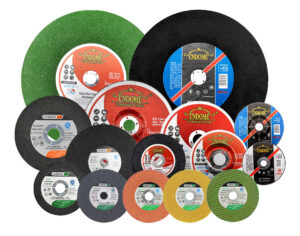
In reality, even with the same 41-type flatbed cutting disc, the requirements for the formula are completely different when cutting stainless steel versus ordinary carbon steel. Your user might use it to cut angle iron, hollow stainless steel pipes, or even aluminum, stone, or railroad tracks. The corresponding abrasive types, binder heat resistance ratings, filler heat dissipation capabilities, and hardness gradients are entirely different.
If the factory simply tells you “T41 105×1.2x16mm stainless steel cutting disc” without asking further questions such as “whether your customer is cutting thin-walled tubes or solid bars, and what the cutting speed is,” then you’re not far from another batch of customer complaints.
When we receive inquiries, we will definitely ask you these questions. Because we know very well that even if the specifications of the films sent to machine shops in Germany are exactly the same as those sent to hardware stores in Southeast Asia to sell to farmers, the formula logic inside must be redesigned.
The key is what the parameter table won’t tell you
You probably have a lot of parameter tables on hand. Dimensions, linear velocity, abrasive codes, and the number of bars on the graph. But what truly determines the user experience of the cutting disc lies outside of those tables.
The glass transition temperature of the binder directly determines whether the abrasive will detach prematurely at high temperatures. Early detachment results in a short lifespan for the abrasive, while late detachment leads to bluing of the cut surface or even burns to the workpiece. The reinforcing mesh, the number of layers, and the processing technology of the fiberglass itself determine whether it can withstand high speeds and whether it can meet the standard safety requirements, rather than simply having a label attached.
Another easily overlooked point is lateral bending resistance. It’s difficult for your user to always keep the blade perpendicular to the ground. If the angle grinder is slightly off-center, and the blade doesn’t have enough resilience, it will either chip at the edge or break completely.
That’s why we make rotational strength, lateral load capacity, cutting life, and cut quality mandatory internal control items for every batch of products. The data is properly archived, and you can access it anytime you want. This is how industrial products are made, not by thinking, “I think the quality is pretty good.”
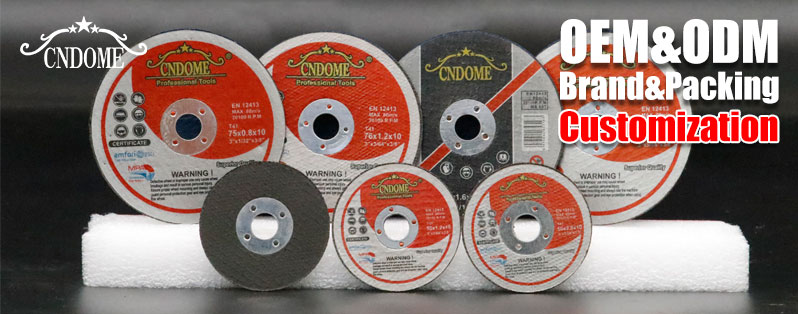
OEM/ODM: Changing the packaging is just the surface; changing the formula is what truly matters
I understand that as a brand owner or trading company, when you find a factory to manufacture your products, your most direct request is: print my logo, use my color scheme, and design according to my label. But this is only the first step in branding. If your chips are repackaged but their performance remains exactly the same as the generic products on the market, end users will switch brands after using them once.
A true ODM is not about simply sending you packaging documents and having us do it; it’s about working together to research the most commonly cut profiles in your market.
European users are very sensitive to dust, so we make some low-dust adjustments to the filling system; in North America, safety and compliance labeling requirements are so detailed that they include every punctuation mark, and we even take into account the ink fastness of the labels; in some Middle Eastern and South American markets, people are used to using angle grinders at full power without protective covers, so we have to upgrade the mesh reinforcement level.
These adjustments are absolutely impossible without our own abrasive processing and resin modification capabilities. Our formula library isn’t just copied; from cold-press density to hot-press curing curves, every single one can be redefined according to your brand positioning. This is the kind of competitive advantage your brand should have.
Certification is not just a piece of paper; it’s every step of the process
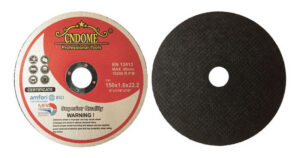
You’ve probably Googled “OSA certified cutting wheel factory” or “cutting disc manufacturer with EN12413.” Frankly, getting a certification isn’t unusual in this industry. But there’s a significant gap between a certificate and every single product conforming to the same standard.
We’ve hosted countless factory audits in Europe and North America, and we understand that what they want to see isn’t just photocopies of certificates on your wall, but whether the temperature and humidity in your mixing workshop are under control, whether the weighing accuracy of resin and abrasives is within 0.3%, and whether the vulcanization curves for each batch of materials deviate from the standard. Even in the packaging workshop, how workers check for printing position offsets—these are the details that make certification effective. When you place our manufactured cutting discs on the shelves of a German building materials supermarket, they’ve already undergone the same process control logic as top-tier brands.
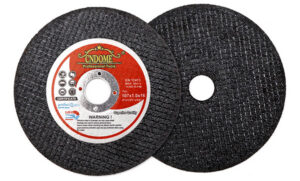
You may not care about the abrasive itself, but you need to know if your supplier has an “abrasive map”
This is no exaggeration. The abrasives used for cutting discs include brown fused alumina, white fused alumina, silicon carbide, zirconium fused alumina, and even ceramic fused alumina. The shape of the fragments, the content of magnetic materials, and the bulk density of each raw material are slightly different at the source, and the “temperament” of the disc when cutting will be completely changed.
We maintain direct cooperation with upstream mining sources year-round, and our key abrasives are sourced from specific regions and batches with identical physicochemical properties. This means that the products you order this year and the ones you reorder next year will have the same feel and quality. Large supermarkets’ biggest fear is customer complaints like, “This time it’s not as good as the last one,” and what we do is eliminate these complaints at their source.
Delivery time is not based on promises, but on safety stock and flexible production lines
In the past two years, raw material prices have fluctuated wildly, and you must have felt frustrated by “out of stock,” “price increases,” and “waiting.” Especially during supermarket promotional periods, or when your client suddenly requests an urgent order, if the factory falters, you lose market opportunities.
Our approach is to maintain a safety stock of several months’ worth of brown fused alumina, fiberglass mesh, and resin systems of major specifications year-round. Simultaneously, our production lines can quickly switch between small and large orders; if you order 5,000 pieces of 125mm ultra-thin sheets today, we can schedule them for the day after tomorrow. For large retailers, we also support annual price lock-in and phased delivery, so you don’t need to worry about the supply chain when planning Christmas or Father’s Day promotions.
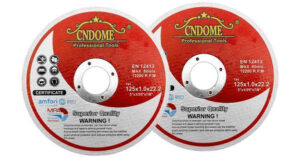
We can directly adopt the rules and regulations of large supermarkets
If you supply chain retailers like Home Depot, Leroy Merlin, or Kingfisher, you should be very familiar with terms like vendor manuals, social compliance audits, logistics labeling systems, GTIN coding, and perforated packaging. Many factories are completely bewildered when they hear these terms.
We have experience; we’ve worked with BSCI and ISO 14001. Our packaging lines can handle mixed-carton packing according to your assortment, with zero errors in outer carton markings. You don’t need to teach a factory “retail-ready packaging” from scratch; just send us your receiving standards, and we’ll handle the rest internally.
When you first start working together, you can try just a small step
When dealing with new suppliers, the biggest fear is having too high a minimum order quantity, resulting in an unsold first container. We understand this concern all too well. Therefore, our principle for new clients is: small trial orders are welcome.
We can even send you free samples first, so you can test them in your lab and at the end user’s location. Once you’re satisfied with the lifespan, cut, and feel, we can then sit down and discuss repeat orders. This trial approach allows you to validate the product without tying up your capital.
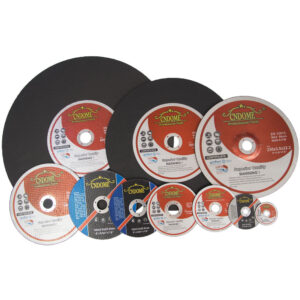
We’ve also fallen into traps alongside our clients before we learned how to avoid them
Here’s a short story. A North American client once wanted to market an ultra-thin cutting disc specifically for cutting thin-walled stainless steel tubes. They required a 30% longer lifespan than mainstream products and that the cut edge not change color. Our initial solution met the lifespan requirement, but it resulted in a slight bluing effect during cutting, which their end-users rejected. We went back and readjusted the abrasive formulation and the particle size distribution of a thermally conductive filler, producing four different samples. The final result not only met the non-bluing requirement but also significantly reduced cutting resistance. Now, this disc has become one of their brand’s most frequently repurchased SKUs, with annual purchases exceeding 2 million discs.
This isn’t about showing off; it’s just to let you know that when there are real technical challenges, we’re willing to work with you to the bitter end, instead of just shrugging our shoulders and saying, “That’s how the market works.”
What you lack is never a supplier; what you lack is a manufacturing partner who can work with you to see things through
The cutting disc category may seem to have no barriers to entry at first glance, but achieving differentiation and long-term stability presents numerous hurdles. What you really need is not just a factory that simply takes orders and produces, but a team that can help you clarify product positioning, ensure packaging compliance, match formulas, and guarantee delivery times.
Next time you have a stack of quotes piled up, consider reserving one slot for us. Let’s not talk about price right away; let’s discuss which market you’re targeting, or what issue your client has recently complained about. Who knows, a solution might be ready in just a few minutes.
FAQ
1. What are type 41 and type 42 cutting discs? How can you tell them apart at a glance?
These are the two most common types of flat cutting blades. Type 41 is a flat type with no recesses on either side; the center hole presses directly onto the flat surface, making it suitable for straight cuts. Type 42 is a type with a recessed center; there’s a recess in the hub area that allows the locking nut to sink in, making it suitable for low-angle cuts close to the workpiece surface, avoiding interference from the nut. You can instantly distinguish them by looking at the center area of the actual workpiece.
2. My cutting disc exploded shortly after I installed it. What could be the reason?
First, check if the linear speed is compatible. If the cutting disc is labeled “80m/s,” and your angle grinder’s no-load speed exceeds this value, it will inevitably explode. Second, check for moisture. The resin binder will soften after absorbing moisture and will crumble under high-speed centrifugal force. Additionally, rough handling, excessive lateral pressure, or the use of deformed flanges can also cause localized pressure-induced disc explosions. If your operation continues to result in disc explosions, contact your supplier to redesign the flange and mesh reinforcement.
3. Why do stainless steel pipes always turn bluish and have burrs when cut? How can this be resolved?
Bluing is a warning sign of overheating and burning in stainless steel. The root cause is insufficient self-sharpening of the cutting disc or it being too hard. The abrasive becomes dull but doesn’t detach, preventing the formation of new, sharper abrasives, resulting in dry grinding and rapid heat buildup. The solution is to switch to a specialized stainless steel cutting disc. These discs use sharper, special abrasives and a softer, better-dissipating binder, enabling cold cutting. If the cut still has many burrs, it indicates the abrasive grain size is too coarse or the binder is too soft, requiring fine-tuning of the formula.
4. Which should I stock up on: resin cutting discs or diamond cutting discs?
It depends on what you’re primarily cutting. Resin blades are used to cut metals, including carbon steel, stainless steel, and cast iron; they’re low-cost and offer flexible sizes. Diamond blades, on the other hand, are best suited for hard and brittle materials like stone, concrete, tiles, and cast iron pipes. They have an extremely long lifespan but are expensive and unsuitable for ordinary steel. If you deal with metal all day, high-quality resin blades are sufficient; for building materials and construction, diamond blades are more efficient. Note that you should never use diamond blades to cut ordinary steel, as this will cause rapid wear and damage to the diamond.
5. What is the shelf life of cutting discs? Can old discs in the warehouse still be used?
Resin-bonded cutting discs slowly absorb moisture, and the official recommended storage period is generally 3 years. They must be stored in a dry, freeze-thaw-free, and light-protected place. Cutting discs older than 3 years, even if they look fine, may have reduced rotational strength, and the factory strength safety factor may have been completely depleted. If you find expired cutting discs in your warehouse, don’t try to save money; discard them immediately. There is no room for complacency when it comes to safety.
6. If a cutting disc breaks into several pieces during use but doesn’t fly out and injure anyone, is that considered a quality issue?
Not necessarily, but it must be checked. If the fragments are uniform and without chipping, and your operation involved a stable feed angle and no pressure testing, then it’s likely not a quality issue, but rather that you used incompatible specifications or installed it improperly. However, if you find obvious delamination, dense pores, or exposed white mesh on the fracture surface, then there’s a problem with the curing process or the mesh impregnation, which is a factory defect. In such cases, we will request the returned fragments for cross-sectional metallographic analysis; we will never refuse.
7. Is it true that the harder the cutting disc, the more durable it is?
Completely incorrect. The hardness of a cutting disc refers to the binding force of the binder on the abrasive, not the hardness of the abrasive itself. If the cutting disc is too hard, the abrasive will become dull and won’t fall off, causing a sharp drop in cutting efficiency, rapid heat accumulation, and potentially leading to workpiece burns, disc chipping, or even disc breakage. A truly durable cutting disc must have a hardness precisely matched to your workpiece material and cutting speed—soft enough when it needs to be soft, and hard enough when it needs to be hard. If you’re unsure, send us a photo of your workpiece and its thickness, and we’ll help you determine the appropriate hardness range for the formula.
8. Why are ultra-thin cutting discs more expensive and more prone to breakage than regular discs?
Ultra-thin cutting discs have finer and more uniform abrasive grains, requiring extremely high precision in the flatness of the mesh and the resin impregnation process, resulting in inherently low production yields. They prioritize extremely narrow kerfs, minimal material loss, and minimal burrs, thus sacrificing some lateral bending resistance. When using ultra-thin cutting discs, you must ensure the angle grinder operates at a stable speed, the feed is perpendicular, and there is no wobbling; even a slight lateral tilt can cause breakage. This isn’t due to poor quality; it’s determined by the product’s characteristics. Using it as a thick disc will inevitably lead to misjudgment.
9. The inner diameter of the cutting disc is slightly larger than the shaft diameter of the angle grinder. Can it be used as is?
Absolutely not. The bore diameter must be precisely matched to the angle grinder spindle. Even a 0.5 mm difference will cause eccentricity after tightening, leading to loss of dynamic balance and violent vibration during operation. This can result in an uneven cutting surface or even the blade shattering completely. If you receive a cutting blade with a bore diameter that is too large, contact the factory for a replacement. Do not use any padding or make do; this is a red line issue.
10. Do all-purpose cutting discs on the market that claim to “cut everything with one slice” really exist?
Technically speaking, there is no cutting disc that can truly cut metal, stone, wood, and plastic simultaneously without sacrificing performance. So-called all-purpose cutting discs are usually compromises based on a mixed abrasive formula; they’re adequate for soft steel, may bluing stainless steel, and are less efficient than diamond discs for stone. Their value lies in emergency rescues or miscellaneous tasks; use them if you can accept the compromise in efficiency. However, if you prioritize professional efficiency and cut quality, you’ll need a dedicated cutting disc.
