
-
May, Sat, 2026

Don’t be fooled by “Top Cutting Wheel Manufacturers”: A OEM manufacturer selection guide
Many people who distribute tools or plan to OEM cutting discs start by searching “Top Cutting Wheel Manufacturers” on Google. Searching this line of text brings up a bunch of web pages with big slogans like “Top Ten Brands” and “Factory Direct Sales.” They look interesting, but after scrolling through a few pages, I’m even more hesitant to choose anything.
Having worked in the OEM cutting wheel manufacturing industry for so many years, I have a particularly deep feeling: the factories that can truly help you with your business are those that rely on solid abrasive formulas and have a low scrap rate in their workshops.
First, figure out what the real “Top Cutting Wheel Manufacturers” look like
In the cutting disc industry, “top-tier” and “large-scale” are not synonymous. Some factories can produce 200,000 general-purpose 4-inch economy cutting discs a day. But if you ask them to reduce the burr to below 0.1 millimeters, they probably can’t do it.
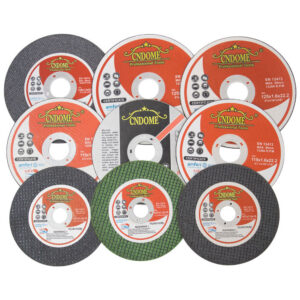
The truly top-tier manufacturers dedicate the vast majority of their production capacity to OEM manufacturing for overseas industrial brands. They may not have lavish showrooms, but they will definitely have a mixing laboratory that is always locked, filled with abrasive samples of different mesh sizes and processing methods. That’s their core competency.
So next time you refer to the “Top Cutting Wheel Manufacturers” list, you might as well ask yourself: Is he a giant in terms of production capacity or a master in terms of technology?
Formula freedom is the watershed moment for OEM customization
The core technology of custom cutting discs lies in the compatibility of the binder and abrasive. Small factories doing OEM often take a general resin formula, change the color, print a label, and ship the product. But if you want to cut a non-blueing, burr-free cut on 304 stainless steel pipe, the general formula simply cannot handle it.
A truly top-tier factory must possess “formula freedom”—to “mix” a cutting disc to be exclusively yours, based on the material of your cutting object, your working line speed, and your grinding habits. Whether it’s adding semi-brittle corundum to enhance self-sharpening properties, or adjusting the ratio of phenolic resin and fillers to control hardness, these adjustments require two or three decades of material expertise to make the final decision. At this point, what’s delivered to you is no longer a standard part, but a carrier of a cutting solution.
Security certification is not just a few pieces of paper stuck on the wall
For private label brands, EN12413 and MPA certifications are crucial. The biggest fear is that once the goods are sold in Europe, a single customer complaint could drag the entire brand down.
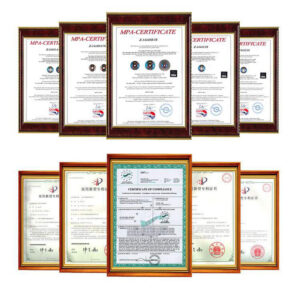
Factories truly rooted in the top tier have long since ingrained safety as a core part of their production lines. After semi-finished products emerge from the hardening furnace, each piece undergoes rotational strength testing; for cutting discs with a production line speed of 80m/s, our internal destructive testing continues at speeds exceeding 160m/s. That small ISO stamp signifies that the mixing, molding, and hardening of each batch of products are all within a rigorously monitored system.
In the production of cutting discs, especially high-speed products, any safety margins are entirely built on cost. Short-sighted factories are unwilling to invest, and this is precisely the hard lever that distinguishes “conducted factories” from “hobby factories.”
The investment in testing hardware directly reveals a manufacturer’s level of expertise
Besides certification documents, I strongly suggest you pay attention to the other party’s testing center. An established manufacturer that is committed to achieving the highest level of quality control will definitely be willing to invest in areas that are not readily visible.
The quality of a cutting disc cannot be determined simply by measuring its diameter and thickness with calipers. A dynamic balancing instrument, X-ray fluorescence spectrometer, angular load testing bench, and a robot testing station capable of simulating cutting under multiple working conditions—once these devices are on display, the true intentions become clear: is the manufacturer merely producing a certificate of conformity, or are they genuinely committed to ensuring the longevity of your brand?
Our factory has a habit of spending three days in our self-built lab creating an “extreme working condition test” using sample pieces before accepting any new brand order. The test data is then shared with the client. Only samples that withstand this rigorous data testing are printed with the client’s logo.
The essence of OEM services is to “prevent problems for you in advance”
Whether an OEM manufacturer can be considered top-tier depends on its ability to participate in your market analysis.
Here’s a small anecdote: A couple of years ago, a Southeast Asian client came to discuss a custom order. The local welders had rather rough working habits, and the humidity in the port city was consistently high. After analyzing his usage scenario, instead of directly offering a conventional mixed material, we developed a new, more resilient, and moisture-proof reinforced cutting disc. The material cost increased by 8%, but after the disc arrived at the port, the distributor’s customer complaint rate dropped by 70%. The client only ordered 200,000 discs in the first year to test the waters, but the second year’s repeat orders steadily increased to 2 million discs.
This deep involvement essentially means preemptively mitigating market risks in your cutting disc formulation and process. This is the most down-to-earth embodiment of the word “Top”—it’s not just about shipping the goods and calling it a day; it’s about you being at the forefront of the market, and me providing you with everything you need, from the tools to the roadmap.
Here are a few self-check checklists; you can’t go wrong by following them
If you search for “Top Cutting Wheel Manufacturers” again and have a bunch of shortlisted companies, try this quick screening method:
- Check if the certification is owned by the factory and is valid. Have someone send you a photo of the original certificate so you can verify it on the official website of organizations like MPA. If there’s anything suspicious, return it here.
- When asked about materials, simply mentioning “white fused alumina” or “brown fused alumina” is too vague. A company that can explain in detail, such as “for 316 stainless steel, we specifically use chemically coated semi-brittle fused alumina from a certain factory, and pre-mix it with a specific particle size distribution,” is someone you can discuss in more depth.
- Discuss delivery time and minimum order quantity. Reliable OEM manufacturers will reply: the first batch of mixed orders can start with 5000 pieces. The sampling period is 10 days, and regular repeat orders are stable at 30 to 35 days. They will never make unfounded promises of “7-day delivery”. Be wary of any promises of unbelievably fast delivery.
- Look at their environmental protection investment. Factories that handle waste gas treatment and dust collection meticulously, and whose operational records are readily available, are showing a commitment to long-term sustainability. Workshops that rely on “hiding” their environmental practices are hardly reliable in terms of product quality and stability.
Flexible manufacturing and green intelligent manufacturing will determine the partnership for the next decade
The international market, especially European buyers, is now tracing the carbon footprint of a cutting disc and the dust emissions from its production facilities. In the future, factories that have already implemented efficient waste gas treatment and closed-loop dust recycling will undoubtedly be among the top manufacturers.
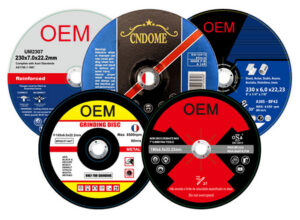
At the same time, the production line must be flexible enough—it can run a trial order of 2,000 pieces of a niche specification in the morning and switch back to large-scale regular production in the afternoon, with full traceability of batch data. This ability to respond flexibly is supported by a digital mixing system and dynamic adjustment of the hardening curve, which cannot be compensated for by simply “hiring more workers”.
Choosing an OEM partner is a long-term strategy that will ensure the future survival of your own brand.
Having written this far, let me give you a practical piece of advice
When you type “Top Cutting Wheel Manufacturers” into the search box, what you’re really looking for isn’t a place on a list, but a production support system that can reliably address your anxieties about efficiency, safety, and repeat purchases.
The next time you’re faced with a screen full of names, why not bring these measuring sticks and measure them one by one? Even if they’re halfway around the world, a phone call and a few words about the technical details will give you a pretty good idea of whether they’re truly confident or not.
If you happen to be looking for a cutting disc OEM factory that can go the extra mile for you on the formula sheet and keep your end-user reputation in mind after shipment, feel free to contact us anytime—we can start by discussing a sample and a detailed technical document.
FAQ
1. Are many top-tier cutting disc brands actually manufactured by the same OEM factory?
Yes, this is the norm in the industry. Many well-known European and American industrial brands choose to license their core formulas to top-tier contract manufacturers in order to balance cost and quality. These behind-the-scenes factories do not show their faces, but they possess the complete process code from mixing to hardening. The brands may use different names, but the cutting quality may come from the same production system.
2. How can we remotely verify a manufacturer’s quality control capabilities without visiting them in person?
Have the manufacturer demonstrate their rotational strength testing machine and dynamic balancing instrument directly during a video call. For a more in-depth look, request a cutting performance comparison report from a third-party organization. The more reputable the factory, the more welcoming this kind of transparent review; it’s the lowest-cost way to build trust.
3. How can I tell whether I’m contacting a direct manufacturer or a trading intermediary?
Ask directly if they can accept minor adjustments to the formula and request a screenshot of the temperature control curve of the running hardening oven. Intermediaries usually only answer with commercial terms and cannot engage in in-depth discussions about the coating ratio of semi-brittle corundum or the specific viscosity values of the binder. A few technical exchanges will immediately reveal whether they have their own production line.
4. In OEM manufacturing, how can we ensure the consistency of quality between the first batch and the tenth batch?
This relies on “front-end control” rather than “finished product sorting.” Top-tier factories re-inspect the particle size of upstream abrasives and have pre-mixing capabilities; simultaneously, the time-temperature-pressure curves for each batch of hardening are digitally stored, enabling traceability of individual pieces. Batch number management systems and rigorous destructive sampling inspections of finished products are the foundation for maintaining continuous repurchase.
5. What specific information do I need to provide to the manufacturer to customize a custom cutting disc?
The more specific the better: the material grade to be cut (e.g., 316L), cross-sectional shape (tube/rod/plate), whether pneumatic or power tools will be used, preferred linear speed (80m/s or 100m/s), and preferred lifespan or cutting speed. Ideally, a competitive benchmark sample that you deem suitable should be provided for the manufacturer’s materials lab to perform XRF fluorescence composition analysis and grinding benchmark testing.
6. How can you determine if a cutting disc manufacturer is capable of customizing “difficult-to-machine materials”?
The most direct way to judge is to ask them to provide actual cutting data and customer examples from their past work on high-temperature alloys, titanium alloys, and hardened steel. Capable manufacturers will ask for detailed material grades and operating parameters, rather than simply saying “no problem.” Further verification can involve requesting a targeted sample and quantitatively comparing the microstructure of the cut, the width of the heat-affected zone, and the burr height. Factories that have truly worked with difficult-to-machine materials will record the formulas and parameters used in each adjustment, creating an iterative “formula library,” rather than guessing from scratch each time.
7. How can I differentiate my OEM cutting discs to establish my brand in the market?
Differentiation doesn’t rely on price wars, but on incremental innovation. Several proven effective approaches include:
- Segmentation: Instead of making “one-size-fits-all” products, we focus on a specific vertical scenario and produce high-quality products, such as “shipbuilding grinding discs” or “auto repair burr-free cutting discs,” and make targeted formula adjustments to match the scenario.
- User experience: Adjusting the stiffness or elasticity of the blade provides users with better tactile feedback on specific tools, an improvement that users can immediately perceive upon first use.
- Packaging and anti-counterfeiting: Each cut piece is sprayed with a variable QR code to achieve “one-scan traceability”, which serves as both anti-counterfeiting and brand endorsement, and is especially advantageous in the mid-to-high-end market.
- Customized colors: It’s not just about printing logos, but about directly mixing the brand’s exclusive color binder layer. Users can immediately recognize which brand the film is from just by seeing the color, creating a strong visual memory.
8. When establishing long-term partnerships with top OEM factories, what else should be discussed besides price?
A long-term, stable OEM relationship is a two-way commitment. Several factors can solidify the depth of the partnership:
- Ownership of the formula file: Clarify who owns this unique formula and whether the formula data can be taken away if the supplier is changed in the future;
- Rolling safety stock: Discuss a material preparation framework that allows the factory to reserve a portion of semi-finished products for you year-round, compressing the replenishment cycle to the limit;
- New product co-development rhythm: Set an annual R&D calendar, and iterate 1-2 formulas at a fixed time each year based on feedback from the end market;
- Immediate customer complaint response mechanism: Clearly define the timeframe within which the factory’s technical team will intervene and analyze a customer complaint, rather than simply having sales representatives take the blame.
9. How can you tell a manufacturer’s technical capabilities from just one sample?
The “soft information” during the prototyping process is more telling than the sample itself:
- Do they ask you questions in return: A good engineer won’t just take the order directly, but will ask about your tool brand, the air pressure/voltage used, the operating method, and even the local climate (humidity affects the moisture absorption of the resin after curing).
- Whether to actively provide boundary conditions: They will tell you “the performance of this film will be compromised under lateral forces”, instead of confidently saying that the sample film is perfect.
- Sample identification labels: Is the batch number, hardness, and mixing date handwritten on the sample? Does the packaging box include self-inspection data for that batch? These details are signals from the factory’s internal quality control system to the end consumer.
- Follow-up point: Two weeks after sending out the sample, will they proactively ask about the actual test results and your feedback on usage? A conscientious factory treats sampling as the starting point of cooperation, while an unconscionable one treats it as a one-off transaction.
10. When testing a cutting disc sample, which indicators should be the focus of observation?
Don’t just look at “how many cuts were made”. It’s recommended to record several key quantitative indicators one by one:
- Cutting efficiency: Time taken for a single cut (in seconds), timed with a stopwatch;
- Cut quality: Check for burrs, discoloration, and chipping with a 10x magnifying glass;
- Self-sharpening: Whether the cutting process maintains a sharp feel and whether there is a dragging sensation of “becoming duller as you cut”;
- Wear ratio: The wear ratio of the sheet diameter to the amount of workpiece removed is the core parameter for calculating the overall cost;
- Explosion risk: Stability during continuous operation at high linear speeds, and whether debris is ejected during lateral pressurization.
Tests must be run under your own real-world operating conditions; do not make decisions based on data from the manufacturer’s ideal laboratory conditions. Furthermore, tests should be conducted over a longer period; relying solely on the data from the first five runs can easily lead to being misled by optimized “test results.”
