
-
Jun, Fri, 2026

Should you be holding a grinding wheel, a sanding belt, or a scouring pad? — The Ultimate Comparison Guide to Three Types of Abrasives
You stand in front of the tool cabinet in the workshop, holding a metal workpiece that needs processing. The weld seams are raised, the edges are sharp, and the surface has a slight oxide scale. Next to you are a resin grinding wheel, a roll of sanding belt, and several nylon scouring pads that look like dishwashing sponges. You know that all three can “grind,” but what are the differences between them? Which one is suitable for the process in front of you?
Choosing the wrong mold can lead to anything from time-consuming rework to complete failure. This is why you must understand the fundamental differences between Bonded, Coated, and Non-Woven molds. The following explanation will not favor any particular product type but will instead offer a clear, objective analysis from an engineer’s perspective.
I. The essence of the three types of abrasives: their structure determines what they can do
Let me start with a blunt truth: many people think that polishing is simply scraping metal with abrasive grains. That’s true, but how the abrasive grains are fixed, how they are stressed, and how they are positioned directly determines what kind of work they can do. The performance secrets of an abrasive tool are hidden in its three-dimensional structure.
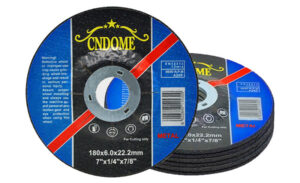
Bonded abrasives are what you’re most familiar with as “grinding wheels.” The abrasive grains are bonded together with a binder, like pouring concrete, forming a specific shape—disc, cylinder, cone, or even cup. The abrasive grains are distributed throughout the entire grinding body, in multiple layers from the outside in. When the surface abrasive grains become dull, break, or detach, the next layer of sharp new abrasive grains naturally emerges; this is called “self-sharpening.” Therefore, a qualified resin-bonded grinding wheel can maintain considerable cutting force from start to finish.
Coated abrasives operate on a different logic. The abrasive grains exist in a single layer, bonded tightly to a flexible backing such as paper, cloth, or polyester film using an adhesive. Sandpaper, abrasive belts, and abrasive discs are all members of this family. The layer of abrasive grains you receive is its entirety. Once the abrasive grains become dull or clogged with debris, the cutting force drops drastically; it must either be replaced or discarded. There is no second tier to replace it.
Non-Woven Abrasives take an open, three-dimensional approach. The abrasive particles are bonded within a loose, intertwined web of nylon fibers, creating a structure resembling a three-dimensional sponge—the fibers form the skeleton, and the abrasive grains are embedded at the nodes of this skeleton. This structure provides ample escape channels for debris and air, making it inherently resistant to clogging and allowing it to flexibly conform to the workpiece’s contours, but don’t expect it to handle heavy-duty tasks.
Three structures, three destinies. The nature of your mission should have led you to the right one from the very beginning.
II. Bonded Abrasives: When your primary goal is to “get rid of the material”
Let’s say your job today is to cut off a solid steel shaft, quickly flatten a protruding fillet weld, or remove burrs from cast iron. These scenarios have one thing in common: you need to remove a large amount of material quickly; shape accuracy and surface finish are secondary considerations.
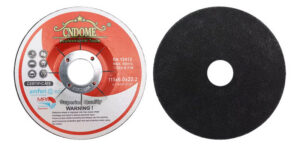
This is the domain of bonded abrasives. They can withstand extremely high linear speeds and feed pressures, making them the “heavy-duty force” of the grinding world. Resin-bonded grinding wheels excel here—they are more elastic than ceramic-bonded wheels, can absorb some impact, and are less prone to micro-fractures when grinding hard and brittle materials, offering an extra layer of protection for operators and equipment. Cutting discs, angle grinders, and grinding wheels are all familiar forms.
The advantages are obvious: fast cutting, durable, and suitable for large-area grinding of flat, cylindrical, or highly curved surfaces. The disadvantages are also clear: bonded abrasives are rigid or semi-rigid, making it nearly impossible to perfectly conform to a complex concave surface. Eccentric installation or improper angle control can easily cause vibration or even breakage, requiring a certain level of skill from the operator. Furthermore, while heat dissipation is not bad, prolonged pressure applied to the same area can still burn the metallographic structure.
In short: If you want to efficiently remove material and the workpiece shape allows for complete tool contact, pick up that resin grinding wheel first.
III. Coated Abrasives: Pursuing Curved Surfaces and Emphasizing Consistency
Now let’s change the scene. In front of you is a curved sheet metal part of a motorcycle fuel tank, or a streamlined armrest of a chair. You need to grind the weld seams flush with the base material without damaging the original lines, and finally prepare it for painting.
This is where coated abrasives excel. The flexible backing of sandpaper or belts can bend to fit complex contours, allowing the abrasive grains to slide and adhere to the workpiece surface. Modern coated products use electrostatic abrasive coating, with the abrasive grains neatly arranged and pointing outwards, resulting in extremely high cutting consistency. This is especially suitable for robotic automated grinding lines—where the machine relies on the predictability of each cut, rather than on manual feel.
However, the cost is also obvious: single-layer abrasive has a limited lifespan, especially when grinding soft metals such as aluminum alloys. The gaps between the abrasive grains are easily clogged by tough chips. Once clogged, grinding becomes “coating,” the workpiece surface turns black and heats up, and the abrasive tool is rendered unusable. Therefore, coated abrasive tools need to be replaced frequently, or equipment with coolant and chip removal systems should be used.
Another easily overlooked advantage is that coated abrasives can be made extremely fine. You can switch from 36 grit all the way to 400 grit, from coarse to fine grinding, all within the same family. This is a chain that neither nonwoven nor bonded abrasives can achieve alone.
If you’re looking for a seamless fit to curved surfaces, consistent surface scratch texture, and quick, continuous operation with interchangeable parts, choose Coating and have a good stock of replacements in advance.
IV. Nonwoven Abrasives: We are not responsible for measurement, only for the “appearance”
Is there a job where grinding depth is not allowed to exceed a few micrometers, but you must blunt sharp edges, clean off oxide stains, or create a uniform short striation on a metal surface? If you put a grinding wheel or belt on these jobs, you’ll instantly get overcuts, steps, and deep scratches.
This is where nonwoven abrasives come in. The three-dimensional elastic space formed by nylon fibers cushions the force you apply to the workpiece, allowing the abrasive grains to scrape away only extremely small high points. This brings two core advantages: first, it’s difficult to use it to “damage” the dimensional accuracy of the workpiece; second, because the fibers spring back, debris is almost never trapped inside the product, so it can handle materials that are particularly prone to clogging sandpaper, such as aluminum alloys, copper, and stainless steel, and can even be wet-ground with water or oil.
Its most classic applications include: burr removal after CNC machining, weld cleaning, roughening before painting, and brushing and matte finishing of stainless steel decorative parts. The uniform, delicate short-wire effect you see in high-end architectural hardware is mostly thanks to nylon wheels or nylon belts.
Of course, it can never replace the coarse grinding function of a grinding wheel. If you try to smooth a large weld seam with a nonwoven abrasive, you might spend your entire lunch break and end up with a weld seam that is still uneven but polished to a shine. That’s not the tool’s fault, it’s a poor choice.
V. Five-Dimensional Comparison: A Single Table to Solve Decision-Making Anxiety
To develop decision-making intuition within one minute, you only need to focus on five dimensions: material removal rate, surface finish, shape adaptability, anti-clogging capability, and overall cost of use.
Material removal rate: Bonded abrasives are much higher than coated abrasives, and coated abrasives are significantly higher than nonwoven abrasives. Large-mass polishing directly removes nonwoven materials.
Surface finish, under the premise of the same abrasive grit size: nonwovens, due to their elasticity and shallow cutting, can usually provide the most uniform decorative surface; coated abrasives, if properly matched, can achieve a very high precision surface finish; bonded abrasives, due to their deep cutting, are often only responsible for the rough shaping cut.
Shape adaptability: Both coated and nonwoven materials can handle curved surfaces, grooves, and chamfered edges; nonwoven materials can even be pressed into small pits for cleaning. Bonded abrasives are mostly only suitable for flat surfaces or regular arcs.
Anti-clogging ability: Nonwovens win without a doubt, followed by bonded abrasives that use wet conditions or have strong self-sharpening properties. Coated abrasives with single-layer abrasives are the most vulnerable to clogging, especially when dry grinding soft metals.
Total cost is an indicator that is easily misinterpreted. Looking only at the unit price, coated grinding wheels are the cheapest; however, when lifespan, replacement frequency, and downtime are factored in, the total cost of ownership for resin-bonded grinding wheels in heavy-duty continuous operation is often more favorable.
Nonwoven abrasives have a higher unit price, but are extremely durable in deburring processes and require less manual replacement time, so their overall cost may not be expensive—it depends on how you use them.
VI. Your role determines which part you should focus on
Now, I want to speak directly to you, regardless of your background. Because the people who find results from the same search term may be thinking completely different things.
If you’re a manufacturing process engineer drafting a standard operating procedure (SOP) document, you need to divide the grinding process into three sub-steps: “rough grinding—semi-finish grinding—surface treatment,” specifying the abrasive type, grit size, and equipment parameters for each step. Your core concerns are stability and repeatability. In this case, bonded abrasives handle rapid dimensional determination, coated abrasives handle the transition surface, and nonwovens handle the final treatment. This three-stage logic can be incorporated into most metalworking processes.
If you’re a workshop foreman or team leader, you’re dealing with production capacity, yield, and consumable consumption every day. You might be more concerned about: Are the grinding wheels wearing out too quickly? Is the sanding belt clogged as soon as it’s replaced? Then you definitely need to look at the comparison of lifespan and anti-clogging in Chapters 3 and 4. You might also need to review whether workers are wasting time repeatedly grinding with sandpaper at the deburring station where nonwoven fabrics should be used.
If you’re a repair technician, your workbench’s casters swivel, and you go wherever there’s a problem. The workpieces you face are incredibly diverse, from rusted journals to chipped die edges. What you need is a portable “grinding combo”: a resin grinding wheel for heavy-duty cleaning, several coated abrasive discs for smoothing and shaping, and a few nylon scouring pads for deburring and cleaning mating surfaces. You don’t have time to agonize over details, so mastering this “three-step” method will allow you to far surpass your colleagues in the quality of your repairs.
If you’re new to the industry, still in technical school or as an apprentice, your mentor might just tell you, “Go and get the sandpaper, grinding wheel, and nylon sheets.” All you need to remember is: the grinding wheel removes excess material, the sandpaper smooths the surface, and the nylon sheets bring out the final texture. Apply this fundamental understanding to specific models, and you’ll progress much faster than your fellow apprentices.
If you’re a purchasing or supply chain manager, when faced with a supplier’s quotation, you can’t just look at the granularity numbers in the specifications; you need to understand the underlying structural type. Even within the same “80 mesh” grade, Bonded, Coated, and Non-Woven have completely different unit prices, lifespans, and production costs per unit time. It’s recommended that you compare and calculate the mold consumption cost per unit for one or two typical parts; this is the true competitive advantage of technical procurement.
VII. Advanced Usage: The three brothers work together, rather than being mutually exclusive
Basic thinking is “using one tool to the end,” while advanced thinking is a “relay race.” A highly skilled craftsman handles the circumferential weld of a stainless steel pipe as follows:
First, use a 60-grit resin abrasive wheel to quickly smooth the weld excess, keeping a close eye on the fusion line, being careful not to damage the base material. Second, switch to a P80 grade alumina abrasive belt or disc to further smooth the transition in the weld area, eliminating any small steps left by the abrasive wheel. Third, use a medium-hardness non-woven abrasive wheel to run along the pipe axis, unifying the color of the weld area and the base material area, and simultaneously removing all minor burrs.
Three minutes later, you’ll get not just a “polished” weld, but a weld that looks like it was manufactured from the same spot. This water-like surface consistency is the value of the correct combination of these three abrasives.
VIII. Common Misconceptions, Explained
“Using a harder grinding wheel will definitely increase grinding efficiency.” In reality, grinding wheels with excessively hard bonds cannot self-sharpen in time, and the dulled abrasive grains remain on the surface without falling off. You are simply rubbing, generating heat, and burning the workpiece, rather than cutting. Choosing the right hardness grade is often much more important than simply pursuing “harder”.
“A broken abrasive belt is not necessarily a quality issue.” Not necessarily. Breakage is often caused by a pulsed overload on the backing or a too-small bending radius. Checking your tension and the hardness of the contact wheel will likely solve the problem.
“Nylon wheels are too soft to grind anything.” They weren’t designed to “grind away” large amounts of material. If your subconscious still expects it to cut through metal shavings, then your needs are misplaced from the start.
Ⅸ. You are only one right choice away from the perfect surface
Ultimately, polishing isn’t about who has the most strength, but about who understands the dialogue between tools and workpiece. Bonded abrasives are your chisels for shaping the contours, coated abrasives are your brushstrokes for smooth transitions, and non-Woven abrasives are your polishing cloth for giving the final finish. There’s no superior method, only which one best suits your current needs.
The next time you stand in front of the tool cabinet or open the purchasing system to place an order, you won’t hesitate. Because you know: let the grinding wheel do its job, let the abrasive belt fulfill its mission, and let the nylon wheel handle its most proficient touch. The boundary between these three is now clear, and it’s perfectly in your hands.
FAQ
1. When grinding weld seam excess, should I choose a resin grinding wheel or a sanding belt?
This depends on the size and location of the weld, as well as your requirements for efficiency and surface consistency. If the weld is large with significant excess material, the primary goal is to remove a large amount of material quickly, in which case a resin-bonded abrasive wheel (bonded grinding wheel) should be the first choice. It can withstand high pressure and high linear speed, cutting extremely fast, and can be quickly smoothed with an angle grinder. If the weld is small and located on a complex curved surface (such as pipe fittings or oil tanks), and it is necessary to remove excess material without damaging the surrounding lines, then coated abrasives (sand belts or sand discs) are more suitable. Their flexible backing can conform to the curved surface, leaving a smooth transition surface and reducing accidental damage to the base material. In high-volume automated production lines, the two are often used in combination: roughing with a grinding wheel first, followed by finishing with sand belts.
2. What are the differences in performance between grinding wheels, belt abrasives, and nylon wheels when polishing stainless steel?
This is a typical material-sensitive issue. Stainless steel has poor thermal conductivity and a high tendency to work harden, resulting in drastically different responses to the three types of abrasives. Bonded abrasives (resin wheels) have strong cutting forces and can quickly penetrate the surface layer, but the correct hardness must be selected and a light feed must be used; otherwise, overheating can easily cause blue spots or burns, leading to a decrease in corrosion resistance. Coated abrasives (belts/discs) are very effective for handling the transitions of curved surfaces on stainless steel, but during dry grinding, a single layer of abrasive is easily clogged by the sticky chips from the stainless steel. It is recommended to use coolant or choose products with anti-clogging coatings. Nonwoven abrasives (nylon wheels) are almost irreplaceable in dealing with weld spots and cleaning oxide stains on stainless steel. They offer flexible cutting, do not clog chips, are not prone to overheating, and ultimately produce a uniform matte finish, making them the standard finishing option for food-grade and decorative stainless steel products.
3. Can nonwoven abrasives be used to replace grinding wheels for heavy-duty grinding?
Absolutely not. The design purpose of nonwoven abrasives is never to remove large amounts of material. Their three-dimensional fibrous structure allows the abrasive grains to elastically yield under stress, buffering a significant portion of the applied pressure. The abrasive grains can only scrape away a tiny amount of high points from the workpiece surface. Using them to grind a large weld seam would not only be extremely time-consuming but would also result in a polished but still uneven weld. Heavy-duty grinding (such as cleaning the root of castings or smoothing thick weld seams) must rely on the high cutting efficiency of bonded abrasives (grinding wheels). The proper applications of nonwoven abrasives are deburring, weld spatter cleaning, blunting sharp edges, and surface finishing.
4. What are the different selection strategies for carbon steel, stainless steel, aluminum, and titanium alloy abrasives?
This is a selection framework anchored by the workpiece material. The principle is: ferrous metals have strong versatility, while non-ferrous metals and high-temperature alloys require extra attention to prevent clogging and burns.
Titanium alloys: high strength, extremely poor thermal conductivity, and high chemical reactivity. Bonded abrasives must use silicon carbide or superhard abrasives and be fully cooled, otherwise burns and hydrogen embrittlement will occur; coated abrasives require ceramic abrasives and strong cooling; nonwoven abrasives can be used for light deburring and cleaning oxide stains, but should not be used for heavy cutting. Grinding titanium alloys should always prioritize cooling and use gentle cutting.
Carbon steel: the most forgiving. Bonded grinding wheels can remove large amounts of material at high speeds; coated abrasive belts are suitable for curved surface transitions; nonwoven wheels are responsible for finishing. Ordinary alumina abrasives are sufficient.
Stainless steel: poor thermal conductivity and easy work hardening. Bonded abrasives should be selected with a slightly softer hardness and a light feed to avoid burning; coated abrasives must be coated with an anti-clogging coating or wet grinding; nonwoven abrasives are anti-clogging and do not easily overheat, making them a perfect match for cleaning weld spatter and wire drawing, and are highly recommended for finishing processes.
Aluminum alloy: soft and sticky, it easily clogs the gaps between sand particles. Bonded abrasives require specialized grinding wheels with high porosity and low hardness, and are best used with a lubricant; coated abrasives will clog instantly when dry-grinding, usually requiring the use of a lubricant or being discarded altogether, and nonwoven abrasives should be used instead. Nonwoven abrasives, due to their open structure, are almost non-clogging, making them the first choice for deburring and brushing aluminum surfaces.
5. Why do coated abrasives dominate woodworking, while bonded abrasives hold a higher position in metalworking?
This is a result forced by the characteristics of the materials being processed. Wood is a fibrous material with low hardness and high heat sensitivity. When sanding, sanding belts or sandpaper with soft backing can “yield” to the wood grain and curved surfaces, avoiding excessively deep scratches. At the same time, the heat generated at high linear speeds is easily carried away by the dissipating wood dust, preventing the workpiece from being scorched. In contrast, the rigidity of bonded grinding wheels can cause overcutting and burning of wooden parts.
Metals, on the other hand, possess sufficient strength and hardness to withstand the high-pressure cutting of bonded abrasives. The self-sharpening property of multi-layered abrasives also allows the lifespan of a grinding wheel in continuous high-load metal removal to far exceed that of a single-layer abrasive belt. While belt grinding of metal is possible, it has a short lifespan and requires frequent replacement, making it more suitable for intermediate stages such as precise contouring and surface polishing. Therefore, you might see a woodworking shop with walls covered in sanding belts, and a metalworking shop with grinding wheel dust everywhere.
6. What does “self-sharpening” mean in bonded abrasives? Why is it important?
Self-sharpening refers to the characteristic of bonded abrasives during grinding, where the surface-passive abrasive grains break off or detach from the bond, exposing the underlying sharp new abrasive grains. This is like the abrasive tool self-renewing, requiring no downtime for maintenance. Self-sharpening is crucial for grinding efficiency and workpiece quality: if the bond is too hard, the passivated abrasive grains won’t detach, resulting in rubbing the workpiece and causing burns and chatter marks; if the bond is too soft, the abrasive grains will detach prematurely before sufficient cutting, leading to extremely rapid wheel wear. Selecting the appropriate hardness grade to ensure the grinding wheel can continuously “use one dull grain and release another” is key to achieving high removal rates and stable surface quality.
7. Is it necessary to use nonwoven abrasives to achieve a brushed or satin finish on a metal surface?
Yes, this is the most classic and almost irreplaceable application of nonwoven abrasives. Grinding wheels and belts are rigid or semi-rigid; the abrasive grains remove material by cutting, leaving sharp, directional scratches that cannot produce a uniform, delicate decorative texture. The three-dimensional fiber structure of nonwoven abrasives allows the abrasive grains to “suspend” on the workpiece surface. Combined with elastic yielding, it can evenly eliminate the peaks from the previous process through scraping and micro-polishing, generating extremely shallow, continuous, and consistent short brushed textures. Whether it’s architectural hardware, stainless steel railings, or electronic product casings, that delicate matte brushed feel is almost entirely achieved through the final “finishing” using nonwoven abrasive wheels or hand-rubbed blocks.
8. How do you choose the hardness of bonded abrasives? Is a harder abrasive necessarily more durable?
Absolutely not. Choosing the right hardness is an art of compromise, matching the machining task. Hardness refers to the bonding force of the binder on the abrasive grains, not the hardness of the abrasive grains themselves. If the hardness is too high, the passivated abrasive grains won’t detach, causing the grinding wheel to clog, slip, vibrate, or even burn the workpiece. If the hardness is too low, the grinding wheel will wear out too quickly and won’t maintain its shape. Correct selection should consider: for hard and brittle workpiece materials, choose a slightly softer grinding wheel to allow the abrasive grains to renew themselves promptly and maintain sharp cutting; for soft and sticky workpiece materials, choose a slightly harder grinding wheel to avoid premature abrasive grain detachment and waste. It’s also necessary to consider the contact area, grinding pressure, and other working conditions. Simply pursuing “harder” is the most common selection mistake.
9. What are the health hazards of dust generated during polishing? Is the dust generated by different polishing tools the same?
The hazards should not be underestimated. The dust consists of grinding debris, broken abrasive particles, and a small amount of binder particles. Different workpiece materials and grinding wheels pose different risks:
The “fibers” in nonwoven abrasives: short filaments of nylon fibers that have been worn away, which can increase respiratory irritation when mixed with dust.
Silica dust risk: When polishing stone, cast iron, or certain silicon-containing alloys, the dust may contain crystalline silica, which can cause silicosis if inhaled for a long time.
Metal dust: Stainless steel contains nickel and chromium, and its dust poses risks of allergies and cancer; aluminum alloy dust can explode when exposed to an open flame at a certain concentration in the air; titanium dust is also flammable. Abrasive particles from the grinding tools themselves may detach, and materials such as alumina and silicon carbide are of low toxicity, but protection is still necessary.
10. How do contact area and pressure affect the actual effect of selecting the hardness of bonded abrasives during grinding?
This is a dynamic matching concept. Hardness selection must take into account “the contact pressure you apply to the grinding wheel”. When using a handheld angle grinder to grind with a small contact area (such as cutting grooves on the edge of the grinding disc), the pressure is extremely high. In this case, a harder grinding wheel should be selected to prevent the abrasive from falling off prematurely due to excessive load.
Conversely, if you’re using a large cup-shaped grinding wheel to grind a wide, flat surface, the large contact area results in low unit pressure and dispersed cutting force on the abrasive, making it difficult for the abrasive to become dull and slip. In this case, you should choose a softer grinding wheel to ensure timely abrasive replacement and prevent slippage. Simply put: small contact area, high pressure → use a harder wheel; large contact area, low pressure → use a softer wheel. This is the wisdom of compensating for working conditions through wheel selection when you cannot change the tool.
