

-
Mar, Tue, 2026

The Complete Guide to Flexible Cutting discs: How to Choose, Safely Use, and One-Stop Solution for OEM Customization
Have you ever been helpless when cutting curved metal sheets or irregularly shaped workpieces because ordinary cutting discs are too hard and brittle? Or when facing thin stainless steel sheets, are you worried that the cutting disc will shatter and cause injury or that the cut surface will be too rough to handle?
If these problems are bothering you, then flexible cutting discs are the missing piece in your toolbox. As a factory owner with many years of experience in the abrasives and grinding tools industry, today I will give you a comprehensive understanding of this amazing tool that combines rigidity and flexibility, and tell you why our OEM customization service can help your brand stand out from the competition.
What is a flexible cutting disc? What makes it “flexible”?
When you first hear the term “flexible cutting disc,” you might wonder: aren’t harder cutting discs always better? How can a flexible one cut?
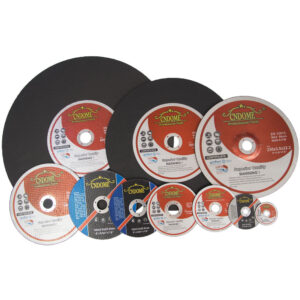
A flexible cutting disc is a thin grinding wheel made with a special resin binder and high-strength reinforcing mesh. Its “flexibility” doesn’t mean it can be bent at will like rubber, but rather that it has a certain degree of elasticity to accommodate lateral forces, while maintaining shape stability during high-speed rotation and resisting brittleness.
What makes it “flexible”?
- Double-Mesh Reinforced Structure: Our factory’s flexible cutting blades are reinforced with double or even multiple layers of fiberglass mesh. This is like adding steel reinforcement to concrete—the middle resin layer provides cutting force, while the fiber mesh on both sides provides tensile strength. This structure allows the blade to withstand enormous centrifugal forces and absorb lateral impacts during high-speed rotation (typically up to 12,000-15,000 RPM).
- Special Resin Formulation: Ordinary cutting blades use highly brittle phenolic resin, while flexible cutting blades incorporate toughening agents to give the binder a certain elastic modulus. When cutting thin-walled pipes or curved surfaces, the blade can slightly deform to adapt to the workpiece contour and then quickly spring back, unlike ordinary blades which shatter directly.
- Ultra-Thin Design: Most flexible cutting blades are between 0.8mm and 2.0mm thick. Thinness means narrower kerf, less material loss, and lower heat generation; thinness also means greater flexibility, easily cutting into narrow spaces.
Applicable scenarios:
- Cutting thin stainless steel sheets and galvanized sheets (burr-free cuts, no blackening)
- Cutting automotive sheet metal and body repair (requires cutting along curves)
- Cutting thin-walled pipes and profiles (to prevent pipe end deformation)
- DIY crafts and model making (requires precise control)

How do you choose the most suitable flexible cutting disc for your application?
Faced with a dazzling array of specifications on the market, you might feel overwhelmed. Don’t worry, mastering the following three core dimensions will allow you to easily make the right choice.
Size matching: First, check your angle grinder.
This is the most basic and also the most important step. The size of your angle grinder chuck directly determines what kind of slices you can use.
Dimension Interpretation: For example, in “115×1.2×22.2mm“, 115mm is the outer diameter, 1.2mm is the thickness, and 22.2mm is the bore diameter. You must ensure that the bore diameter is perfectly matched to the angle grinder spindle; using an adapter ring poses a significant safety hazard.
Abrasive material: Matching the material to the desired material.
Different materials require different cutting blades with different “teeth”.
- Brown Aluminum Oxide: Offers the best value for money, suitable for cutting ordinary carbon steel, iron pipes, and profiles. If you primarily do general steel structure processing, this is the most economical choice.
- White Aluminum Oxide: Slightly harder than brown aluminum, with a sharp cutting edge and good self-sharpening properties, suitable for cutting hard materials such as high-carbon steel and high-speed steel.
- Zirconia Alumina: A high-end abrasive with a microcrystalline structure that continuously breaks down during cutting to form new cutting edges, exhibiting excellent self-sharpening properties and a lifespan 3-5 times longer than brown aluminum. Suitable for cutting difficult-to-machine materials such as stainless steel and titanium alloys.
- Silicon Carbide: High in hardness but brittle, mainly used for cutting non-metallic materials such as stone, glass, and cast iron.
Advice for brand owners: When customizing products, you can choose the most suitable abrasive formula based on the main materials of your target customer group. If your customers are mainly stainless steel processing plants, we recommend the high-end series with a zirconium corundum formula. Although the cost is slightly higher, the user experience and repurchase rate will far exceed those of ordinary products.
Hardness and microstructure
The hardness of a grinding wheel refers to the binding force of the bonding agent on the abrasive grains.
- Soft (P-R grade): Abrasive grains detach quickly, suitable for cutting hard and brittle materials (such as cast iron), preventing workpiece burns.
- Medium-hard (R-T grade): Most versatile, suitable for cutting most metals.
- Hard (T grade and above): Abrasive grains hold firmly, suitable for cutting soft and tough materials (such as copper and aluminum), preventing premature wear of the cutter.
Safety First – A Guide to the Correct Use of Flexible Cutting Discs
While flexible cutting discs are more forgiving than regular discs, they are still high-speed rotating consumables, and safety must always be the top priority. Both the Canadian Centre for Occupational Health and Safety (CCOHS) and the UK Construction Industry Training Board (CITB) emphasize that improper use can lead to serious injury.
Three checks before installation
- Check the expiration date: All resin grinding wheels have a shelf life, usually 3 years from the date of manufacture. Expired blades will become brittle and prone to cracking during use. You must check the product for a production date or expiration date label.
- Check the appearance: Before installation, carefully inspect the blade for cracks, missing corners, and warping due to moisture. A little tip: For blades larger than 100mm in diameter, you can hold them up with your finger and tap them lightly with a mallet; listen to the sound. A dull sound indicates possible internal cracks.
- Check the speed: Check that the maximum speed indicated on the blade is not lower than the rated speed of your angle grinder. This is a strict rule; exceeding the speed limit is absolutely prohibited.
Two “musts” during installation
- Power must be disconnected during installation: When changing blades, always unplug the angle grinder or remove the batteries. Accidental start-up is the leading cause of cuts.
- A dedicated pressure plate must be used: Ensure the flange (pressure plate) is clean, flat, and of the correct diameter. Tighten the nut by hand; overtightening may cause uneven pressure on the blade.
Four things to avoid during operation
- Don’t apply force immediately: After installing a new blade, let it idle in a safe area for at least one minute to observe whether the operation is smooth and whether there is any abnormal vibration. Let the blade “warm up.”
- Don’t apply sudden lateral pressure: Flexible blades allow for some lateral force, but you should keep the blade at approximately a 90-degree angle to the workpiece and use a cutting motion rather than “prying.” Excessive lateral force can still cause the blade to twist and break.
- Don’t remove the dust hood: Many workers remove the dust hood because they find it inconvenient, but this is extremely dangerous. Once the blade breaks, the flying fragments can reach speeds of hundreds of kilometers per hour; the hood is your last line of defense.
- Don’t cut in the direction of people: Adjust the position of the hood so that sparks and fragments fly away from yourself and others.
Why choose our factory’s OEM customization service?
If you are a tool brand owner, importer, or have your own hardware sales channels, you know this: selling generic goods will only keep you stuck in a price war. What truly makes your brand stand out on the shelf is differentiation.
Who are we?
We are a source factory specializing in the research and development and production of abrasives and grinding tools. We hold ISO9001 quality management system certification, our products comply with the European EN12413 safety standard, and have passed German MPA certification. From raw material formulation to finished product packaging, we have full supply chain control capabilities.
What can we do for you?
Brand OEM: Enhancing Your Brand’s Value
You only need to provide your brand concept and design requirements. We provide a one-stop solution, from formula development and finished product manufacturing to packaging design. Your logo will be printed on the product; we guarantee the quality, and you retain the brand value.
Customization: Meeting the Needs of Niche Markets
- For Special Materials: If your customers primarily cut aluminum alloys, we can optimize the formula to reduce chip adhesion and prevent the cut surface from melting.
- For Special Sizes: Can’t find non-standard hole diameters (e.g., 10mm, 20mm) on the market? We can customize the inner and outer diameters according to your requirements.
- For Special Thicknesses: Need ultra-thin 0.8mm for precision grooving, or thickened 2.5mm for heavy-duty cutting? We can adjust both.
Customized Packaging: Enhancing Product Value
In this “appearance economy,” packaging is the face of a product. We support:
- Blister cardboard packaging (suitable for supermarket shelf display)
- Color box sets (multiple pieces combined + connecting rods, increasing average order value)
- Industrial bulk packaging (100 pieces/box, suitable for bulk factory purchases)
Technical Support: Helping You Understand Your Products Better
We’ll provide you with detailed product technical information, safe usage guidelines, and even assistance in filming product demonstration videos. This will empower you not only to sell products but also to professionally answer end-user questions.
Our Advantages
Storage and maintenance of flexible cutting discs
Good products also require proper storage. Improper storage can significantly shorten the lifespan of slices and even pose safety hazards.
- Moisture Protection: The resin binder absorbs moisture from the air, leading to a decrease in strength. The storage environment must be kept dry, and the relative humidity should not be too high.
- Freezing and Heat Protection: Avoid extreme temperature changes. High temperatures accelerate resin aging, while low temperatures make the chips brittle. The ideal storage temperature is between 5℃ and 30℃.
- Impact Protection: The chips are brittle; handle them gently during transport and stacking to prevent breakage or impact. When stacking, they should be laid flat or upright as per the original packaging to avoid deformation under heavy pressure.
- First-In, First-Out (FIFO): Warehouse management follows the “first-in, first-out” principle, prioritizing the issuance of products with earlier production dates to avoid product expiration.
Find your personalized “flexible” solution
Flexible cutting discs, seemingly simple consumables, are actually the culmination of materials science, manufacturing processes, and safety standards. Every precise cut and every safe operation relies on the support of a high-quality cutting disc.
For end users, choosing the right cutting disc means choosing efficiency and safety.
For brands, choosing the right partner means choosing market competitiveness.
We don’t just sell cutting discs; we provide flexible cutting solutions. Whether you want to build your own cutting disc brand or need to solve specific cutting challenges, we welcome you to contact us with your needs.
Contact us now to customize a “flexible” solution tailored to your needs, enabling your brand to cut faster and go further in the cutting disc market.
