
-
Sep, Thu, 2026

How to Choose a Grinding Disc for 304 and 316 Stainless Steel
As the most widely produced grades of 300-series austenitic stainless steel, 304 and 316 are virtually indistinguishable in appearance and are widely accepted and used by consumers in everyday life. If you have already read our general guide on selecting stainless steel grinding discs, you likely already know that specialized discs are required for grinding stainless steel.
You might be thinking: it’s all stainless steel, so why not just use the same grinding disc? However, in actual practice, there are significant differences in the grinding performance of these two materials. During the grinding process, there are subtle differences regarding the tendency for work hardening, thermal sensitivity, and cutting pressure.
This article focuses on the differences between 304 and 316 stainless steel, helping you understand when to treat them differently and when they can be used interchangeably.
What is the difference between 304 and 316 stainless steel?
As the most widely used stainless steel, 304 has a chromium content of 18% to 20% and a nickel content of approximately 8%. This combination offers good corrosion resistance and formability, making it the most commonly used grade for kitchenware, food processing equipment, and architectural decoration. 316 stainless steel contains an additional 2% to 3% of molybdenum compared to 304 stainless steel. This molybdenum content makes 316 stainless steel significantly superior to 304 stainless steel in terms of resistance to chloride ion and salt spray corrosion. Therefore, 316 stainless steel is more commonly used in pharmaceutical equipment, chemical processing equipment, and seawater environments. However, when it comes to grinding, the addition of molybdenum makes machining 316 stainless steel more difficult.
Another difference that affects your grinding process is the tendency for work hardening. When subjected to friction or cutting, the surface hardness of austenitic stainless steel increases rapidly. Studies comparing the work-hardening behavior of 304 and 316 stainless steels have found that their yield strengths are similar in the annealed state. However, 304 stainless steel exhibits a more pronounced work-hardening effect than 316 stainless steel, and its tensile strength can exceed 700 MPa. What does this mean? If you apply excessive pressure to 304 stainless steel, the surface will rapidly work-harden, making subsequent grinding slow and causing heat buildup. Although 316 stainless steel has a slightly lower degree of work hardening, it possesses superior toughness and ductility; consequently, grinding chips adhere more readily to the abrasive grains, leading to clogging.
In short, you can achieve material penetration using moderate pressure when grinding 304 stainless steel, whereas 316 stainless steel requires greater cutting force to remove the same amount of material in the same amount of time. Both issues lead to the same conclusion: you must use grinding discs with higher abrasive sharpness and heat resistance.
Key Considerations for Selecting Abrasives for 304 and 316 Stainless Steel
Once you understand the differences in machining 304 and 316 stainless steel, you will have a clear basis for selecting the right abrasive.
If you are grinding only 304 stainless steel, zirconia abrasives offer the best cost-performance ratio. The self-sharpening properties of zirconia ensure consistent cutting performance under moderate pressure, making it suitable for weld grinding and general material removal. The abrasive also has a much longer lifespan than aluminum oxide. Although work hardening occurs with 304 stainless steel, zirconia can fully handle it when appropriate pressure and rotational speeds are used. However, take care to avoid continuing to grind forcefully with a dull grinding disc; replace it when necessary.
Grinding 316 stainless steel generates more heat and requires higher cutting forces. You need to prioritize the heat resistance of the abrasive. Ceramic abrasives are a particularly worthwhile choice, especially for 316-grade workpieces used in chemical or marine environments. Ceramic abrasives retain their sharpness under continuous pressure, offering fast cutting speeds and generating relatively less heat. Comparative data shows that the operating temperature of ceramic abrasives when grinding weld seams is approximately 30% lower than that of zirconia abrasives. This is a critical factor for 316 stainless steel; its toughness and tendency to become sticky make it more prone than 304 stainless steel to the adhesion of grinding chips to the abrasive grains—and once this adhesion occurs, the grinding process shifts to friction, causing a rapid rise in heat. Excessively high temperatures can cause the formation of chromium carbides on the surface of 316 stainless steel, damaging the passivation layer. The micro-fracturing characteristics of ceramic abrasives allow abrasive grains to continuously expose new cutting edges, effectively “shedding” adhered grinding debris.
If your grinding process involves both 304 and 316 stainless steel, the recommended approach is to use resin-bonded grinding discs with ceramic abrasives for rough grinding and weld removal, and zirconia discs for finishing and blending. This way, you do not need to stock these two materials separately, yet you can still ensure cutting efficiency and heat control during critical processing steps.
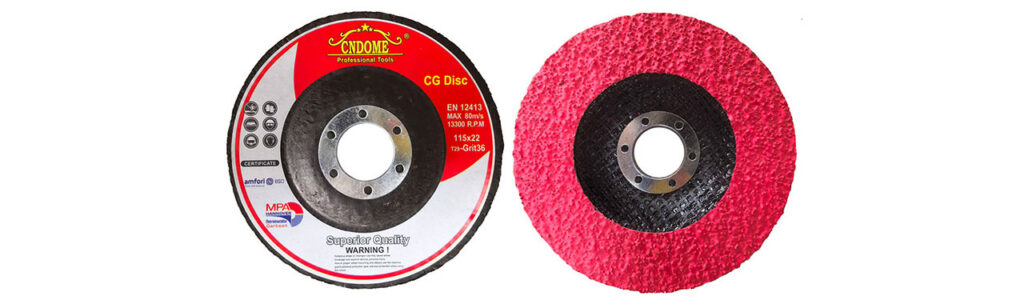
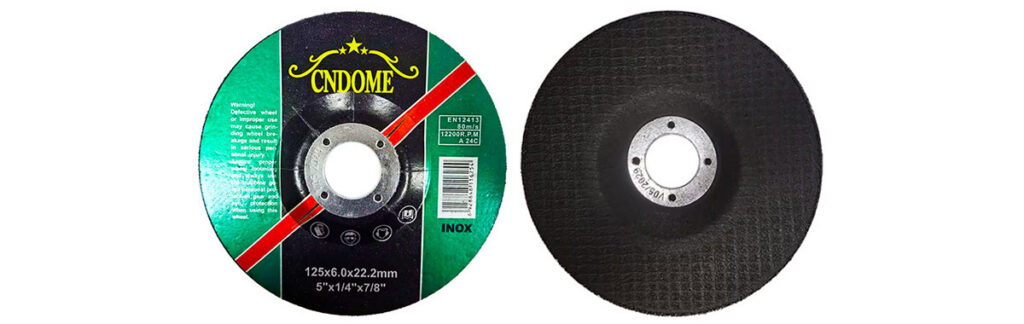
As an OEM/ODM manufacturer of resin-bonded grinding wheels, we possess proprietary technology for the formulation of stainless steel grinding discs. The focus is on two key aspects: first, strictly controlling iron, sulfur, and chlorine content to ensure compliance with INOX standards; and second, adjusting the bond hardness and porosity structure to enable the grinding disc to dissipate heat effectively while maintaining cutting efficiency. If you have specific requirements regarding model selection, we can provide recommendations on appropriate specifications based on your workpiece material and process conditions.
Performance Differences Between Resin Grinding Discs and Flap Discs on 304 and 316 Stainless Steel
Resin-bonded grinding discs are the primary tools for heavy-duty material removal (such as weld reinforcements, casting flash, and burrs on thick plates). For 304 stainless steel, the rigid structure of the 6mm INOX resin grinding disc allows you to apply significant pressure, enabling efficient operation when used at a working angle of 15° to 30°. These types of grinding discs typically feature a softer grade, allowing dulled abrasive grains to shed promptly under pressure and thereby preventing glazing. When working with 316 stainless steel, you need to pay attention to two things: first, select a coarse-grit abrasive—this results in a high cutting load, greater material removal per pass, and shorter contact time, thereby generating less heat; second, control the duration of each grinding pass by using a technique involving short strokes and multiple passes.
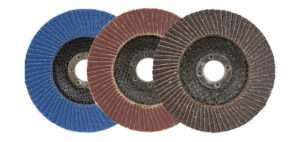
The layered abrasive cloth structure of flap discs offers advantages for weld blending and surface finishing on 304 and 316 stainless steel. As each sheet of abrasive cloth rotates, it continuously exposes fresh abrasive grains, ensuring consistent cutting performance from the very first second to the last. For grinding welds on 304 stainless steel, 60 to 80 grit zirconia alumina flap discs are the standard choice. For 316 stainless steel, if you choose a T29 flap disc with ceramic abrasive, a 60 grit grinding disc is capable of handling rough grinding. However, for finishing work, it is recommended to use a new 120 grit grinding disc.
In practice, a combination of methods is often used: resin grinding discs or coarse-grit flap discs for rough stock removal, followed by finer-grit flap discs for blending and finishing. The key is not to attempt to go from rough grinding to final finishing using a single abrasive disc—too large a jump in grit size will result in a loss of control over surface quality.
Recommendations for Particle Size and Pressure for 304 and 316 Stainless Steel
There is little difference between 304 and 316 stainless steel regarding the choice of grain size. Rough grinding: 24–60#; finishing: 80–120#; pre-polishing treatment: 150–240#. However, for 316 stainless steel, the method of applying pressure is more critical than the particle size.
304 stainless steel is more forgiving of pressure; if you apply a little extra force, the abrasive grains generally maintain their cutting action. 316 stainless steel is different; if you feel the grinding disc “slipping,” applying more pressure will only cause the surface temperature to rise sharply. The correct approach is to replace the disc or switch to a coarser grit, allowing sharp abrasive grains to cut into the material again. Observing the color of the sparks is a practical method for assessment: when grinding 304 stainless steel, the sparks appear pale yellow; if the sparks turn dark orange or even scatter with flying embers during the grinding of 316 stainless steel, it indicates that the pressure being applied is excessive.
Recommendations for Choosing Between 304 and 316 Stainless Steel Based on Application Scenarios
As a supplier of stainless steel grinding discs, we suggest you use the following guidelines to determine which product is right for your needs:

Food or pharmaceutical industry. If you are grinding 316 equipment in this industry, contamination control is the top priority. You must use certified INOX grinding discs (with iron, sulfur, and chlorine content controlled below 0.1%); ceramic abrasives are preferred, with a grit size starting at 80. After grinding, clean the surface and perform passivation. Rework costs in this industry are extremely high; do not take risks just to save money on grinding discs.
Shipbuilding or offshore engineering environments. When grinding 316 structural components in this industry, INOX grinding discs are still required, though requirements regarding surface finish can be somewhat relaxed. T29 zirconia flap discs with a grit size of 60 to 80 can meet most requirements for weld cleaning and blending.
Metal processing industry. When grinding 304 and 316 stainless steel in a metalworking shop, resin-bonded grinding discs with ceramic abrasives can be used for the rough grinding stage. For precision finishing, zirconia flap discs should be used. It is feasible to use the same specifications for both materials, but it is essential to ensure that the grinding discs are INOX-rated. Please note that grinding discs should not be used interchangeably between carbon steel and stainless steel; doing so contaminates the stainless steel, and the resulting losses far outweigh the cost of keeping a few extra discs on hand.
Installation or repair. If you are a welder performing on-site installation or repair work, an 80 grit T29 zirconia flap disc can handle most scenarios involving weld blending, surface preparation, and edge chamfering.
There are no grinding discs designated exclusively for “304” or “316” stainless steel; there are only choices based on proper matching.
In the hardware and tool market, it is rare to find manufacturers labeling grinding discs as “suitable only for 304” or “suitable only for 316” stainless steel. The reason is simple: their core requirements overlap—specifically regarding INOX formulations, cold-cutting capabilities, and appropriate grain size and morphology. 316 stainless steel has a stronger tendency toward work hardening, requiring stricter control over abrasive sharpness, pressure, and heat management, though it does not necessitate a completely different system of abrasive discs.
As a manufacturer of resin grinding wheels, we can supply products in all the specifications you need for stainless steel grinding. For example, T27 or T29 INOX resin grinding discs, and flap discs featuring zirconia and ceramic abrasives. Regarding model selection, you can simply provide details about the workpiece and operating conditions, and we will help you determine the appropriate abrasive and grit size; this is much faster than running repeated tests yourself.
