
-
Sep, Sat, 2026

What Is the Best Grinding Disc for Stainless Steel?
When selecting grinding discs for stainless steel, you need to focus on the compatibility between the material properties and the grinding discs. There is no “universal” grinding wheel on the hardware tool market suitable for all stainless steel working conditions. Unlike carbon steel, stainless steel is a material extremely sensitive to heat, with thermal conductivity only about one-third that of carbon steel. If the wrong grinding disc is selected, heat will concentrate in the grinding zone and fail to dissipate. Once high temperatures damage the protective anti-corrosion film on the stainless steel surface, thermal discoloration and rusting will occur in the ground areas.
This article will help you understand why stainless steel grinding requires specialized grinding discs and how to select the right grinding wheel for your specific working conditions.
Why do stainless steel applications require specialized grinding discs?
You might be thinking: isn’t a grinding disc just abrasive material plus a resin binder—what difference could there be?
The difference lies in two dimensions.The first is iron contamination. Iron particles from ordinary carbon steel grinding discs can become embedded in the stainless steel surface during grinding, causing these areas to rust after a few weeks. It looks as though the stainless steel has “rusted on its own,” but in reality, it is caused by external iron particles. The second is thermal management. When grinding stainless steel, the temperature in the grinding zone exceeds 300°C; chromium combines with carbon to form chromium carbide, resulting in a loss of corrosion resistance in that area. Thermal damage may also occur during grinding, manifesting as blue-violet discoloration, which indicates that the passivation layer has been destroyed.
Therefore, as a manufacturer of stainless steel grinding discs, we use a specialized “IONX-grade” abrasive formula in their production. The abrasives and bonding agents are optimized for the low thermal conductivity of stainless steel. A high-quality stainless steel grinding disc has iron, sulfur, and fluorine contents of less than 0.1%. This is a bottom line, not an option. When shopping, check whether the product packaging bears the “INOX” or “Stainless” mark. This is the industry-standard marking for stainless steel.
Abrasive Selection: Aluminum Oxide, Zirconia, or Ceramic Abrasives?
Once you have decided to use INOX grinding discs, the key choice you face next is the type of abrasive material. The abrasive determines cutting efficiency, heat generation, and service life. There are three mainstream types of abrasives for stainless steel grinding discs on the market, and their performance differs significantly. You are essentially choosing between the upfront cost and the total cost of ownership.
Alumina is the most fundamental and economical choice. It is suitable for light grinding and general surface finishing, and can also be used on stainless steel. However, aluminum oxide has a significant drawback: it gradually passivates under sustained pressure. When used on hard materials like stainless steel, the rate at which aluminum oxide wears down accelerates significantly. You need to increase the pressure to maintain the cut, which exacerbates heat generation. If you only occasionally work on small parts, aluminum oxide is sufficient. However, if you need to grind stainless steel workpieces all day long, you will frequently have to change grinding discs, which affects your work efficiency.
Zirconia is a practical choice for heavy-duty grinding. Zirconia abrasives possess self-sharpening characteristics; however, it is important to note that sufficient pressure must be applied to activate this self-sharpening action. If you are in the habit of applying light pressure and grinding slowly, its advantages will be significantly diminished. Zirconia abrasives themselves operate at lower grinding temperatures, effectively reducing the risk of heat discoloration on stainless steel. Although zirconia is more expensive than alumina, its higher material removal rate and longer service life result in a lower overall cost. For tasks such as weld grinding, heavy stock removal, and deburring, zirconia grinding discs vastly outperform aluminum oxide discs and offer the best value for money.
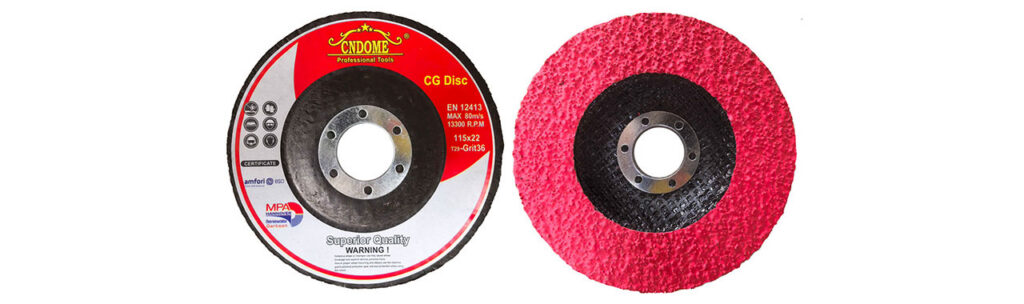
Ceramic abrasives represent the pinnacle of performance in the field of stainless steel grinding. The ceramic abrasive grains are engineered to have a more uniform microstructure than zirconia. It continuously fractures during the grinding process, exposing sharp cutting points. Ceramic abrasives maintain high-speed cutting capabilities throughout their entire service life, while generating less heat and lasting longer than zirconia abrasives. Grinding tests demonstrate that ceramic grinding discs offer at least a 66% higher cutting rate compared to zirconia grinding discs. Although ceramic grinding discs are significantly more expensive than the other two types, they are virtually standard equipment in sectors such as precision instruments, aerospace, and food processing machinery, where surface integrity and consistency are critical. If you are working with high-value stainless steel components, the overall cost of ceramic grinding discs is actually lower.
Grinding wheel type: resin grinding discs, flap discs, or ceramic grinding discs?
Once you have confirmed the abrasive material, you need to select the structural configuration of the grinding wheel based on the specific process. These three types of grinding wheels each play an irreplaceable role in stainless steel processing; it is not a question of which is “best,” but rather which is “more suitable.”
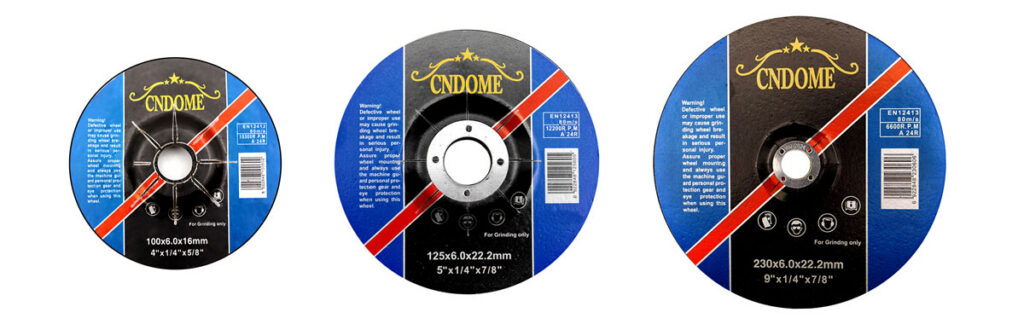
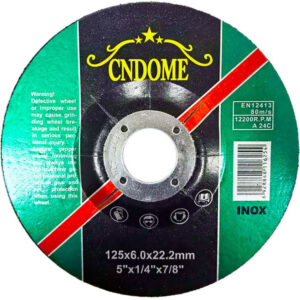
Resin-bonded grinding discs are your primary tools for heavy-duty rough grinding and material removal. Resin grinding discs offer high rigidity, making them suitable for the rapid removal of weld reinforcement, burrs on thick plates, and casting flash. You can use a resin grinding disc and apply pressure while grinding; that is the most efficient method. Resin grinding discs designed specifically for stainless steel are typically marked in blue or green (in accordance with industry practice); they generally have a thickness of around 6 mm and are used with an angle grinder at a working angle of 15°–30°. The elasticity of the resin bond helps absorb vibration and impact, while its unique “INOX” formulation meets requirements for contamination control on stainless steel.
Flap discs are the core tools for weld blending and surface shaping. Its layered abrasive cloth structure continuously exposes fresh abrasive grains during rotation, ensuring consistent cutting performance from the very first second to the last. This is critical for processes requiring uniform surface quality. Flap discs are available in two types: T29 (conical) and T27 (flat). Compared to the flat T27 type, the conical T29 type offers a larger contact area and higher efficiency when working on edges and corners. Regarding grit selection, 36# to 40# are used for rough grinding of welds, while 80# to 120# are used for finishing and preparing the surface for a brushed finish. Flap discs are the top choice for 80% of stainless steel grinding applications.
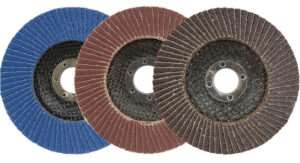
Ceramic grinding discs are suitable for applications requiring high-speed cutting while maintaining a certain degree of flexibility. Ceramic grinding discs excel at grinding curved surfaces and irregular shapes. Ceramic grinding discs consist of 100% ceramic abrasive cloth and a reinforced fiberglass backing, combining both rigidity and toughness. When used on stainless steel, the material removal rate is impressive. If you are grinding pipe fittings or irregularly shaped parts, ceramic grinding discs offer better conformability than flap discs.
Grit Selection: From Rough Grinding to Finishing
The abrasive type determines what the grinding disc “can do,” while the grit size determines the “degree” to which it performs that task.
When it comes to grinding stainless steel, surely you don’t think a single grit size can handle the entire job? The correct approach is to use different grit sizes in stages—coarse, medium, and fine grinding/polishing—thereby establishing a grinding sequence that progresses from coarse to fine. Due to the high toughness and poor thermal conductivity of stainless steel—combined with the tendency for grinding chips to adhere and cause clogging—excessively fine abrasive grit sizes should be avoided; otherwise, the workpiece surface is prone to scoring or burning.
The lower the grit number, the coarser the abrasive particles; grinding is faster, but the resulting surface is rougher. Conversely, a higher grit number indicates finer particles and a smoother surface, making it suitable for finishing and polishing. For stainless steel, we generally recommend using medium-grit (36#, 46#, 60#) grinding discs. This is because a medium grit size ensures cutting efficiency while effectively reducing wheel loading caused by the high toughness of stainless steel.
The following is a guide to selecting particle size based on processing objectives:
| Processing stage | Particle size (mesh/#) | Uses and Effects |
|---|---|---|
| coarse grinding | 12-24# | It offers a high material removal rate and is used to remove heavy burrs and thick mill scale. |
| 24-40# | Suitable for high stock removal, effectively eliminating scale, burrs, and rough surfaces. It is one of the most commonly used grit ranges for the rough grinding of stainless steel. | |
| 36#、46# | The standard choice for stainless steel rough grinding; it offers high efficiency and is resistant to clogging. | |
| Medium grinding | 50-58# | It offers a moderate material removal rate, used to eliminate scratch marks left by rough grinding and prepare the surface for finish grinding. |
| 60# | Commonly used for the fine grinding of stainless steel to achieve a relatively smooth surface, this grit size is often paired with 46-grit abrasive and is suitable for both rough and fine grinding operations. | |
| 80-120# | It achieves a smoother surface finish while maintaining cutting speed, making it suitable for grinding or fine finishing. | |
| Precision Grinding/Polishing | 150-240# | It involves minimal material removal and is used to achieve a smooth surface as a final step before polishing; 240-grit is commonly used for fine grinding and finishing. |
| 280# and above | The amount of material removed during grinding is minimal, preparing the surface for mirror polishing. |
A piece of advice often overlooked: if you start sanding with a coarse grit, do not try to skip the intermediate grits and jump straight to the finishing stage. The high toughness of stainless steel means that skipping sanding stages makes each step more laborious, ultimately resulting in poorer surface quality. If you spend a few extra minutes working through the full sequence of grit sizes, you will save even more time during the finishing stage.
Additionally, many people assume that coarse-grit grinding generates more heat, but the reality is quite the opposite. Coarse-grained abrasive particles bear a heavy cutting load and remove a large amount of material per pass; due to the short contact time, the actual heat generated is lower than that produced by fine-grained abrasives. The prerequisite is applying sufficient pressure to ensure the abrasive grains truly bite into the material, rather than merely sliding across the surface. When using fine-grained media for finishing, it is actually necessary to control the pressure and dwell time; otherwise, grinding debris may adhere due to high temperatures—causing “loading”—and the process will generate increasingly more heat as grinding continues.
Factors Affecting the Performance of Grinding Discs for Stainless Steel
Choosing the right grinding disc doesn’t guarantee a good result. In practice, three factors directly determine the lower limit of the grinding quality achieved by stainless steel grinding discs.
I. Rotational speed. You need to ensure that the maximum speed of the grinding disc matches the output of the angle grinder. The operating linear speed of stainless steel grinding discs is approximately 80 m/s, with corresponding maximum rotational speeds ranging from 6,600 to 15,200 RPM, depending on the disc diameter. If you use a 9-inch grinding disc rated for a maximum speed of 6,600 RPM with an angle grinder that operates at a higher speed, the result will not be increased grinding efficiency; instead, the disc could shatter due to excessive centrifugal force, posing a serious safety hazard.
II. Pressure. A counterintuitive fact is that when polishing stainless steel, applying heavy pressure often yields poorer results than grinding lightly. Excessive pressure causes abrasive grains to overheat and become dull, accelerating glazing, while simultaneously forcing more heat into the workpiece surface. The correct approach is to cut across the workpiece with moderate pressure while maintaining continuous movement, avoiding lingering on any single spot for more than a second or two. If you notice the surface of the workpiece starting to turn blue or purple, it is a sign that heat damage is occurring; you need to immediately reduce the pressure or increase your movement speed.
III. Angle. A grinding angle of 15° to 30° is the recommended range for most stainless steel grinding applications. If the angle is too shallow, the contact area between the grinding disc and the workpiece becomes excessively large; while heat is dispersed, the friction area increases. The angle is too steep, concentrating the contact area into a narrow band and causing a rapid rise in local temperature.
How to Choose Grinding Discs for Stainless Steel
Based on the analysis above, it is recommended that you follow the decision-making process outlined below, rather than relying on subjective, trial-and-error judgments.
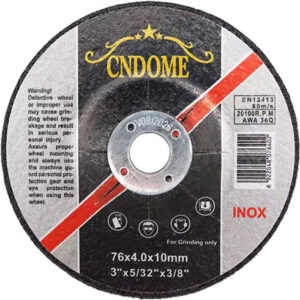
Step 1: Contamination control requirements. Any grinding wheel used for processing stainless steel surfaces must feature an “INOX-grade” formulation. If used in the fields of food processing, pharmaceuticals, or nuclear power, contamination control requirements are stricter. You need to confirm whether the product is clearly marked with Fe+S+Cl < 0.1%.
Step 2: Select the grinding wheel type based on the machining process. Choose resin-bonded discs for heavy-duty stock removal and rough grinding; select flap discs for weld blending and surface finishing; and opt for ceramic discs for contoured surfaces and fine blending. This is not a question of choosing which is better, but rather a matter of the division of labor across the production process.
Step 3: Select the abrasive based on pressure and duration. For high-intensity, continuous grinding applications, ceramic or zirconia materials are preferred. Alumina is suitable for intermittent, light-load operating conditions. Insights from a grinding wheel manufacturer: If you need to grind for more than 30 seconds with a single wheel, zirconia is the minimum requirement; if your goal is to minimize process time and the frequency of wheel changes, go straight for ceramic.
Step 4: Select the grit size based on the surface quality of the workpiece. Use 24–60# grit for rough grinding, 80–120# for finishing, and 150–240# for pre-polishing treatment. Do not attempt to complete all stages of the process using a single coarse-grit grinding wheel; doing so will only waste time and shorten the wheel’s lifespan.
Step 5: Safety standards. Regardless of the grinding wheel you choose, it must comply with the EN 12413 safety standard and bear the OSA (Organization for the Safety of Abrasives) certification mark. These standards specify the maximum permissible peripheral speed and bursting strength of grinding wheels; they are not merely “recommendations” but mandatory requirements. The maximum rotational speed specified on the grinding wheel must match the speed of the angle grinder; operating at excessive speeds is the primary cause of grinding wheel breakage accidents.
There is no “best”—only the best fit.
As an OEM/ODM manufacturer with 26 years of experience in the industry, Dome Abrasive Manufacture explains that the corrosion resistance of stainless steel stems from its surface passivation layer; therefore, selecting the right grinding disc is essentially about performing material removal and finishing processes while preserving this protective layer. The harder and more self-sharpening the abrasive, the less heat is generated per unit of time, and the less threat it poses to the passivation layer. The purer the grinding wheel’s formulation (Fe+S+Cl < 0.1%), the lower the risk of contamination.
If you need to grind dozens of weld seams daily in your workshop, the efficiency gains from using ceramic flap discs or ceramic grinding discs far outweigh the cost savings of using standard grinding wheels. For the grinding of most stainless steel railings, doors, windows, and steel structures, zirconia flap discs (T29, 60#–80#) meet your requirements. For high-intensity stainless steel production lines or applications requiring strict surface quality, ceramic abrasive discs and flap discs meet your needs. For occasional DIY use, aluminum oxide resin grinding discs offer the best value for money.
No single grinding disc can handle every task involving stainless steel. The “best” grinding disc is the one that—given the angle grinder you are holding, the pressure you apply, and the workpiece itself—allows you to complete the job in the shortest time without leaving behind any risk of future corrosion. The model doesn’t matter; compatibility is what counts.
Grinding Disc for Stainless Steel FAQ
Q1: What is the difference between grinding discs for stainless steel and standard grinding discs?
Standard grinding discs contain iron, sulfur, and chlorine; when used on stainless steel, they can embed iron particles into the surface, leading to the appearance of rust spots within a few days. Discs designed specifically for stainless steel are usually marked “INOX” or “Stainless” and feature an iron- and sulfur-free formulation to prevent contamination.
Q2: Should I choose aluminum oxide, zirconia, or ceramic abrasives for stainless steel grinding discs?
Aluminum oxide is inexpensive and suitable for occasional, light grinding. Zirconia is self-sharpening, pressure-resistant, and durable, making it ideal for heavy-duty weld grinding. Ceramic abrasives offer fast cutting, generate less heat, and have a long service life; while the unit price is higher, the overall cost for continuous operations may actually be lower. Choose based on your specific working conditions rather than just the unit price.
Q3: In which stainless steel processing stages are resin grinding discs, flap discs, and ceramic grinding discs respectively used?
Resin-bonded grinding discs offer high rigidity, making them suitable for rough grinding (stock removal) and removing excess weld reinforcement. Flap discs are ideal for weld blending and surface shaping, with the T29 profile being better suited for edges and corners than the T27. Ceramic grinding discs offer excellent conformability, making them ideal for curved surfaces and irregularly shaped parts. They serve distinct functions and are not interchangeable.
Q4: Should I use a flap disc or a resin grinding disc for grinding stainless steel welds?
Use a resin grinding disc or a coarse-grit flap disc to remove excess weld reinforcement; use a Type 29 (T29) flap disc—most commonly 60 or 80 grit—for blending and transition; switch to 120 grit for finishing and pre-treatment for a brushed finish. Don’t try to do the entire job with just one coarse disc.
Q5: How do I choose the grit size for stainless steel grinding discs? What are the specific uses for 40#, 60#, 80#, and 120# grits?
40# to 60# grits are used for rough grinding of welds and material removal; 80# to 120# grits are used for finishing, blending, and preparing the surface for a brushed finish; finer grits are reserved for pre-polishing treatment. Skipping too many grit levels results in low efficiency and increases the risk of burning or smearing the surface.
Q6: Why does stainless steel turn blue or discolor during grinding? How can this be avoided?
Turning blue indicates that the temperature in the grinding zone has exceeded 300°C, damaging the passivation layer and reducing corrosion resistance. To avoid this, use short strokes and multiple passes rather than pressing hard in one spot; keep the abrasive sharp; and prioritize ceramic or zirconia abrasives for heavy-duty applications.
Q7: Does stainless steel rust after grinding because of the grinding disc?
It is likely due to iron contamination or thermal damage. Using grinding discs intended for ordinary carbon steel, sharing tools, or failing to clean the surface after grinding can all introduce iron onto the stainless steel. Use iron-free and sulfur-free (INOX) grinding discs, keep tools separate, and clean and passivate the surface after grinding.
Q8: Are ceramic abrasive discs for stainless steel worth buying?
If you are grinding stainless steel welds continuously on a daily basis, ceramic discs offer fast cutting, generate less heat, and require fewer disc changes; the savings in labor and downtime are often more valuable than the higher cost of the discs. However, for occasional DIY work, zirconia flap discs are a more practical choice; aluminum oxide discs will also work, though they have a shorter lifespan.
Q9: Can stainless steel grinding discs be used on 304 and 316 grades? Is there a difference?
They can be used on both, but 316 is more corrosion-resistant and more prone to work-hardening, so pressure control needs to be steadier. Regardless of whether it is 304 or 316, the principles of using iron-free and sulfur-free discs and employing cold-cutting techniques remain the same; do not skimp on grinding discs just because the material is expensive.
Q10: How do I match the angle grinder’s speed with the grinding disc’s maximum speed rating?
The maximum RPM specified on the grinding disc label must be greater than or equal to the angle grinder’s no-load speed. Look for the EN12413 and OSA safety marks; operating at speeds exceeding the limit is the leading cause of disc breakage accidents. If the speeds do not match, even the highest-quality abrasive disc cannot be used safely.
Q11: Are there specific requirements for the installation direction of stainless steel grinding discs?
Flap discs and ceramic grinding discs must be installed according to the direction indicated by the arrow, ensuring the nut faces the correct way; for resin grinding discs, check the flange and label, and inspect for any cracks. Disconnect the power before installation, and after mounting, run the tool at no-load for several seconds to ensure there are no abnormalities before contacting the workpiece.
Q12: How do I know when a stainless steel grinding disc needs replacing?
Signs that a replacement is needed include slower cutting, noticeable heat buildup, surface glazing or clogging, and the abrasive flaps wearing down close to the backing pad. Dull abrasive grains fail to cut and instead generate heat through friction; forcing the tool to work while dull can actually damage the stainless steel.
Q13: Can stainless steel grinding discs be used on carbon steel? What are the risks of using them interchangeably?
They can be used, but cross-contamination will occur. Once carbon steel particles become embedded in the stainless steel, the material is prone to rusting later on. Ideally, you should use separate discs for stainless steel and carbon steel; at the very least, switch to an INOX-rated disc before grinding stainless steel and clean both the angle grinder and the workpiece surface.
Q14: What should be considered when grinding stainless steel for food and pharmaceutical equipment?
Key points include ensuring the process is free of iron, sulfur, and chlorine; controlling heat discoloration; and performing cleaning and passivation after grinding. Surface roughness must meet hygiene standards to avoid scratches that could harbor dirt or contaminants. Use grinding discs specifically designed for stainless steel (INOX) rather than making do with standard carbon steel discs.
Q15: What parameters and certifications should be checked when purchasing stainless steel grinding discs?
Check the abrasive material, grit size, disc profile (T27 or T29), maximum RPM, INOX designation, iron- and sulfur-free status, and EN12413/OSA certifications; then, verify the MOQ and lead time. To avoid selection errors, first determine the specific application process, then select the abrasive and grit size, and finally compare prices.
