

-
Oct, Fri, 2026

What Grit Grinding Disc Should You Use for Stainless Steel?
Workers in metal workshops who perform grinding tasks are required to carry out various types of metal surface grinding operations on a daily basis. When you pick up a grinding disc, you will see grit ratings — such as 40#, 60#, 80#, or 120# —marked on its surface, with the phrase “for stainless steel” indicated after each number. Generally speaking, coarse grit is used for material removal, while fine grit is used for finishing. However, there is no single, standardized answer as to which grinding disc should be selected; the choice depends on factors such as the type of workpiece, the specific machining process, and the specifications of the angle grinder. Nevertheless, there is a clear, logical framework for making this decision.
This article focuses exclusively on the parameter of particle size. It aims to clarify what these numerical values signify, how they relate to specific process stages, and where common misconceptions arise in practical application—with the goal of resolving these issues once and for all.
The Meaning of Granularity Values
The smaller the grit number, the coarser the abrasive grains; this results in faster cutting but a rougher surface. Conversely, a larger grit number indicates finer abrasive grains, which produce a smoother surface but result in a lower material removal rate. This is a fundamental concept, yet a key point often overlooked during actual selection is that grit size is not an isolated parameter; rather, it works in conjunction with the type of abrasive, the shape of the grinding wheel, the applied pressure, and the rotational speed to determine the final outcome. A 60-grit zirconia flap disc and a 60-grit ceramic resin-bonded grinding wheel may perform quite differently when used on the same workpiece. Therefore, before determining “which grit size to use,” you should first ensure that the correct abrasive type and form have been selected. Grit size is a final, fine-tuning step, not an initial decision.
Coarse grinding: 24# to 40#
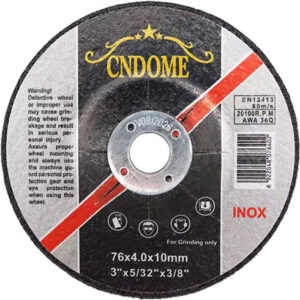
The task of rough grinding is clear-cut: to remove weld reinforcement, casting flash, burrs on thick plates, and extensive layers of scale. At this stage, surface finish need not be considered; the primary objective is material removal rate. The 24# to 40# range serves as the primary grit spectrum, with 36# and 40# being the most widely used for the rough grinding of stainless steel, as they offer an optimal balance between cutting efficiency and resistance to clogging. Stainless steel has high toughness, and grinding debris tends to adhere to the surface; using an excessively fine grit can actually cause the debris to clog the abrasive grains, leading to slower cutting and the accumulation of heat. Coarse-grained abrasive particles bear a larger cutting load and remove more material in a single pass; despite the shorter contact duration, the actual heat generated may—counterintuitively—be lower than that produced by fine-grained particles. This holds true, however, only if sufficient pressure is applied to ensure the abrasive particles effectively penetrate the material, rather than merely sliding or rubbing across its surface.
Resin-bonded grinding wheels exhibit the greatest stability within this grit size range; they possess high rigidity and are well-suited for pressure-assisted grinding. Flap discs can also be used for coarse material removal (e.g., 40-grit); the T29 conical-shaped disc, in particular, offers a larger contact area when working on edges and corners, delivering efficiency comparable to that of resin-bonded grinding wheels. However, it should be noted that the scratches left by coarse grinding are relatively deep; therefore, intermediate grinding and finishing steps are required before proceeding—one cannot move directly to polishing.
Medium grinding: 46# to 60#
Grinding a weld seam typically cannot be completed in a single step. After rough grinding removes the excess weld reinforcement, noticeable grinding marks and transitional steps remain on the surface; intermediate grinding serves to eliminate these traces, preparing the surface for the final finishing process. The 46# to 60# range constitutes the core grit interval for this stage, with 60# being the most widely used: it is capable of addressing scratches left by coarse grinding while also laying the groundwork for subsequent finishing steps using 80# or 120# grit. Many welders in the field use a 60-grit T29 zirconia flap disc to blend weld seams, covering the transition from coarse to medium grinding in a single pass—a highly efficient approach.
However, 60-grit is not suitable for all situations. When working with 316 stainless steel, 60-grit abrasive can still generate heat under continuous pressure—a problem that becomes especially pronounced if one continues to grind after the abrasive disc has become dull. Grade 316 stainless steel contains molybdenum, which imparts high toughness and stickiness; this causes grinding debris to readily adhere to the surface of the abrasive grains. Once clogging occurs, the grinding action effectively shifts into friction. Therefore, during the intermediate grinding stage for 316, it is recommended to use sharp, new abrasive discs, apply moderate pressure, and avoid dwelling too long in any single spot. Ceramic-grain flap discs (60# grit) offer more stable performance on 316, as their micro-fracturing characteristic helps effectively reduce the likelihood of clogging.
Finish: 80# to 120#
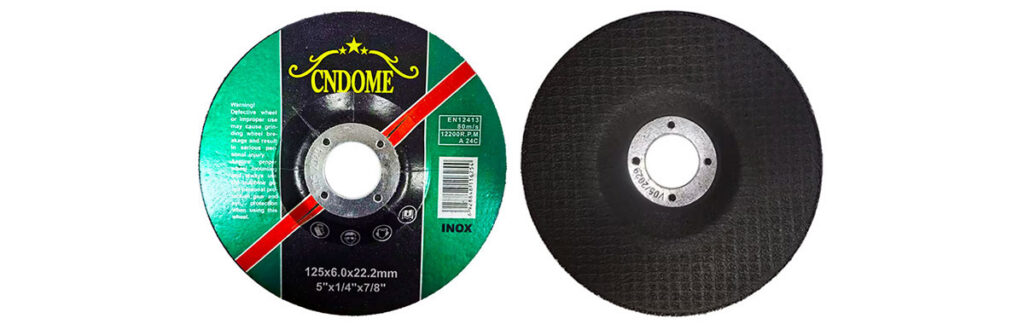
The 80# to 120# grit range is the most critical segment in the grinding of stainless steel. 80# grit is used to remove the marks left by intermediate grinding, resulting in a relatively uniform surface; 120# grit is employed for finishing and preparing the surface for a brushed texture, significantly reducing surface roughness. The choice of grit within this range directly determines the level of difficulty for subsequent polishing or passivation processes. If a worn (dull) abrasive disc is used during the 120# stage, the abrasive grains will merely slide across the surface, causing heat to concentrate and frequently leading to blue discoloration. Grade 316 stainless steel is particularly sensitive in this regard; due to its relatively poor thermal conductivity, heat tends to accumulate more readily in the contact zone. Therefore, for finishing operations using 120# grit or finer, it is recommended to use new abrasive discs rather than reusing discs that have already been employed in earlier stages of the process.
Flap discs excel within the 80# to 120# grit range; their layered abrasive cloth structure ensures consistent cutting performance from start to finish, resulting in excellent surface uniformity. The T27 flat type is suitable for flat-surface grinding, while the T29 conical type is suitable for edges, corners, and transitional areas. Resin-bonded grinding wheels are less frequently used in this range, as their rigid structure tends to generate more heat when fine grit sizes are employed—unless the workpiece is a large, flat surface for which high surface uniformity is not required.
Pre-polishing treatment: 150# to 240#
Grit sizes from 150# to 240# are used for final preparation before polishing. The amount of material removed is minimal, with the goal of achieving a smooth surface in anticipation of mirror polishing. This stage is not required for all stainless steel grinding; it is only necessary when there are strict requirements regarding appearance or surface roughness. Many people encounter issues at this stage because the jumps between grit sizes in the preceding steps are too large. For instance, skipping directly from 60# to 240# makes each subsequent step more laborious and actually results in poorer surface quality. Due to the high toughness of stainless steel, such large jumps in grit size cause the abrasive particles to slide across the surface for longer periods, leading to excessive heat buildup—which can ultimately result in surface burns or tearing. Spending a few extra minutes to progress systematically through the 80#, 120#, and 150# stages is, in fact, more time-efficient than struggling to achieve the desired finish by repeatedly grinding with 240# grit.
Why You Can’t Skip Levels: The Underlying Logic of Granularity Sequences
The sequence of grit sizes is not a fabrication by manufacturers intended to drive more sales of abrasive discs. Each grit level is designed to remove the scratch marks left by the preceding stage. If you jump, for instance, from 40# directly to 120#, the 120# abrasive particles will be tasked with removing scratches far deeper than their capacity allows. This causes the particles to merely skid across the surface, leading to reduced cutting efficiency, increased heat generation, and a loss of control over surface quality. This issue is particularly pronounced with stainless steel, as the material’s inherent toughness makes it prone to “loading”—where metal debris adheres to the abrasive, causing the disc to clog—a risk that increases significantly when skipping steps in the grinding sequence. The correct approach is to follow the full progression: coarse grinding (24#–40#), medium grinding (46#–60#), fine finishing (80#–120#), and pre-polishing (150#–240#). While it is not necessary to spend an excessive amount of time at each individual stage, it is essential to ensure that each step is completed thoroughly.

The Counterintuitive Relationship Between Particle Size and Heat
Many people assume that coarse-grit grinding generates more heat because it “removes more material.” In reality, the opposite is true. Coarse-grit abrasives impose a higher cutting load, removing a greater volume of material per pass; because the contact duration is short, the material is carried away as swarf before heat can accumulate. Conversely, fine-grit abrasives remove less material; if the applied pressure is insufficient, the abrasive grains merely slide or rub against the surface, which actually facilitates heat buildup. Therefore, when using fine-grit abrasives during the finishing stage, precise control of pressure and dwell time becomes even more critical than during coarse grinding. If the surface turns blue or purple—indicating that the temperature has exceeded 300°C and the passivation layer has been compromised—switching to an even finer grit will not solve the problem. Instead, one should reduce the applied pressure, increase the speed of movement, or replace the abrasive disc with a sharper one.
Are the grain size strategies for 304 and 316 the same?
The process is essentially the same for both. Use 24#–60# grit for rough grinding, 80#–120# for finishing, and 150#–240# in preparation for polishing; this sequence applies to both 304 and 316 stainless steel. The difference lies in the operational details: 316 has a greater tendency toward work-hardening, as well as higher toughness and “stickiness,” making it more prone to heat buildup and clogging when using finer-grit abrasives. Consequently, when working with 316 using grits of 80# or finer, it is recommended to use fresh abrasive discs, apply moderate pressure, and employ a technique involving short, repeated strokes—avoiding sustained pressure on any single spot. 304 is more tolerant of pressure; even if the pressure is increased slightly, the abrasive grains typically continue to cut effectively. Regardless of whether you are working with 304 or 316, using “INOX-grade” (iron-free) abrasives is a fundamental requirement; even if the correct grit is chosen, using products with impure compositions can still lead to iron contamination.
How to Match Grit Size with Grinding Wheel Shape
Resin-bonded grinding wheels are suitable for rough and medium grinding, typically ranging from 24# to 60# grit; they offer high rigidity, making them ideal for applications that require the application of pressure during grinding. Flap discs are designed for medium grinding and finishing—most commonly in the 60# to 120# range—where their layered abrasive cloth structure ensures a uniform surface finish. When working on edges or corners, T29 conical (angled) discs provide a larger contact area than T27 flat discs, resulting in higher efficiency. Fiber discs are well-suited for curved surfaces and complex-shaped workpieces; while the logic for selecting grit size is similar to that of flap discs, fiber discs offer superior conformability. It is not necessary to stock both resin-bonded wheels and flap discs for every single grit size; a more practical approach is to use resin-bonded wheels for rough grinding and flap discs for medium grinding and finishing.
What problems can arise from choosing the wrong particle size?
Using an excessively fine grit for rough grinding results in slow cutting speeds, increased heat generation, rapid clogging of the abrasive disc, and reduced efficiency. Conversely, using an overly coarse grit for finishing deepens surface scratches, complicates subsequent polishing, and raises the costs associated with rework. Skipping grit stages leads to poor control over surface quality, shortens the lifespan of abrasive discs, and causes heat accumulation that results in blue discoloration. When 316 stainless steel is subjected to forced grinding with a dull abrasive disc—even at a fine grit—it intensifies work hardening, triggers a sharp rise in surface temperature, and destroys the passive layer. While these issues are not caused solely by grit selection, an inappropriate choice of grit is frequently the triggering factor.
Security and Compliance: Matters Beyond Granularity That Cannot Be Overlooked
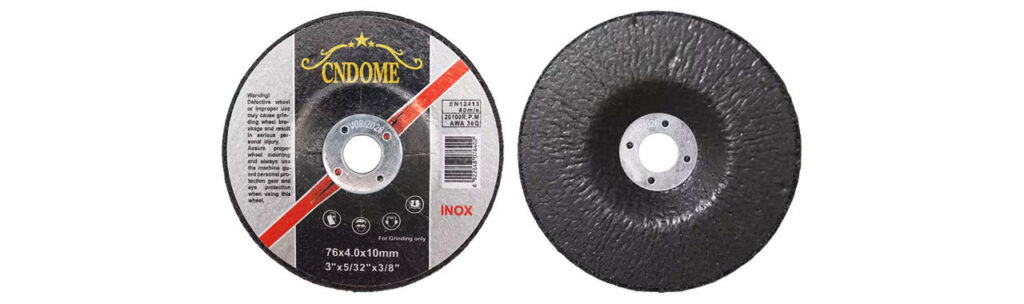
Choosing the right grit size does not mean you can overlook safety. The maximum RPM specified on the grinding wheel’s label must be equal to or greater than the no-load speed of your angle grinder; operating a wheel above its rated speed is the leading cause of wheel breakage. Compliance with EN 12413 standards and OSA certification is a fundamental requirement, not an optional extra. Maintain a working angle of 15° to 30°, apply moderate pressure, and avoid grinding in a single spot for more than a second or two. These operational guidelines are just as important as the choice of grit: while grit determines surface quality, safety protocols determine whether the job can be completed without incident.
How a Resin-Bonded Grinding Wheel Manufacturer Views the Issue of Grit Size
We manufacture resin-bonded grinding wheels and flap discs specifically designed for stainless steel (INOX). Our range covers grit sizes from 24# to 36#, with options for both zirconia and ceramic abrasives. Available in T27 and T29 configurations, these products come in diameters ranging from 38mm to 405mm. The iron, sulfur, and chlorine content are strictly controlled to meet INOX-grade standards. If you are unsure about which grit size to choose, simply provide us with details regarding your workpiece material, the grinding process, surface finish requirements, and the rotational speed (RPM) of your angle grinder. We will help you determine the optimal grit sequence and abrasive type—a much more efficient approach than conducting repeated trial-and-error tests on your own. We also offer OEM/ODM services, and minimum order quantities (MOQ) can be negotiated based on your specific market needs.
A coarser grit is not necessarily better, nor is a finer one inherently superior. The process follows a progression from coarse to fine, with each stage serving a specific purpose. One should first define the operational steps, then determine the appropriate grit size, and finally consider the abrasive type and its form. Following this sequence ensures that the selection process remains accurate and free of errors.
FAQ
Q1: What exactly do the numbers for grinding disc grit represent?
A lower grit number indicates coarser abrasive grains, which cut deeper—removing material quickly but leaving a rough surface. A higher grit number indicates finer abrasive grains, which cut less deeply—resulting in a more uniform surface, though they are also more prone to generating heat through friction. Choosing the right grit isn’t a matter of “finer is always better”; rather, it depends on how much material needs to be removed during that specific stage of the process.
Q2: What grit should be used for the initial grinding of welds on stainless steel?
For removing excess weld material, burrs on thick plates, or flash on castings, a grit range of 24# to 40# is the appropriate starting point. This range involves a high cutting load and is suitable for heavy material removal using a stainless steel grinding disc; however, it will leave noticeable scratch marks on the surface, necessitating a follow-up step with 60# or 80# grit.
Q3: Should I use 60-grit or 80-grit abrasives for weld blending and surface shaping?
60-grit and 80-grit are the most commonly used options. 60-grit offers a balance between moderate material removal and weld blending, while 80-grit is better suited for surface shaping and preparation for a brushed/satin finish. An 80-grit T29 flap disc is versatile enough to handle most weld cleaning and edge chamfering tasks encountered during on-site installation and maintenance.
Q4: What grit is appropriate for finishing stainless steel surfaces?
A grit range of 80# to 120# is typically used for the finishing stage. 120# is commonly employed for surface shaping and as a preparatory step before applying a brushed (linear grain) finish. When working with 316 stainless steel using grits finer than 120#, extra care must be taken regarding heat generation; it is recommended to use fresh abrasive discs, control the applied pressure, and keep the tool in constant motion to prevent heat damage.
Q5: Are 150# to 240# grits used for removing weld seams?
No. 150# to 240# grits are part of the pre-polishing process; they have a low material-removal rate and are used to refine the scratch patterns left by 120# grit. Attempting to remove excess weld material with 240# grit is inefficient, generates excessive heat, and is the wrong approach.
Q6: Can I skip grit sizes—for example, going directly from 40# to 120#?
This is not recommended. Skipping grits prevents the deep scratches left by coarse-grit grinding from being effectively removed. When a fine-grit abrasive is used on an uneven surface, localized pressure increases, and heat tends to concentrate in those areas. Adding an intermediate step—such as 60# or 80#—will actually save time in the overall finishing process.
Q7: Is the grit size range the same for 304 stainless steel and 316 stainless steel?
The grit size framework is essentially the same: 24#–40# for stock removal, 40#–60# for shaping, 60#–80# for transitioning, 80#–120# for finishing, and 150#–240# for pre-polishing. The difference lies in pressure control: 316 stainless steel is more prone to work hardening and material adhesion (clogging/loading); therefore, when using the same grit, greater attention must be paid to the sharpness of the abrasive and the speed of movement.
Q8: How should the grit sizes for resin-bonded wheels and flap discs be selected?
Resin-bonded wheels are rigid, making them suitable for coarse grinding and medium-duty material removal (grit range: 24#–60#). Flap discs are better suited for blending weld seams and shaping surfaces (grit range: 60#–120#). T29 (conical) discs are more convenient for working on edges and corners, while T27 (flat) discs are designed for grinding flat surfaces. Grit size should be matched to the specific tool type and application.
Q9: Why do fine-grit abrasive discs tend to generate excessive heat?
Fine-grit abrasive particles make shallower cuts. If the disc lacks sharpness or if the applied pressure is inappropriate, the abrasive particles may “rub” against the surface rather than “cut” into it; this increases friction and causes heat to accumulate in the contact zone. Since stainless steel has poor thermal conductivity, it is especially important to control both the applied pressure and the dwell time when performing finishing operations with fine-grit abrasives.
Q10: Do coarse-grit abrasive discs necessarily generate more heat than fine-grit ones?
Not necessarily. If the applied pressure is sufficient and the abrasive grains effectively penetrate the material, a larger amount of material can be removed in a single pass with a shorter contact time; in such cases, the heat generated may not be higher than that produced by fine-grit discs. The issue does not lie in the grit size itself, but rather in whether the abrasive grains are “cutting” or “rubbing” the material.
Q11: Is there a relationship between the INOX formulation and the choice of grit?
The INOX specification concerns contamination control, while the grit size relates to the cutting grade; they address different aspects. Regardless of whether you choose 60-grit or 120-grit, a stainless steel grinding disc must meet the requirement of Fe+S+Cl < 0.1%. Otherwise, iron contamination will still cause 304 and 316 stainless steel to rust.
Q12: How can I tell if the current grit is incorrect?
Signs include sparks suddenly becoming denser and brighter, the surface beginning to take on a yellow or blue tint, the abrasive disc feeling like it is slipping, or a noticeable slowdown in cutting accompanied by significant heat generation. In such cases, you should switch to a coarser grit (one step down) or replace the disc; do not attempt to resolve the issue by applying more pressure.
Q13: Is there a relationship between maximum RPM and grit size?
There is no direct relationship, but the safety requirements remain the same. The maximum RPM specified on a grinding wheel’s label must be greater than or equal to the no-load speed of the angle grinder; furthermore, the wheel must carry both EN 12413 and OSA certifications. Operating a wheel above its rated speed is the leading cause of wheel-burst accidents, regardless of the grit size.
Q14: How should the grit size be selected when working with 316 stainless steel for food or pharmaceutical equipment?
Prioritize contamination control and heat input management. Use INOX-certified ceramic or zirconia abrasive discs, starting the finishing process with 80-grit to avoid deep scratches caused by coarser abrasives. Following grinding, the surface must be cleaned and passivated, and the surface roughness must meet the relevant hygienic requirements.
Q15: How should I clearly specify my grit requirements when making a purchase?
You should inform the supplier of the following: whether the workpiece is 304 or 316 stainless steel; the specific operation (material removal, weld blending, or finishing); the type of abrasive (resin-bonded wheel or flap disc); the shape (T27 or T29); and the required grit. Also, confirm whether the product carries an “INOX” marking and includes a test report for Fe+S+Cl content, and verify that it complies with EN 12413 standards and holds OSA certification. Finally, ask about the minimum order quantity (MOQ) and lead time. Always define the process first, then compare prices.
