
-
Sep, Thu, 2026

Zirconia vs Ceramic Grinding Discs for Stainless Steel
If you are already using INOX grinding discs, then you know that ordinary carbon steel grinding discs cannot be used for grinding stainless steel. Zirconia and ceramic are the two most widely used mainstream abrasives by grinding wheel manufacturers for producing stainless steel grinding discs. Both types of abrasives have their proponents, and there is a significant price difference between them—so, how exactly should you choose?
This article compares zirconia and ceramic abrasives point by point across several dimensions—including wear patterns, heat generation, and usage costs—to help you understand the differences between them.
How do zirconia abrasives work?
Zirconia abrasive grains undergo micro-fracturing under stress, exposing new cutting edges—a phenomenon known as “self-sharpening.” Unlike aluminum oxide abrasives, it does not become dull during use and subsequently skid across the workpiece surface. Therefore, zirconia grinding discs consistently deliver stable performance in operations requiring sustained pressure, such as heavy stock removal from thick plates, the removal of casting flash, and rough grinding of welds.
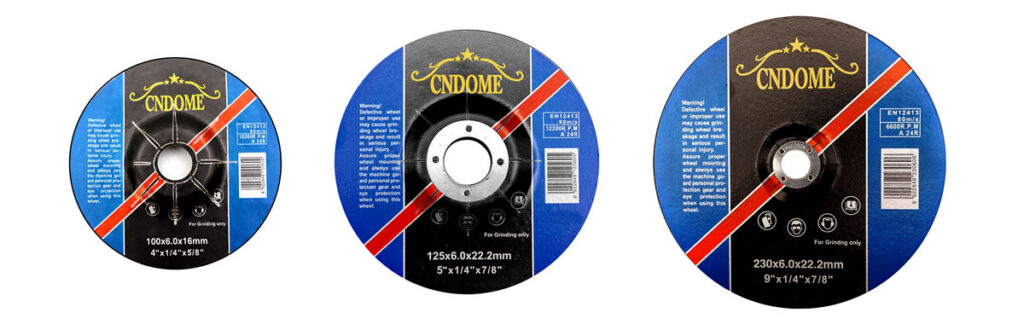
However, “Sharp” comes with a prerequisite: it requires sufficient pressure to trigger. If you are accustomed to applying light pressure and grinding slowly, zirconia abrasives will not undergo micro-fracturing; instead, they will become dull on the surface, at which point their performance may actually be inferior to that of alumina abrasives. Quite a few of our customers using zirconia grinding discs have complained about poor durability, but whenever we ask about the application pressure, it turns out to be far too light. Zirconia grinding discs are suitable for grinding under pressure; the more firmly you press, the faster they self-sharpen and the higher the cutting efficiency.
Zirconia grinding wheels offer an outstanding cost-performance ratio for grinding 304 stainless steel. Although 304 stainless steel exhibits a tendency toward work hardening, zirconia grinding wheels can readily cut into the material under moderate pressure, and their service life is far longer than that of aluminum oxide wheels. For grinding welds on railings, doors, windows, and steel structures—whether on-site, in maintenance, or in metal fabrication workshops—T29 zirconia flap discs with 60 to 80 grit abrasive are essentially the standard choice.
How do ceramic abrasives work?
Ceramic abrasives represent another approach. Its abrasive grains are engineered to possess a more uniform microstructure; under stress, they undergo continuous micro-fracturing, constantly exposing sharp cutting points. This means it maintains high-speed cutting throughout its entire service life, without the significant drop-off in cutting speed seen with zirconia abrasives.

For stainless steel, the greatest value of ceramic abrasives lies in cold cutting. The temperature in the grinding zone is lower, and the risk of thermal damage is reduced. Comparative tests show that when grinding stainless steel welds, ceramic abrasives operate at temperatures approximately 30% lower than zirconia abrasives and achieve a cutting rate at least 66% higher. This difference is particularly critical for 316 stainless steel. 316 stainless steel contains molybdenum; its toughness and tendency to be “sticky” make it prone to having grinding chips adhere to the abrasive grains. Once adhesion occurs, the grinding process shifts to friction, causing a rapid rise in temperature; exceeding 300°C destroys the passivation layer. The surface turns blue or purple, chromium carbides precipitate, and corrosion resistance drops sharply. The micro-fracturing characteristics of ceramic abrasives allow for the continuous exposure of new cutting edges, effectively “shedding” adhered grinding debris. Therefore, ceramic abrasives demonstrate significantly better stability on 316 stainless steel and heat-sensitive workpieces.
Differences in Cutting Speed and Heat Generation Between Ceramic and Zirconia Abrasives
If you look solely at the experimental data, ceramic abrasives vastly outperform zirconia abrasives. However, actual usage depends on the specific operating conditions. Under conditions of sustained high pressure and continuous grinding, ceramic abrasives demonstrate a clear advantage in cutting speed and generate less heat. However, in scenarios involving intermittent, light-load, and short-duration grinding, the self-sharpening mechanism of zirconia maintains good cutting efficiency, meaning the advantage of the ceramic’s high unit price may not necessarily be realized.
Heat management is another dividing line. Stainless steel has poor thermal conductivity—only about one-third that of carbon steel—causing grinding heat to concentrate in the contact zone. Zirconia abrasives themselves operate at lower temperatures; however, if the pressure is insufficient, the abrasive grains will merely slide across the surface, causing heat to build up nonetheless. The micro-fracturing characteristics of ceramic abrasives keep the abrasive grains continuously sharp, reducing the likelihood of heat generation caused by sliding and rubbing. Therefore, its cold-cutting advantage is more reliable for workpieces sensitive to heat input.
Differences in Lifespan and Cost Between Zirconia and Ceramic Abrasives
It is a fact that zirconia grinding discs have a low unit price, while ceramic grinding discs have a high unit price. However, the selection process should not stop at the unit purchase price. What you need to calculate is the cost per cut: the service life of a single ceramic cutting disc, the reduction in replacement frequency, the decrease in downtime, and the savings in labor costs.

If you grind dozens of stainless steel welds daily in the workshop, you might need to replace a zirconia grinding disc every half-day, whereas a ceramic disc might last a day and a half before needing replacement. Replacing the grinding disc itself takes only a few seconds, but the cumulative time cost of stopping the machine, realigning the angle, and reapplying pressure is often far greater than the price difference between the discs. Purchasing managers and cost accountants, in particular, should factor in the calculation of “number of tool changes × time per tool change × labor rate”; when this is done, the comprehensive cost of ceramics often turns out to be lower. However, if you are just doing some weekend DIY or have a minimal amount of grinding to do, zirconia grinding discs offer excellent value; there is no need to use ceramic discs for tools that see only occasional use.
For which operating conditions are zirconia and ceramic abrasives respectively suitable?
For on-site installation and repair, welders can handle most weld blending, surface preparation, and edge chamfering tasks using 80-grit T29 zirconia flap discs. For a metal processing workshop handling both 304 and 316 grades, ceramic resin grinding discs can be used for rough grinding, while zirconia flap discs are suitable for finishing and intermediate steps; this approach ensures efficiency in critical operations without the need to stock ceramic discs for every stage of the process. For grinding 316 stainless steel structural components used in marine and offshore environments, 60- to 80-grit T29 zirconia flap discs are sufficient for most requirements, as surface finish specifications can be somewhat relaxed.
In short, zirconia abrasives are the more pragmatic choice for scenarios involving intermittent grinding, budget constraints, or on-site operations, and where surface consistency requirements are not extremely stringent.
For 316 stainless steel equipment in the food, pharmaceutical, and medical device industries, contamination control and heat input are the top priorities. When using ceramic INOX grinding discs with a grit size of 80 or finer, the subsequent cleaning and passivation processes entail extremely high rework costs; it is not worth taking the risk just to save money on the discs. For aerospace, precision instruments, and high-value stainless steel components—where requirements for surface integrity and consistency are extremely stringent—ceramic grinding discs are virtually standard equipment. On automated production lines, the consistency of ceramic abrasive lifespan and pressure control are more predictable, resulting in more stable tool-change intervals.
On automated production lines, the consistency of ceramic abrasive lifespan and pressure control are more predictable, resulting in more stable tool-change intervals.

What should be considered during model selection?
Whether you choose a grinding wheel with zirconia or ceramic abrasive, the INOX formulation is the baseline requirement. Iron, sulfur, and chlorine content must be below 0.1%; otherwise, iron contamination will still cause the stainless steel to rust. Avoid excessive jumps in grit size: use 24–60 mesh for coarse grinding, 80–120 mesh for finishing, and 150–240 mesh for pre-polishing preparation. The grinding wheel’s rotational speed must match the angle grinder; the wheel’s maximum RPM must be greater than or equal to the angle grinder’s no-load speed. Certifications such as EN12413 and MPA are not optional. Maintain a working angle of 15° to 30° and moderate pressure; do not grind on a single spot for more than a second or two.
Common misconceptions. Misconception #1: Ceramic abrasives are necessarily better than zirconia abrasives. Ceramic abrasives offer distinct advantages for applications involving sustained heavy pressure or heat-sensitive workpieces; however, if you are only occasionally grinding small parts, their high unit cost and the requirement for significant pressure to perform effectively may mean they are not necessarily more cost-effective than zirconia. A second misconception is that zirconia abrasives are suitable only for rough grinding. Zirconia flap discs can also be used for finishing and intermediate grinding—even with grit sizes of 80–120—provided the discs are sharp and the applied pressure is appropriate; consistent surface quality can be achieved.
As a manufacturer of resin-bonded grinding wheels, how do we view these two types of abrasives?
We manufacture INOX resin grinding wheels and flap discs specifically designed for stainless steel, covering both zirconia and ceramic abrasive types. If you are unsure whether to choose zirconia or ceramic abrasives, simply provide us with details regarding the workpiece material, grinding process, application pressure, and surface finish requirements. We can help you determine the appropriate abrasive type and grit size—a much faster approach than conducting repeated test runs yourself. We can discuss OEM/ODM arrangements and MOQs based on your market requirements. Ultimately, however, we would prefer that you first understand the differences between the two types of abrasives and then determine whether our products are suitable for your specific operating conditions.
No single grinding disc is a universal solution for all stainless steel applications. Zirconia and ceramic abrasives do not simply replace one another; rather, the choice depends on matching the material to specific pressures, workpieces, and budgets. Determine your process and heat input requirements first, select the abrasive next, and compare prices last—never reverse this order.
Q1:Zirconia vs. Ceramic Grinding Discs for Stainless Steel: What is the key difference?
Zirconia relies on self-sharpening—where abrasive grains undergo micro-fracturing under stress—requiring sufficient pressure to deliver optimal performance. Ceramics rely on micro-chipping to continuously expose fresh cutting edges, offering superior cool-cutting capabilities. While both are available in formulations designed for stainless steel (INOX), they differ in their heat generation profiles and cost structures.
Q2: When grinding 304 stainless steel, should I choose a zirconia grinding disc or a ceramic grinding disc?
Type 304 stainless steel exhibits moderate work-hardening, making zirconia the most cost-effective choice. It maintains stable self-sharpening characteristics under moderate pressure and is fully adequate for weld grinding and general material removal. Unless the workpiece is of high value or has strict heat-input requirements, there is no need to use ceramic abrasives.
Q3: Why is a ceramic grinding disc recommended over others when grinding 316 stainless steel?
Grade 316 contains molybdenum, resulting in high toughness and high ductility; grinding chips tend to adhere to the abrasive grains, concentrating the heat generated. The micro-fracturing characteristics of ceramic abrasives reduce loading, while cool cutting lowers the risk of heat damage and preserves the passivation layer.
Q4: Ceramic grinding discs have a high unit price; is the cost per cut really lower?
It depends on the operating conditions. For production lines involving continuous grinding and frequent disc changes, ceramic discs offer longer service life and reduced downtime, often resulting in a lower total cost compared to zirconia. For occasional DIY use or small-batch work, zirconia is more cost-effective due to its lower unit price.
Q5: How much pressure is required for zirconia grinding discs? Can they be used with light pressure?
Zirconia requires sufficient pressure to trigger its self-sharpening action. Light pressure causes the abrasive grains to merely skid across the surface, leading to rapid dulling and excessive heat buildup. If you feel the disc “slipping,” switch to a new one or drop down a grit level—don’t force it.
Q6: Under what operating conditions do ceramic grinding discs offer the most significant advantages?
Applications involving sustained heavy loads—such as food and pharmaceutical processing equipment, marine and offshore engineering, and automated production lines—demand superior resistance to heat damage and work hardening, as well as strict contamination control; ceramics offer greater stability in these environments.
Q7: Which abrasive offers better control to prevent stainless steel from turning blue or discoloring during grinding?
Ceramic abrasives operate at lower temperatures—about 30% lower than zirconia—resulting in a reduced risk of blueing. However, regardless of the type used, temperatures can still exceed 300°C if excessive pressure is applied or the tool dwells too long; therefore, operating technique remains critical.
Q8: How do I choose the grit for zirconia and ceramic grinding discs?
Use 24–60 grit for rough grinding, 80–120 grit for finishing, and 150–240 grit for pre-polishing. For fine-grit finishing on 316 stainless steel, use new abrasive discs to prevent frictional heat caused by dull abrasive grains. Excessive jumps between grit sizes can easily lead to a loss of control over the surface finish.
Q9: What types of abrasives are used for resin-bonded wheels and flap discs, respectively?
For heavy-duty stock removal, use an INOX resin-bonded wheel (ceramic or zirconia are both suitable). For weld blending and surface shaping, use a T29 flap disc; ceramic is preferred for 316 stainless steel, while zirconia suffices for 304. The T27 type is suitable for flat surfaces.
Q10: Is the INOX formulation necessary for both zirconia and ceramic grinding discs?
All are essential. Keeping Fe, S, and Cl levels below 0.1% is the baseline requirement; otherwise, iron contamination will cause 304 and 316 stainless steel to rust after grinding. No matter how expensive the ceramic is, an impure formula renders it useless.
Q11: Can the same zirconia or ceramic grinding disc be used for both 304 and 316 stainless steel?
It is acceptable for short-term use but not recommended for the long term. Machining 316 stainless steel generates higher cutting forces, leading to faster wear on zirconia components; furthermore, alternating between materials risks cross-contamination. It is safer to keep separate burs for each material.
Q12: How do I evaluate the quality of zirconia and ceramic grinding discs when purchasing them?
Check the abrasive specifications, grit, T27/T29 designation, maximum RPM, INOX rating, and EN 12413/OSA certifications. Clarify the MOQ and lead time; determine the manufacturing process first, then compare prices.
Q13: Does the short lifespan of zirconia grinding discs indicate poor quality?
It isn’t necessarily a quality issue. It could be due to insufficient pressure, the wrong grit, mismatched rotational speed, or the fact that the material being ground is 316 stainless steel. Check the operating conditions first before evaluating the grinding disc itself.
Q14: Are ceramic grinding discs suitable for DIY?
For occasional DIY tasks, using a zirconia flap disc is more practical. Ceramic discs have a higher unit price and require sufficient pressure to deliver their “cool cutting” benefits; for small workpieces or brief grinding sessions, zirconia offers better value for money.
Q15: Are EN 12413 and OSA certification related to abrasive selection?
Certifications ensure safety, while the abrasive material determines performance. Whether using zirconia or ceramic, the maximum RPM rating must match the angle grinder’s no-load speed. Overspeed operation is the leading cause of grinding wheel failure; compliance with EN 12413 and OSA standards is the baseline requirement.
