
-
Nov, Fri, 2026

How is the effective thickness threshold for a cutting disc defined?
When cutting steel with a thickness of 10 mm, a resin cutting disc with a nominal thickness of at least 2.0 mm must be used as the cutting tool. This selection requirement is not based on subjective judgment derived from experience; rather, it stems from explicit criteria defined in the technical specifications for cutting-wheel performance — specifically, that the thickness of the cutting wheel must be at least 20% of the thickness of the workpiece being processed. This serves as a rigid threshold essential for ensuring both safety and efficiency during cutting operations. However, in engineering practice, most practitioners still rely on subjective feel when selecting cutting discs, rather than following these quantitative selection criteria.
For cutting discs of varying thicknesses, the focus and objectives for performance optimization differ fundamentally.
Resin-bonded cutting discs with a thickness of 1.0–1.6 mm. Key performance characteristics include a narrow kerf, low heat generation during the cutting process, and minimal axial feed resistance. These cutting discs are suitable for the precision cutting of thin-walled pipes, thin sheets, and small-sized profiles, as well as for cutting stainless steel. They are designed to effectively reduce material loss, and they minimize the risk of tempering-related discoloration on the workpiece surface after cutting.
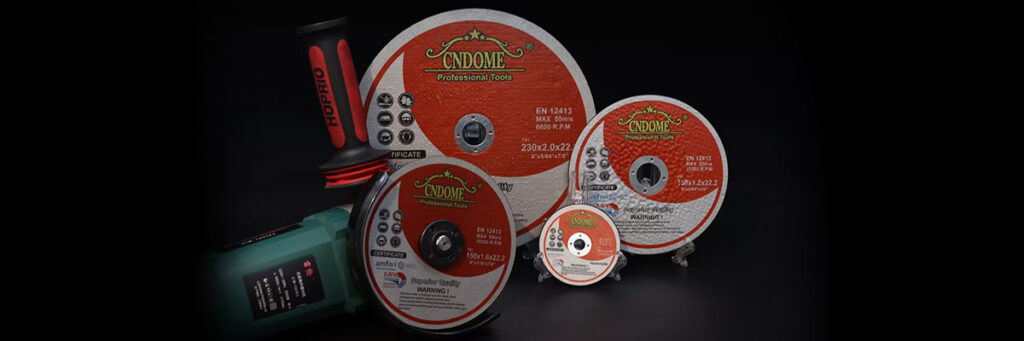
When the thickness of a cutting disc reaches 2.0 mm or greater, its radial stability, structural rigidity, and service life are significantly enhanced. However, this comes with the drawbacks of increased cutting resistance and a wider kerf (cut width) during the cutting process.
Therefore, the core challenge in selecting the thickness of a cutting disc can be summarized as a trade-off between two dimensions of technical requirements. The first dimension concerns process objectives, such as achieving high cutting efficiency, a narrow kerf, and a minimal heat-affected zone. The second dimension relates to operational objectives, including structural stability, a long service life, and a greater margin for error during handheld use.
The “20% of workpiece thickness” selection rule merely establishes a minimum threshold for the thickness of a cutting disc; it is not the sole criterion for final selection. For instance, when cutting a workpiece with a wall thickness of 4 mm, a 1.0 mm thick cutting disc satisfies this ratio. When cutting a steel plate with a thickness of 10 mm, a cutting disc with a thickness of at least 2.0 mm represents a reasonable lower limit. For workpieces with thicknesses falling between these two scenarios, opting for an intermediate 1.6 mm thick cutting disc offers greater process reliability than choosing between the two extremes.
Equipment specifications also establish boundary constraints for the reasonable range of cutting-blade thickness options.
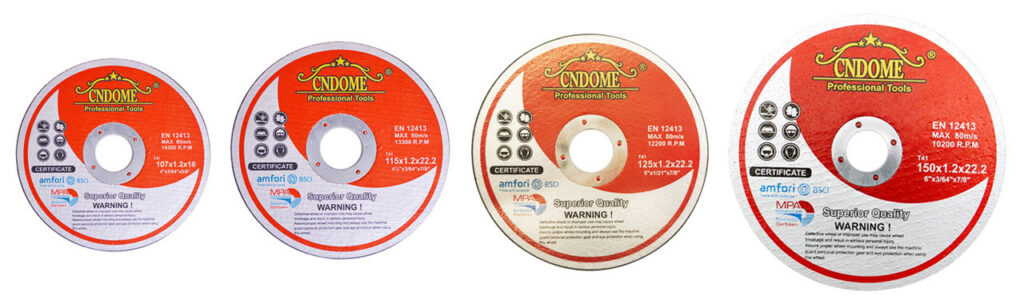
Selecting the thickness of a cutting disc should not be based solely on the thickness of the workpiece. For angle grinders with disc diameters of 115 mm and 125 mm, the appropriate cutting discs typically range from 1.0 mm to 1.6 mm in thickness—a configuration designed specifically for rapid, efficient cutting. For equipment designed for 150 mm, 180 mm, and 230 mm discs, the suitable thickness range generally shifts upward to 1.6–3.0 mm. This is because larger disc diameters and higher power outputs are inherently engineered for cutting thicker materials. Fitting a 3.0 mm thick disc onto a smaller, lower-power tool creates a mismatch between the motor’s load capacity and the stability required for handheld operation. Conversely, using a 1.0 mm thin disc for deep cuts with a large, high-power tool significantly reduces the safety margin regarding the disc’s stability within the cut.
In engineering practice, a decision-making logic chain for selection can be established as follows: the workpiece thickness sets a lower threshold for the cutting disc thickness (at 20% of the workpiece thickness); equipment specifications refine the permissible upper and lower limits for the disc thickness; and the specific operational priorities dictate the preferred choice within that thickness range.
The thickness of the cutting disc should be determined based on a quantitative relationship with the workpiece thickness, rather than relying on subjective judgment or experience.
Selecting the thickness of a cutting disc is fundamentally a matter of quantitative proportional matching, rather than a decision based on subjective operational experience. The selection process should follow these standardized steps: first, determine the thickness of the workpiece; second, establish the minimum allowable thickness for the cutting disc by applying the “20% rule”; third, narrow down the appropriate thickness range by considering equipment specifications and specific operational requirements; and finally, verify that the nominal thickness—as indicated on the product label—falls within this determined range.
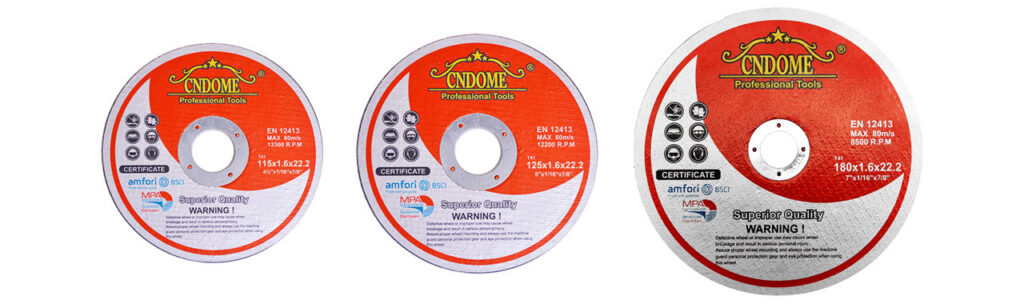
Resin-bonded cutting discs manufactured by Changzhou Dome Grinding Wheel Manufacturing Co., Ltd. (czdome.com) feature labels that clearly specify their thickness and the range of compatible materials; the company’s product catalog is organized based on dimensions and intended applications. To determine the appropriate match between workpiece thickness and cutting disc thickness, one can employ a verification method that combines a specification table with the “20% rule.” Compared to subjective, visual-based assessments, this approach significantly enhances the precision of the matching process, ensuring a selection that aligns more closely with the optimal range.
FAQ
Q1: Is there a strict lower limit for the thickness of a cutting disc?
Yes. A common industry benchmark is that the disc thickness should be at least 20% of the thickness of the material being cut. For cutting 10 mm steel, the disc should be no thinner than 2.0 mm; for cutting 2 mm thin-walled tubing, a thickness of 0.8–1.6 mm is more appropriate. This represents a structural lower limit, not an optimal value.
Q2: What is the core difference between thin slices and thick slices?
Thin discs offer fast cutting, a narrow kerf, and low heat generation; thicker discs provide greater stability, better resistance to lateral forces, and a longer service life per disc. Your choice depends on whether you prioritize cutting speed or stability when dealing with thicker sections and demanding, rugged job-site conditions.
Q3: How much faster is 1.0 mm compared to 2.5 mm?
For a sense of scale: a 1.0 mm disc can be approximately 40% faster than a 2.5 mm disc, as it removes less material and encounters lower feed resistance. The trade-off is that thinner discs are more sensitive to lateral forces and twisting, requiring a steadier hand.
Q4: How should I determine the thickness when cutting stainless steel?
Stainless steel has poor thermal conductivity, which causes heat to accumulate—leading to discoloration, deformation, and subsequent rusting. Thin cutting discs (1.0–1.6 mm) designed specifically for stainless steel (INOX) minimize heat input and burr formation, making them ideal for thin-walled pipes, sheet metal, and food-processing equipment; for thicker sections, consider using a thicker disc.
Q5: When are thicker slices safer and more cost-effective?
When cutting sections thicker than 5 mm, or in situations where on-site conditions are unpredictable or operator experience is limited, 2.0–2.5 mm thick blades offer superior lateral stability and torsional resistance. In high-volume, heavy-duty cutting operations, the longer service life of these thicker blades also helps minimize downtime caused by frequent blade changes.
Q6: If a thin disc wears down quickly, does that mean it’s not cost-effective?
One should not look solely at absolute wear. Because thin cutting discs remove less material per pass, they generate less thermal shock when used on thin-walled stainless steel or sheet metal; consequently, the number of effective cuts they can perform is not necessarily lower than that of thicker discs. The focus should be on the “number of successful cuts” rather than “how long the disc itself lasts.”
Q7: Should I choose a thin or thick blade for cutting aluminum?
Aluminum is soft and prone to adhesion; with thicker discs, the larger contact area leads to greater frictional heat and more pronounced aluminum chip buildup. Ultra-thin discs (around 1.0 mm) offer a narrower cut, more efficient chip evacuation, and a lower risk of adhesion. However, discs intended for aluminum require specialized abrasives or structural designs—standard thin discs designed for steel cannot simply be used as a substitute.
Q8: Is thickness related to the rotational speed of an angle grinder?
Thickness does not alter the rules regarding rotational speed; however, the maximum RPM specified on the disc itself must be no lower than the machine’s no-load rotational speed. Centrifugal force increases with the square of the rotational speed; if the speed limit is exceeded, even a thin disc will shatter and fragment—it will not simply undergo gradual wear.
Q9: What thickness should I choose by default for a 125 mm angle grinder disc?
For cutting sheet metal, pipes, profiles, and general metal components, the 1.0–1.6 mm range is the most versatile thickness interval for 125 mm-class tools. The 2.0–2.5 mm range is better suited for thick-walled pipes, solid bars, and heavy-duty workpieces, while thicknesses exceeding 3.0 mm typically require stationary machinery or specialized track-guided cutting systems.
Q10: Do I need to adjust my operating procedure when changing the thickness?
Yes. When switching to a thinner blade, you must exercise greater control over lateral forces and ensure a straighter, steadier feed. When switching to a thicker blade, anticipate increased resistance and greater heat generation; do not increase downward pressure simply because the cutting feels “slow”—this helps avoid overloading the tool and overheating the workpiece.
Q11: Does thickness affect the shelf life of resin sheets?
This does not affect the rules. Regardless of their thickness, resin-bonded cutting discs typically have a shelf life of 3 years from the date of manufacture. The expiration date is usually marked on the central metal ring in the format “V + month/year.” Storing the discs in a dry environment at a temperature of 18–22°C, while keeping them laid flat, helps to better maintain their structural integrity.
Q12: At what point must it be discarded?
Assess the remaining material volume and structural integrity. If you observe chipped edges, cracks, significant discoloration, or wear-enlarged flange holes—or if the component continues to vibrate even after ruling out machine-related issues—it should be discarded immediately. A thicker piece is not inherently more resistant to damage simply because of its greater initial thickness.
Q13: How does thickness affect the cost per blade?
The formula is: unit cost of the cutting disc ÷ number of successful cuts, plus the costs associated with downtime for disc changes and downstream finishing. While a thinner disc may have a lower unit price and faster cutting speed—potentially reducing the cost-per-cut on stainless steel by 15%–25%—the equation can shift when dealing with thick cross-sections, where a thicker disc helps minimize jamming and operational downtime.
Q14: How should thickness be determined when stocking inventory?
Stock materials based on operational requirements rather than the principle of “the more comprehensive, the better.” For operations focused on thin sheets, pipe fittings, and routine processing, 1.0–1.6 mm stock should form the core inventory; 2.0–2.5 mm stock serves to accommodate thicker sections and heavier-duty applications; and material 3.0 mm or thicker should be kept only when there is a specific, confirmed demand.
Q15: What is the most straightforward sequence for selecting thickness?
Machine specifications dictate the disc diameter and RPM; the “20% rule” establishes the lower limit for material thickness; the nature of the task determines the optimal thickness; and the cost per cut serves as the final validation. “Thin” does not inherently mean “advanced,” nor does “thick” necessarily mean “durable.” Thickness is a trade-off between cutting speed, thermal management, and tool lifespan—the specific task dictates the right choice.
