
-
Oct, Sat, 2026

What is the difference between cutting discs and grinding discs?
In the resin-bonded grinding wheel industry, the distinction between cutting discs and grinding discs is often simplified as: “thin ones for cutting, thick ones for grinding.” This assertion is not exactly wrong, but it overlooks the key factor that truly determines safety: thickness is merely an outcome, whereas the number of structural layers and the direction of applied forces are the actual causes. Cutting discs are designed to withstand the rotational tension encountered during edge-cutting, while grinding discs are designed to withstand the lateral pressure exerted on the disc surface. The two types of loads are not interchangeable, and the number of fiberglass layers in the disc body is likewise not interchangeable. This logic will be detailed below; the conclusions drawn may vary depending on how it is applied to the observation of the grinding wheels in question.
Edges and Planes: Two Distinct Modes of Load-Bearing
For cutting wheels (Type 1 / Type 41), the abrasive material is concentrated along the outer edge; during operation, the disc enters the workpiece surface at a 90° angle, using the abrasive grains on its edge to “plow” a narrow slot. The applied force is transmitted along the plane of the disc; the disc itself sustains the tension resulting from rotation, as well as a minor amount of radial friction generated by the cutting process. For a grinding disc (Type 27, depressed-center), the entire disc surface serves as the working face; it is applied to the workpiece at a shallow angle of 15°–30°, with pressure exerted laterally.
These two types of loading impose diametrically opposite requirements on the structure of the grinding wheel body.
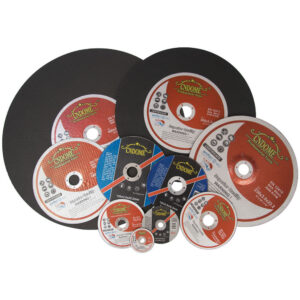
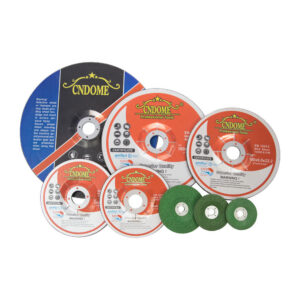
A standard resin-bonded cutting disc typically has a thickness ranging from 0.8 mm to 3.2 mm and contains only two layers of fiberglass mesh internally for stabilization. Two layers of fiberglass are sufficient to maintain the rigidity of the disc under “edge-cutting” loading conditions, but they are far from adequate for resisting lateral pressure. The grinding disc typically has a thickness of 6 mm or more and incorporates three layers of fiberglass mesh along with two sheets of black paper; these added fabric layers provide lateral stability. Its “thickness” is the result of the combined effect of the number of structural layers and the amount of resin binder used; the purpose is to enable the disc surface to withstand the applied pressure.
A useful rule of thumb to remember is: if you need to make contact with metal using the edge of a grinding wheel, you should use a cutting disc. If you need to bring the flat surface of a grinding wheel into contact with metal, you should use a grinding disc. Any other combination constitutes the use of a rotating brittle component in a manner involving mechanical loading for which its structural design was not intended.
What happens when you use a cutting disc for grinding?
If you flip a 1.2 mm cutting disc over so that its flat side comes into contact with the weld seam, the force is converted into a lateral load acting perpendicular to the disc’s surface. The thin sheet begins to bend, and the fiberglass layer undergoes delamination due to repeated flexing—all while it is rotating at a linear velocity of tens of meters per second, potentially approaching 80 m/s. Under the influence of centrifugal force, the delaminating component loses its structural integrity and shatters, leaving virtually no time to react.
This goes beyond the level of being “perhaps a bit dangerous.” Statistically, angle grinders are among the power tools with the highest injury rates, and the use of incorrect discs is the primary cause of such injuries. Conversely, using an abrasive disc for cutting also presents problems: the kerf is wide, and the friction generates significant heat. Forcing such a disc to function as a saw blade can overload the motor and substantially increase the risk of kickback. If a thick blade becomes jammed by the workpiece during a cut, the rotational force will be transmitted directly to the wrist.
Rotational speed is the bottom line for safety.
Thickness and structure determine what a grinding wheel is “meant to be used for,” while the RPM rating determines whether it can be spun up safely. These two matters must be confirmed separately.
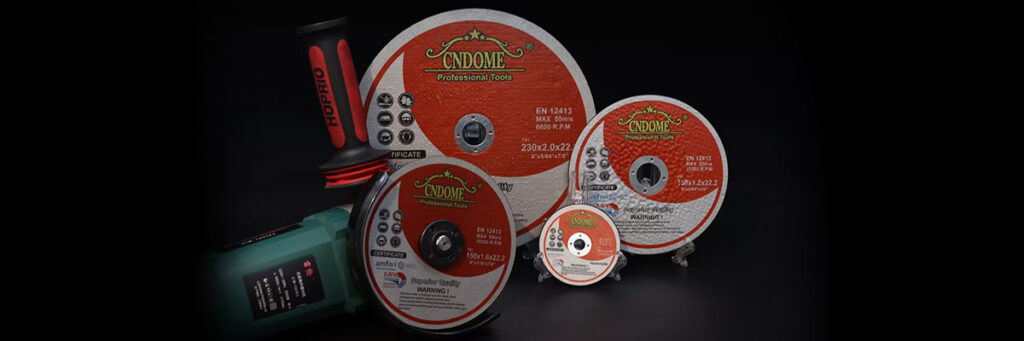
Every qualified resin-bonded cutting or grinding disc has its maximum permissible rotational speed printed on its label. The speed indicated on an angle grinder’s nameplate is the no-load speed. There is only one rule: the maximum RPM of the grinding wheel must be greater than or equal to the no-load RPM of the angle grinder. A “mismatch”—specifically, when the machine’s rotational speed exceeds the limit permitted for the grinding wheel—is one of the most direct, yet highly preventable, root causes of grinding wheel bursting accidents. In an actual accident case, a grinding disc rated for 6,650 rpm was mounted on an angle grinder with a no-load speed of 8,500 rpm—an overspeed condition of nearly 22%—with catastrophic consequences.
You also need to ensure that the grinding wheel’s diameter is compatible with the machine’s guard and spindle. If a 230 mm cutting disc is mounted onto an angle grinder designed for 125 mm discs, the linear velocity at the disc’s edge will far exceed the limits for which both the machine’s guard and the disc itself were designed—even if the nominal RPM rating might appear “sufficient.” The warning from the grinding wheel manufacturer is clear: larger grinding wheels are not designed for the high rotational speeds of smaller angle grinders.
In practice, when changing a grinding wheel, take ten seconds to do three things. First: Check that the RPM figure on the grinding wheel’s label is greater than or equal to the machine’s RPM. Second: Check whether the diameter and bore size of the grinding wheel are compatible with the spindle and the guard. Third: The diameters of the upper and lower flanges must be identical (mismatched flanges will crack the metal ring area of the grinding wheel, which can lead to damage around the flange hole during operation).
The material and specifications determine whether the grinding wheel in your hand is actually the right one for the job.
Distinguishing between cutting and grinding is merely the first step in the selection process. The second step occurs when you are faced with a specific workpiece. Are you cutting carbon steel, stainless steel, or aluminum? How wide should the cut be, and how small should the heat-affected zone be?
Take stainless steel as an example. A standard cutting disc intended for carbon steel may contain iron, sulfur, or chlorine within its fillers and bonding agents. When used on stainless steel, minute iron particles can become embedded in the cut surface; in a humid environment, these particles rust, resulting in what is known as “free iron contamination.” This issue is difficult to detect during the cutting process; it may only become apparent weeks later—once the workpiece has been installed on-site—manifesting as rust spots or leading to the rejection of the weld seams. Therefore, the key criterion for “INOX” (stainless steel-grade) discs is not that they are of a “higher grade,” but rather that the levels of iron, sulfur, and chlorine are strictly controlled to remain below very low limits—typically specified as Fe+S+Cl < 0.1%. White fused alumina is the preferred abrasive, as it cuts cooler and sharper than brown fused alumina—making it well-suited for stainless steel, which has a lower tolerance for heat.
Thickness and abrasive grit size also have practical consequences. Thin discs (1.0–1.6 mm) feature a narrow kerf, minimal material loss, and low heat generation, making them suitable for thin-walled pipes and precision cutting. However, “ultra-thin” does not necessarily mean “the thinner, the better”; it must be matched with the workpiece support conditions and the feed method. The logic for abrasive grit size is the opposite: coarser grits (24–30 mesh) prioritize metal removal rate over the surface finish of the cut. When making a choice, the question to consider is not “which is better,” but rather “what levels of heat input, kerf width, and subsequent processing does the workpiece allow?”
Three common on-site issues that appear to stem from the grinding wheel itself, but actually do not.
When you search for terms like “cutting disc short life,” “disc wobble,” or “edge chipping,” your first instinct might be to conclude that the disc itself is of poor quality. However, in the context of troubleshooting, the disc is rarely the root cause; the operating conditions are usually to blame.
The most common reason for an abnormally short service life of a cutting disc is excessive applied pressure, rather than a lack of hardness in the disc itself. Operators often try to “speed things up” by applying pressure with their body weight; however, this causes the disc edge to overheat and the abrasive to dull prematurely, while also dragging down the motor speed—ultimately resulting in lower cutting efficiency. Dome’s troubleshooting guide also points out that failing to move the tool back and forth within the cut can lead to localized overheating and inefficient use of the abrasive material; this results in excessive wear on one section of the cutting disc, causing it to be discarded while the rest remains in good condition. Another often-overlooked factor is the storage duration of resin-bonded cutting discs: if a disc is more than three years past its manufacturing date, the resin binder may have degraded, resulting in reduced strength; therefore, it is not recommended for use, even if it appears to be in good condition.
If a cutting disc wobbles or the cut deviates, the first thing to check is the mounting surface. Burrs or dirt on the flanges, or a mismatch in diameter between the upper and lower flanges, will prevent the disc from remaining flat during high-speed rotation. This causes the cutting line to shift, and in severe cases, can even lead to cracking around the flange hole. Vibration resulting from inadequate clamping of the workpiece can also transform regular wear into edge chipping.
When a grinding disc “fails to cut” or its surface turns blue from overheating, it is often not because the disc has become too dull, but rather because the grit size was chosen in the wrong direction. When using a worn-down, fine-grit grinding disc to tackle a thick weld, the operator will instinctively apply more pressure; this leads to heat buildup, discoloration of the workpiece, and even more severe wear on the disc’s surface. The correct response is to go back to a coarser grit, or to switch to a flap disc as an intermediate step, rather than continuing to apply pressure while using the wrong grit.
When making purchases, should you focus on the “price per blade” or the “cost per cut”?
If you are buying one or two grinding wheels for home use, the unit price is, of course, important. However, if you are making decisions regarding consumables for a workshop, construction site, or fleet, the price per individual grinding wheel provides almost no useful information.
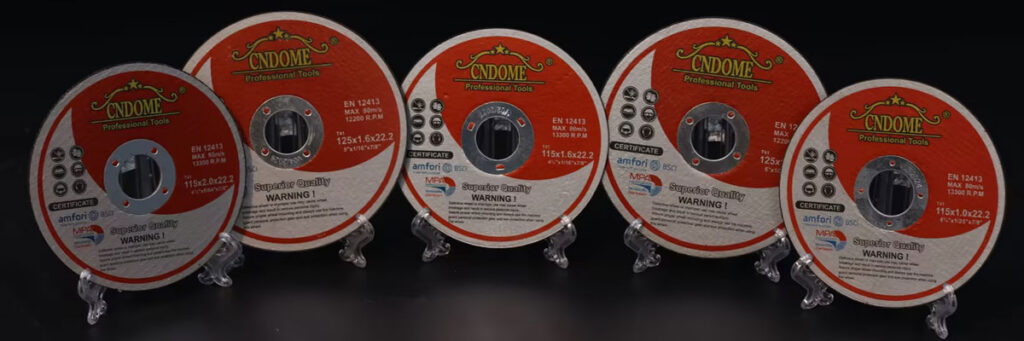
What truly determines expenditure is the cost per cut. If a $0.40 cutting disc can only perform 25 cuts, the cost per cut is 1.6 cents; if a $1.10 cutting disc can perform 90 cuts, the cost per cut is 1.2 cents. More expensive cutting discs actually work out to be cheaper—and this calculation doesn’t even account for the downtime required to change discs or the time spent on subsequent deburring. High-quality cutting discs typically offer a 30%–100% longer lifespan and 20%–40% faster cutting speeds compared to lower-end products; in workshops where productivity is measured by piece count or labor hours, these differences translate directly into labor costs.
Moreover, the difference between certified and uncertified products goes beyond just a piece of paper. EN 12413 or MPA certification signifies that the manufacturer has undergone rigorous safety audits and traceable burst testing; with ultra-cheap discs that lack these certifications, the very thing being “saved” is the one thing you least want to compromise on—your safety. The cost of a single breakage accident far outweighs the price difference between cutting discs over an entire lifetime.
Summarize
The distinction between cutting discs and grinding discs essentially represents a divergence in manufacturing logic: one is designed to separate material using its edge, while the other is designed to remove material using its face. Thickness, number of fiberglass layers, geometry of the indentation center, allowable inclination, and lateral load capacity—these parameters are all projections of this bifurcation across different dimensions. You should select the appropriate parameters based on the task—not the other way around—by forcing a grinding wheel to endure forces it was never designed to withstand.
As a manufacturer of resin-bonded grinding wheels, Dome offers a comprehensive product range—from ultra-thin resin-bonded cutting discs to standard grinding discs. Every product is marked on its metal ring with the maximum RPM and manufacturing batch number, and all items undergo safety and performance control in accordance with the EN 12413 standard. If you are looking to match the right disc type to a specific workpiece—whether it involves thin-walled stainless steel tubing, beveled thick plates, weld dressing, or batch cutting—you can navigate directly to the relevant product specification page at czdome.com. Alternatively, you may provide us with details regarding the workpiece material, thickness, and your machine model, and our application team will offer tailored recommendations. Get the direction right first; then, focus on efficiency.
FAQ
Q1: What is the most obvious difference between a cutting disc and a grinding disc?
Thickness. Cutting discs typically range from 0.8–3.2 mm in thickness, while grinding discs are commonly 6.0–8.0 mm thick. A thinner profile reduces resistance during entry and results in a narrower cut, whereas a greater thickness ensures the disc does not bend under surface pressure. Thickness is a function of the disc’s intended purpose; it is not an interchangeable parameter.
Q2: Why shouldn’t cutting discs be used for grinding?
Their structural design does not permit it. Standard cutting discs contain only two layers of fiberglass mesh for reinforcement, meaning their capacity to withstand lateral loads is intentionally kept very low. If you use the face of the disc for grinding, you exert bending stress perpendicular to the disc surface, which can cause the disc to shatter while spinning at high speeds.
Q3: Can a grinding disc be used in reverse for cutting?
This is not recommended. Grinding discs feature three layers of fiberglass mesh, which provides greater lateral stability; however, they are designed for surface grinding at an inclination angle of 15°–30°. Using a 6 mm-thick disc for deep cutting results in a wide kerf and significant heat generation. Furthermore, the thick profile of the disc is more likely to become wedged within the cut, which can trigger kickback.
Q4: What is the operating angle for a cutting disc?
The feed direction of the cutting disc should be perpendicular to the material surface, with the disc positioned at an angle of approximately 90° to the workpiece. The cutting disc is designed to withstand only radial and tangential forces—those acting along the plane of the disc—and should not be subjected to lateral (side) pressure.
Q5: What is the working angle for a grinding disc?
The grinding disc should contact the workpiece at an angle of 15°–30°, using the face of the disc—rather than its edge—to remove material. The depressed-center (T27) design is specifically intended to allow the face of the disc to sit nearly flat against the workpiece without the mounting nut getting in the way.
Q6: How should the maximum rotational speed marked on a grinding wheel be interpreted?
The maximum RPM specified on a grinding wheel must be at least equal to the no-load speed of the angle grinder. Doubling the rotational speed increases the centrifugal force fourfold. Installing a grinding wheel rated for 6,650 RPM onto a tool with a higher rotational speed means subjecting a bonded abrasive—which was never designed for such speeds—to an overspeed condition.
Q7: What other structural differences exist between cutting discs and grinding discs?
Beyond the number of fiberglass layers, their shapes also differ. Cutting discs are primarily T41 (flat) or T42 (depressed center) in profile, while grinding discs are typically T27 (depressed center). The recessed geometry of the T27 design allows the disc to be used at a shallow angle, whereas the thin profile of a cutting disc is designed for straight-in feeding.
Q8: Are there grinding wheels that can be used for both cutting and light grinding?
Yes, but these are a specialized category of product—they are by no means a license to simply use a standard cutting disc for grinding tasks. Combination discs typically feature three full-layer fabric reinforcements and a thickness of approximately 1.9 mm, allowing the user to switch between cutting, chamfering, and deburring. Standard cutting discs lack this lateral stability; they should never be used for grinding simply because “they both fit on an angle grinder.”
Q9: How do you decide whether to use a cutting disc or a grinding disc when working with stainless steel?
The choice depends on the task: use a cutting disc for severing material, and a grinding disc for cleaning weld beads or creating chamfers. However, when it comes to stainless steel, there is an additional chemical factor to consider: elements such as iron, sulfur, and chlorine—often present in standard abrasives—can contaminate the cut surface and lead to subsequent rusting. Grinding or cutting discs marked “INOX” (with a combined iron, sulfur, and chlorine content of ≤ 0.1%) are specifically designed to prevent this type of contamination. If you use a standard disc on stainless steel, rust spots may appear on the cut edge after just a few days.
Q10: How do I choose the grit size for an abrasive disc?
Use 24–36 grit for coarse grinding (e.g., removing weld seams), 40–60 grit for general grinding, and 80 grit or higher for finishing or surface refinement. A lower number indicates faster material removal and a rougher surface, while a higher number indicates slower material removal and a finer surface.
Q11: Do cutting discs also have a “grit” (mesh) rating? How should this be understood?
Yes, they do, but the logic is different. For cutting discs, the grit rating primarily influences the cutting speed and the condition of the cut surface; it does not serve the function of “controlling surface roughness.” For cutting carbon steel, a grit range of 36–60 is typically used, while for precision cutting of stainless steel, a range of 60–80 is generally preferred.
Q12: Do resin-bonded cutting and grinding discs have a shelf life?
Yes. Under the EN 12413 standard, resin-bonded products have a shelf life of 3 years from the date of manufacture. The strength of the resin in an expired disc becomes unpredictable. The expiration date is typically stamped on the central metal ring in the format “V” followed by the month and year—for example, “V07/2022” indicates an expiration date of July 2022.
Q13: How should cutting and grinding discs be stored?
Store them in a dry place at room temperature, laid flat, and protected from moisture and freezing. Do not stack them vertically, and keep them away from heat sources or direct sunlight. Resin-bonded discs are sensitive to humidity and temperature; storage conditions directly affect their actual strength throughout their shelf life.
Q14: At what point should a cutting or grinding disc be discarded?
Discard the disc immediately if it shows signs of chipping, cracking, significant discoloration, or enlargement of the mounting hole (flange hole) due to wear—or if the disc diameter has worn down to a point where it can no longer be securely clamped. Do not attempt to use it “just one more time.” When a damaged bonded abrasive tool fails at high speed, it does so by shattering, rather than through gradual degradation.
Q15: What is the simplest rule for choosing between a cutting disc and a grinding disc?
Ask yourself one question: Are you trying to separate the material, or remove material from its surface? If you want to separate it, use a cutting disc—apply it via the edge at a 90° angle; these discs are thin. If you want to remove material, use a grinding disc—apply it via the face at an angle of 15°–30°; these discs are thick. Define the task first, then let factors like thickness, shape, number of fiberglass layers, and the permissible working angle be determined by that task.
